



The Excellence Journey: Beyond the Certificate
The company hung its ISO certificate in the reception lobby in an elegant frame, the team posed smiling beside it, and a picture of the certificate was added to the customer presentation. It was a lovely day, worth celebrating. Eight months later a message arrived from the company’s biggest customer: your technicians arrive late, and your maintenance reports do not match what we saw on site. The managing director looked at the framed certificate and asked a simple question: we have a certificate, so why is this happening?
This article tries to answer his question. Its central idea is that a certificate proves you met the requirements of a standard at a given moment. It does not prove you are an excellent organization. A standard is not the goal. It is a means of transformation. Treat it as the goal and you get a paper on the wall. Treat it as a means and you get a different organization.
We will follow one case from start to finish: Khalid, the quality manager of a maintenance company. In each section Khalid finds a new difference between compliance and excellence, then applies it to his company. By the end you will have a clear grasp of the difference between the two, a five-level ladder on which to place your own organization, and a five-step path from the paper to real transformation.
Khalid and a certificate on the wall
“You will learn to read a standard as a map rather than a task list, to place your organization honestly on a maturity ladder, and to take the steps that move you from compliance to excellence. At every step we ask: what changed at Khalid’s company?”
Khalid is quality manager at a company that provides field maintenance to facilities: air conditioners, generators and equipment. A year ago he led the project to earn ISO 9001, an international standard for quality management systems. The team spent months documenting procedures, gathering records and preparing staff for the auditor’s questions. On audit day everything went smoothly, and the company received its certificate.
But Khalid noticed something odd within weeks. Technicians sometimes filled in the maintenance report form before they reached the site, so as to hand reports in on time. Periodic review sheets were signed in bulk at month’s end. When he asked one supervisor why, the answer was candid: “These papers are for the auditor. The work has its own way.” That was when Khalid understood that the certificate had succeeded at one thing and failed at another.
Then came the big customer’s message. It never mentioned a “certificate.” It mentioned a technician two days late and a report claiming a generator had been inspected when nobody had opened it. Khalid decided to take the matter seriously: not to hunt for a culprit, but to look for the gap between what the company had written and what it did.
“Khalid, the company and the numbers in this article are invented for illustration and do not refer to any real organization.”
What happened at Khalid’s company happens in many organizations, and it does not mean the people are bad. It means a great deal of effort was aimed at a specific goal, the certificate, and the goal was met. But it was not what the customer needed.
“Five minutes: write one sentence describing what changed in your organization’s daily work after the last certificate or accreditation you earned. If you cannot find a sentence, keep that observation. You will need it in the final section.”
A certificate is a photograph, not a film
Khalid sat wondering how to explain to his manager what had happened, and a simple picture came to him. A certificate is a photograph taken of the organization on one particular day. It is accurate, no doubt: it shows that procedures were documented, records were complete, and staff answered the auditor’s questions. But it remains a frozen moment. It does not tell you what happened a week before, or what will happen a month after.
Many organizations prepare for an audit the way one prepares for a photo session: a quick tidy, a ready smile, then back to normal once the lights go off. We call this occasion quality: a state of alert before the auditor’s visit, when missing records are gathered and overdue documents updated. After the visit the documents go back to sleep in their drawers until the next date. The certificate is renewed, and nothing essential changes.
The paradox Khalid fell into was holding a valid certificate and a struggling practice at once. That is the clearest sign that compliance was achieved while excellence was absent.
A standard is written as a shared minimum that different organizations can agree on, not as a ceiling for ambition. When an organization designs its processes to pass the test of the standard alone, it is designing for the minimum. When it designs them to achieve their real purpose, which is customer satisfaction, operating efficiency and lasting results, passing the standard becomes a side effect that arrives on its own. It is like the difference between a student who studies to pass the exam and one who studies to understand. Both may pass, but only one comes out having learned.
“A standard is a shared minimum, not a ceiling for ambition. Design your organization only to pass the test and you design it for the minimum.”
The case now
Khalid wrote on the meeting board: “The certificate is a photograph, and we want a film.” Then he put one question to the team: what do we do before the auditor’s visit that we do not do afterward? The list was longer than he expected, and it became his first work map.
“Ask yourself or your team: what do we do before an audit that we do not do after it? Write the list without judging it. Every item is a gap between the paper and the reality.”
Compliance and excellence: a difference of kind, not degree
The following week Khalid wanted to move past slogans, so he sat down to compare the two ideas. Compliance means matching a written requirement. Excellence means your organization genuinely transforms in how it thinks, works and performs. The distance between them is not a distance of degree but of kind. They are different logics in intent, in measurement and in outcome.
Compliance asks: do we match the requirement? Its driver is external: a granting body, a regulation, a customer. Its time is periodic, tied to audit dates. Its measure of success is binary: conforming or not. When it becomes an end in itself it breeds behavior known in quality literature as box-ticking: doing enough to pass the audit, not enough to improve the work.
Excellence asks: are we really improving? Its driver is internal, a conviction that the work can be better. Its time is continuous and does not stop when a visit ends. Its measure is graded: how far have we matured compared with ourselves yesterday? Excellence does not ask “did we pass?” but “did we get better?”
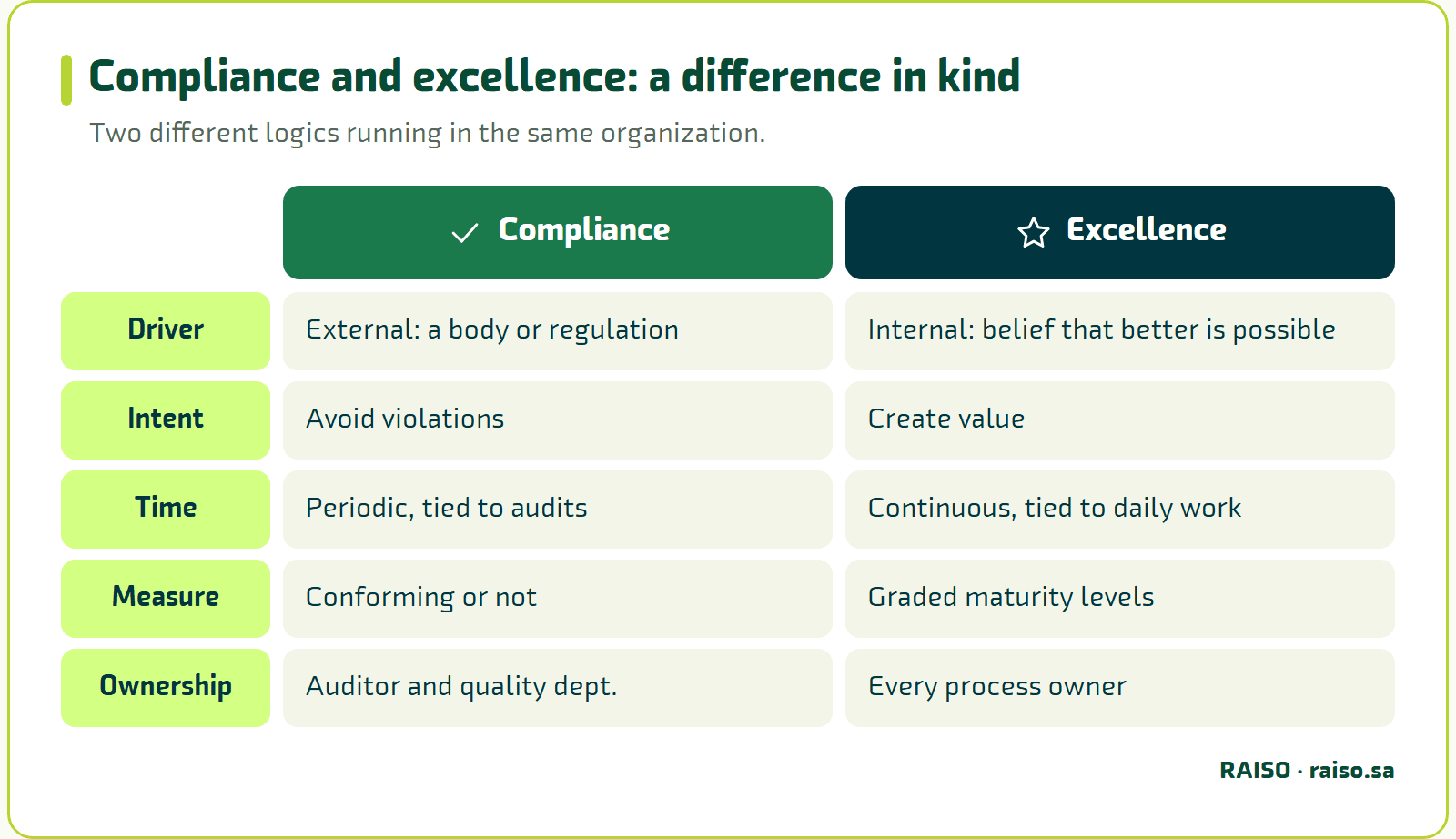
These are the axes that separate the two logics:
- Driver: compliance is external (a body, a regulation, a customer); excellence is internal (a belief that better is possible).
- Intent: compliance avoids violations; excellence creates value.
- Time: compliance is periodic and tied to audits; excellence is continuous and tied to daily work.
- Measure: compliance is binary (conforming or not); excellence is graded (maturity levels).
- Ownership: compliance belongs to the auditor and the quality department; excellence belongs to every process owner.
- Customer: compliance may satisfy the auditor without the customer feeling it; excellence is felt by the customer directly.
None of this means compliance is the enemy of excellence. In fact, smart compliance can be the first rung on the ladder of excellence. The trouble begins when an organization stops at the first rung and takes it for the top. When a certificate is treated as the finish line, it turns from a bridge toward transformation into a ceiling that confines it.
The case now
Khalid put a two-column table in front of the managing director. In the compliance column he wrote what the company does for the auditor; in the excellence column, what the customer feels. The first column was full and the second nearly empty. After a short silence the director said: “So we are passing the wrong exam.”
Why do organizations stop at the certificate?
The managing director asked Khalid: if the difference is this clear, why do we and others stop at the certificate? The answer is not a shortage of intelligence. It is incentives and psychological and organizational forces pushing toward early stopping, and understanding them is the condition for getting past them. Khalid found four of them in his own company.
The first is that a certificate is clear and excellence is vague. A certificate is a defined goal with a date, a known cost and a tangible result to hang on the wall. Excellence is a journey with no finish line, whose progress is hard to measure and whose milestones are hard to celebrate. The organizational mind, like the individual mind, is drawn to clear goals that can be closed, and avoids open-ended journeys.
The second is project logic rather than system logic. Many organizations treat quality as a project with a start and an end: form a team, document, earn the certificate, close the project. But excellence is not a project that closes. It is a permanent operating system. When the “ISO project” closes, attention closes with it, and three years later we discover we need a new project for renewal.
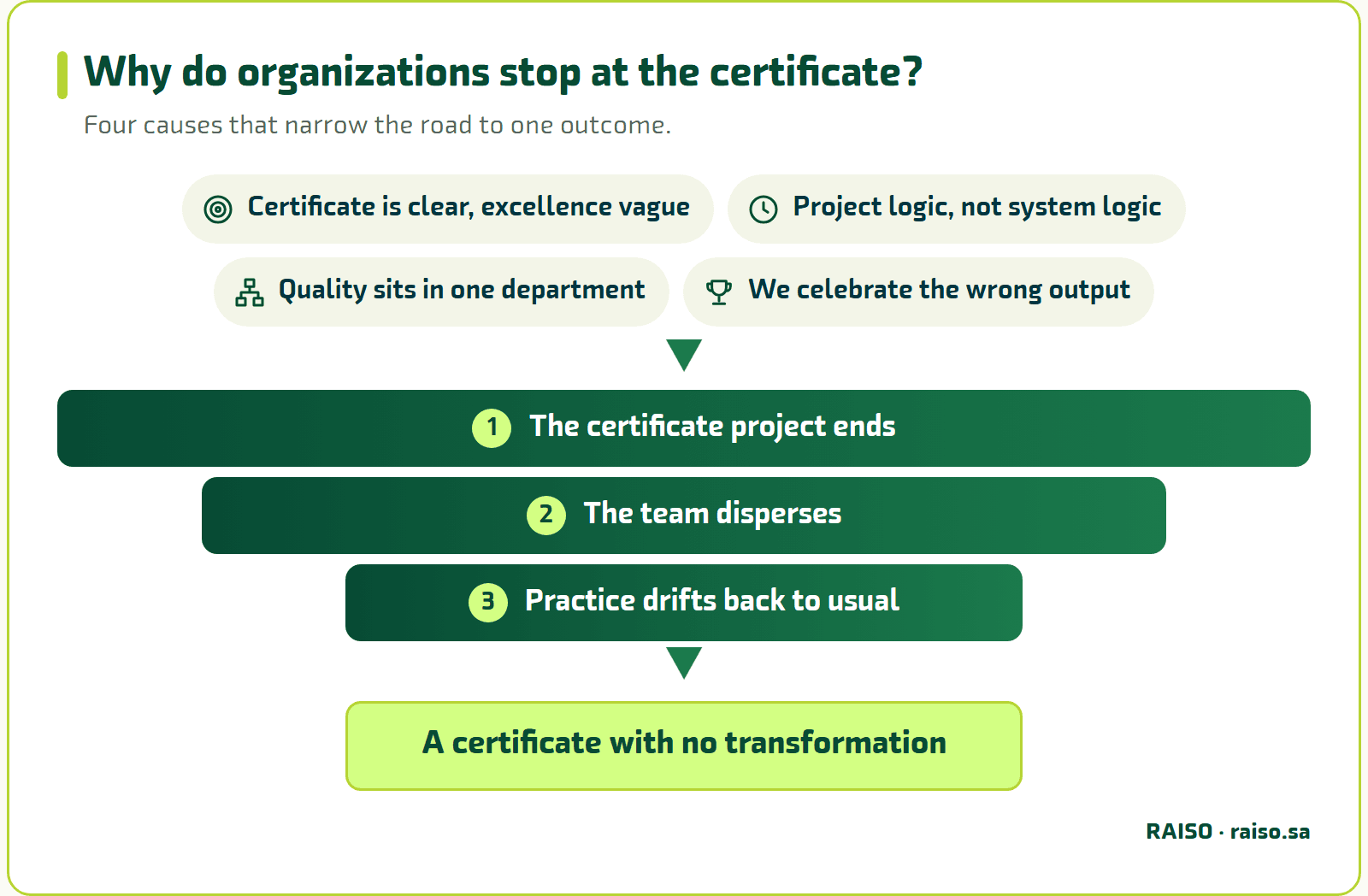
The third is that quality is owned in the wrong place. When quality is the job of one department, everyone else learns that it is “not our business.” They hand over their processes at audit time and take them back afterward. At Khalid’s company the technicians said: “quality papers are Khalid’s.” Excellence, by its nature, is a responsibility spread across everyone who touches a process.
The fourth is that we celebrate the wrong output. When an organization rewards its team for obtaining the certificate rather than for better results, it sends a clear message: the paper is the goal. And people do what they are rewarded for. The first step toward excellence is therefore changing what we celebrate: from passing the audit to improving the process.
The case now
Khalid looked again at the certificate party held months earlier. The awards went to the team that finished documentation fastest. There was not a single award for a technician who had cut repeat repair visits. So he decided that the awards at the next celebration would change.
“List the last three things your organization formally rewarded. How many rewarded an improved result, and how many rewarded a finished paper? If papers dominate, that is the first thing you change.”
The standard is a means, not an end
Flipping the equation begins with changing the question we ask when we read a clause of the standard. The compliant organization asks: what does the auditor want here, and what is the least that satisfies it? The excellent organization asks: what real problem was this clause written to solve, and how do we solve it in a way that serves our own work first?
Take an example from Khalid’s case. The standard requires documented corrective actions for nonconforming cases. His company filled in a simple form at audit time to prove compliance. When he read the clause with the new question, he saw an opportunity to build a real system for learning from mistakes: root-cause analysis, treating the source rather than the symptom, and following up to make sure the fix lasts. Both approaches pass the audit, but only one makes the company less likely to repeat the error. The clause is the same. The difference is intent.
This reading restores the standard’s proper role: a road map pointing to areas that deserve attention, not a list of tasks to finish and forget. Most serious standards, such as ISO 9001, rest on sound principles: customer focus, leadership, a process approach, continual improvement and evidence-based decisions. These are not bureaucratic clauses but the distillation of decades of quality experience. Whoever reads them as principles to absorb rather than requirements to pass discovers they are building excellence while meeting compliance.
In the Saudi context, where Vision 2030 pushes public and private organizations to raise operating performance, the danger of confusing means with ends grows. When certificates and accreditations become an indicator that is collected and announced, organizations are tempted to chase the count rather than the depth. The real measure of maturity is not how many certificates an organization holds, but how much its way of working changed because of them. A certificate that leaves no mark on the beneficiary’s experience is a cost without a return.
“Chase the paper and you get a paper. Build the substance and you get the paper and the substance together.”
The case now
Khalid picked three clauses of the standard and re-read them with the new question: what problem was this clause written to solve? The corrective-action clause revealed that the company repeats the same errors on field visits. The customer-satisfaction clause revealed that it never asks the customer after a visit. The competence clause revealed that new technicians learn by trial, at the customer’s expense.
“Pick one clause from a standard you comply with and write two questions beside it: what problem was it written to solve? And does it solve it for us today?”
The maturity ladder: where do you really stand?
If excellence is a journey and not a moment, we need a map showing where we stand and where we are heading. This is where the idea of process maturity comes in: seeing an organization not as a binary state, good or bad, but as a position on an evolutionary ladder. The excellence literature has settled on five levels, which an organization climbs through work, not through a certificate.
These are the five levels, with where Khalid’s company stood:
- Level one: Ad hoc
Work depends on people, not on a system. Each employee performs the process in their own way, results swing, and knowledge lives in heads rather than systems.
- Level two: Documented
Processes are written and approved. This is often the level an organization reaches the moment it earns its certificate. But documentation alone does not guarantee that what is written is followed. Here stood Khalid’s company.
- Level three: Applied
What is written is actually practiced. The gap between document and reality narrows, and employees follow the process because it makes sense, not because the auditor is coming.
- Level four: Measured and managed
Processes are measured with real operating indicators and managed by evidence rather than instinct. Deviations are caught and treated, and decisions rest on data that reflects reality.
- Level five: Continually improved
Improvement is part of the organization’s identity. Every process owner looks for better without being asked. Only here can we speak of real excellence.
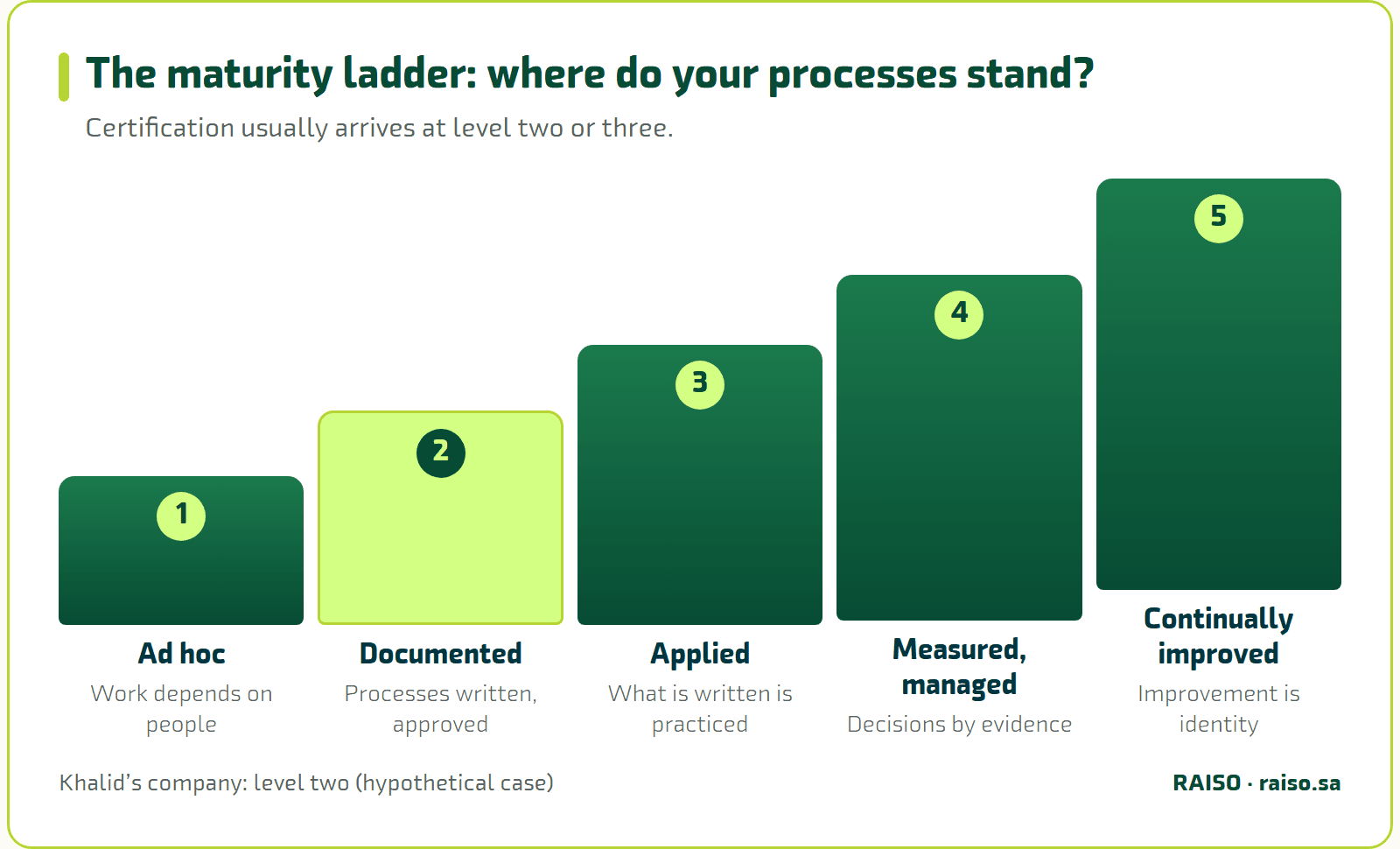
The key observation is that a certificate is usually granted at level two, or level three at most. An organization that has “got ISO” therefore stands in the middle of the ladder, not at its top. The real transformation lies between three and five, and that is exactly what a certificate neither measures nor guarantees. So the more useful question for leadership is not “do we have a certificate?” but “at which level do we stand, and what does it take to reach the next?”
The value of the ladder is that it turns excellence from a vague slogan into a measurable path. Instead of asking “are we excellent?”, a question with no precise answer, we ask: where do we stand, what is the gap, and what is the next step?
The case now
Khalid took the company’s five main processes and rated each honestly on the ladder. He came out with a shocking and useful result: three processes at level two, two at level three, and none higher. He did not hide it. He presented it to the managing director as it was, who said: “This is the first time we know where we stand.”
“Choose three processes from your work and place each honestly on the ladder. Then write beside each one a single piece of evidence that proves its level, not an impression.”
Quality culture: what the auditor cannot see
There is a fundamental difference between an organization that has a quality system and one that lives a quality culture. The first has documents, procedures and committees. The second has something deeper that appears in no file: a shared conviction that good work is everyone’s responsibility, that a mistake is a chance to learn rather than to be punished, and that “this is how we always work,” not “this is how we work when the auditor comes.”
| # | Statement | Conforming | Partly | Not conforming |
|---|---|---|---|---|
| Practice | ||||
| 1 | What we do before an audit, we also do after it. | |||
| 2 | Staff follow the procedure because it makes sense, not because the auditor is coming. | |||
| Ownership and measurement | ||||
| 3 | Every core process has an owner who knows its maturity level. | |||
| 4 | We measure what the customer feels, not only what satisfies the auditor. | |||
| Culture | ||||
| 5 | We reward improved results, not merely finished paperwork. | |||
| 6 | Staff can report a mistake without fear of blame. | |||
| 7 | Improvement is a weekly habit shared by all, not a seasonal initiative. | |||
Rate your organization honestly on each statement.
Culture is exactly what an auditor cannot measure in a visit lasting days. He can inspect records, review documents and question staff. But he cannot see what an employee does when no one is watching, or how the organization behaves when a problem arises that the auditor knows nothing about. That is where real excellence lives: in spontaneous behavior, not staged behavior.
Building culture is much slower than building a system, because it touches convictions rather than procedures. And it begins at the top: when leaders show through their behavior that quality is a real priority and not a slogan, that they take bad news about processes graciously, and that they reward the person who reveals a problem rather than the one who hides it. An employee reads leaders’ actions far more clearly than their written policies.
Culture is also what makes excellence last. A system may collapse when its builder leaves, but culture remains because it lives in people, not in drawers. An organization that invests in it builds an asset that cannot be removed by a manager’s departure or a project’s end.
The case now
Khalid sat with field technicians and asked them: when do you wish you could stop work for a moment and cannot? One said he fears admitting to his supervisor that he does not know how to diagnose a new fault, so he writes in the report what he assumes. That one sentence explained the reports that did not match reality. The problem was never the form. It was fear.
A five-step path: from certificate to transformation
Starting from this distinction, RAISO’s approach proposes a practical path that moves an organization from formal compliance to real transformation. The path does not reject the certificate. It puts it in its right place: a stop, not a destination. It consists of five steps, each built on the one before. Here they are, with what Khalid did in each.
Step one: honest diagnosis
The problem it solves: the illusion that we are excellent because we hold a certificate. How it is done: determine the organization’s real maturity level, not the declared one. Where do its processes truly stand on the ladder? Where is the gap between document and practice? The case now: Khalid drew a maturity map of his five processes and admitted before everyone that they sat at levels two and three.
Step two: lay the foundation
The problem it solves: processes with unclear ownership. How it is done: make sure core processes are clearly documented and owned, not to pass the audit but because they are the backbone of the work. Here compliance is met as a floor, not a ceiling. The case now: Khalid named an owner for each of his five processes and cut the maintenance report from twelve fields to the seven a technician actually needs.
Step three: close the application gap
The problem it solves: what is written differs from what is done. How it is done: move the organization from “documented” to “applied,” narrowing the distance between the document and daily work. This is the hardest and most important step, because it turns quality from a document into a habit. The case now: a supervisor began accompanying one technician each week on a real visit, comparing what he saw with what was written, and correcting the form, not the technician.
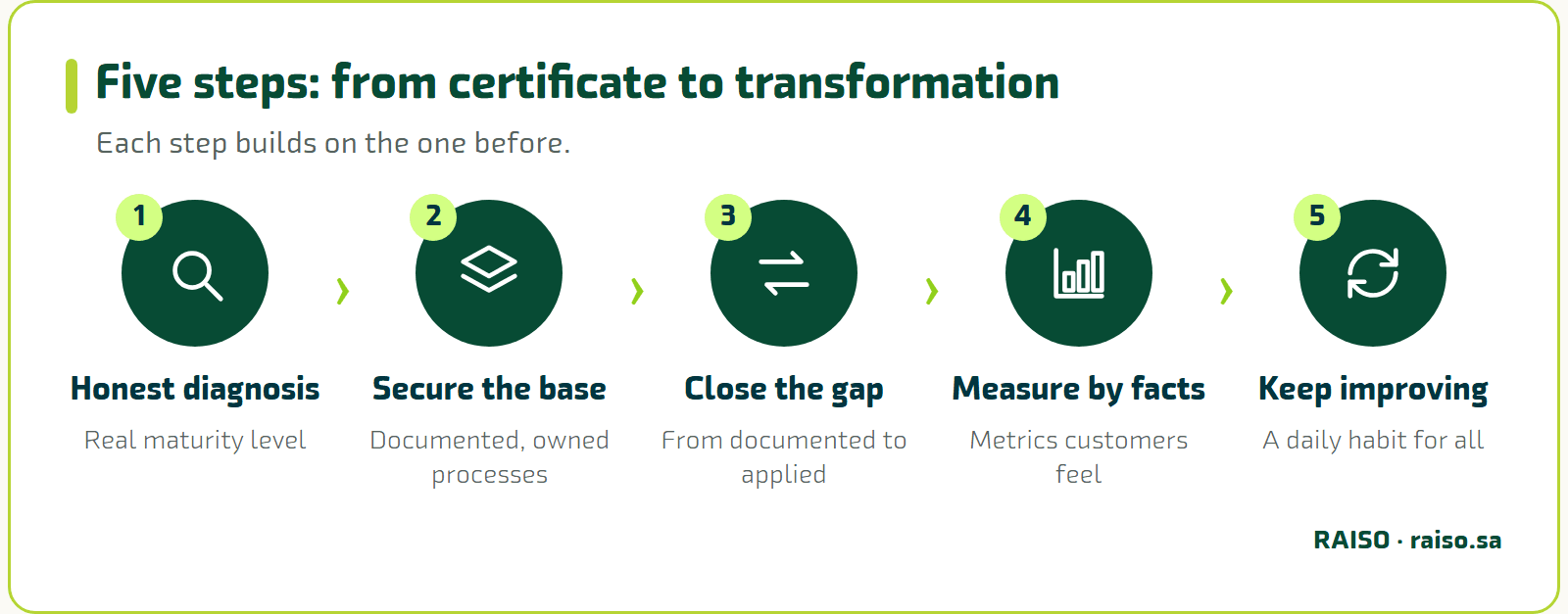
Step four: measure to understand, manage by evidence
The problem it solves: decisions built on impressions. How it is done: give process owners operating measures that reveal how processes really behave, so they are run on data rather than instinct and deviation is caught before it becomes a crisis. The case now: Khalid began measuring the share of repeat visits to fix the same fault, a measure the customer feels directly. The number was higher than they expected, and that was exactly what they wanted to know.
Step five: root a culture of continuous improvement
The problem it solves: improvement that stops when the project stops. How it is done: turn improvement from a periodic initiative into a daily habit spread across everyone, so excellence becomes an operating system, not a campaign, and continues after whoever launched it has left. The case now: Khalid set aside half an hour each week in which one technician presents a problem he faced and how he handled it, with no accountability attached. Within two months technicians were asking for their turn.
What distinguishes this path is that it reverses the usual order. Many organizations start from the certificate and hope transformation will follow later, and it does not. RAISO’s approach starts from transformation, so the certificate arrives as a natural result of an organization that has already become better. The corporate excellence team still has an important role, but a redefined one: not to own quality on the organization’s behalf, but to build the organization’s ability to own it. It is the facilitator who supplies the method, the mirror that reflects maturity honestly, and the memory that keeps improvement alive.
“Pick the one of the five steps closest to where you stand, and write one small action you will take in it this week. Make it something you can finish in an hour.”
Excellence models: a compass, not a prize
Alongside compliance standards like ISO, there are more ambitious excellence models, such as the European EFQM model and national excellence awards like the King Abdulaziz Quality Award. These differ from standards: they do not ask “do you match a minimum?” but “how excellent are you compared with the best?” They are designed for high maturity, not for the minimum.
The paradox is that they too can be reduced to prize hunting if misunderstood. Some organizations prepare for an award the way they prepare for an audit: a polished file, a dazzling presentation and a team devoted to writing the application. Then they win and go back to what they were. An award, like a certificate, can turn from a compass that guides into a medal that hangs.
The real value of these models lies in the self-assessment they require. When an organization assesses itself honestly against the dimensions of excellence, which are leadership, strategy, resources, processes and results, it discovers its true gaps whether or not it wins. A mature organization uses them as an annual mirror to measure its progress, not as a contest it wins once and forgets. A compass is useful every day. A medal is hung once.
And so the meaning is complete. Whether we speak of a compliance standard or an excellence model, the lesson is the same: the tool serves transformation or is reduced to a symbol. The difference lies not in the tool but in whose hand holds it and with what intent. A standard in the hand of one who wants transformation is a bridge. In the hand of one who wants the paper, it is a ceiling.
What you carry with you
We return to where we began. Getting ISO does not make you an excellent organization. But this is not a call to belittle the certificate, only to put it in its place: a useful stop on the road, not the whole road. Whoever celebrates reaching the stop as if it were the destination deprives the organization of the most important journey.
At Khalid’s company, six months into this path, repeat visits for the same fault fell by roughly half, and the big customer wrote a second message. This time it named one technician, in thanks. The certificate in the lobby did not change, but what stood behind it did.
Five ideas to carry from Khalid’s case:
- Diagnose your maturity honestly: determine your processes’ actual level, not the declared one, and start from where you are.
- Change what you celebrate: reward improved results, not merely passing the audit.
- Spread ownership of quality: move it from one department’s island to every process owner.
- Read the standard as principles: in every clause, look for the problem it was written to solve.
- Make improvement a daily habit: turn quality from a project that closes into an operating system that never stops.
The question worth asking your leadership today: do we want a certificate hanging on a wall, or a transformation felt in every process and lived by every employee? The first is granted in a day. The second is built every day.
Next step: start with your own diagnosis
What you have read here is the framework. Applying it to your organization’s processes, determining their maturity level, and building the plan to reach the next level with an expert coach is what RAISO’s corporate excellence practice is for. Learn more and register at raiso.sa, or write to us at marhaba@raiso.sa.
The cases, names and numbers in this article are hypothetical, for illustration only, and do not refer to any particular organization.