



Signs of a Broken Process: How to Know Before It Breaks
Sunday morning looked ordinary at an office-supplies distributor. The weekly report was green, on-time delivery stood at ninety-six percent, and the regular meeting ended on schedule. Then a large order arrived from a corporate customer, and within two days the whole process seized up. Four hundred orders were late, customers were calling in anger, and the managing director asked: how did this happen so suddenly?
The uncomfortable answer is that it did not happen suddenly. The process had been wearing down for weeks and sending signals every single day. Nobody knew where to look. This article shows you where to look.
We will follow one case from start to finish: Hala, the operations manager of that company. In each section you will see a new warning sign, how it showed up in her process, and what she did about it. By the end you will have eight signs to check any process in your organization, a way to read them together, and clear steps for what to do once you see them.
Hala in front of a green dashboard
“You will learn to see a fault while it is still small. We follow Hala’s order-to-delivery process, turn each sign into a question you can ask and a check you can run, and end with a simple health sheet you can start using tomorrow.”
Hala runs operations for a company that sells stationery to schools and businesses. Her most important process is called order-to-delivery. An order arrives, is reviewed, is picked in the warehouse, is invoiced, and is delivered. She tracks it weekly on a dashboard with three indicators: orders completed, on-time delivery, and customer satisfaction. All three were green.
Then that Sunday came. A corporate customer sent one order for twenty schools at once. It was bigger than usual, but not impossible. The warehouse started picking and found that half the order data was incomplete. Invoicing had to re-enter the addresses. Then item errors appeared and picking was redone. By the middle of the second day, the ordinary orders and the big one were stuck in the same queue.
A week later Hala sat with her team and reviewed what had happened. She found no single huge event that explained the collapse. She found dozens of small things that had been going on for two months: a spreadsheet that Majid used in the warehouse and nobody else knew about, orders sent back to invoicing three times, and two departments trading curt messages. Everything was visible. Nobody had treated it as a signal.
“A collapse that looks sudden is always the end of a long chain of signals that nobody read.”
“Hala, the company and the numbers in this article are invented for illustration and do not refer to any real organization.”
What Hala needs, and what you need, is not a smarter system. It is knowing what to look at. That is what we build step by step in the sections ahead.
“Five minutes: pick one process in your organization and write down the last three times it stumbled this past month, however small. Do not analyze anything yet. Keep the list, because you will need it in the final section.”
Why did Hala not see what was in front of her?
Hala is not inexperienced. She reads her reports and visits the warehouse. Even so, she missed every signal. The reason is not missing intelligence. It is four habits in how we manage processes, and they affect everyone who runs one.
First, our indicators measure results, not health. Hala’s dashboard knew how many orders were completed. It did not know how much hidden effort it took to complete them. A process can post excellent results while bleeding behind the scenes. On-time delivery stayed high because the team worked extra hours, and the indicator had no way of knowing.
Second, people are brilliant at adapting. When a procedure stumbles, staff do not stop and raise a flag. They invent a fix, stay an extra hour, and plug the gap with their own effort. That skill is admirable, but it hides the fault. The process looks fine because someone is carrying it on their shoulders.
Third, there is a culture of “if it works, don’t touch it.” As long as orders go out, nobody asks: at what cost? That culture rewards quiet and punishes curiosity, so people learn not to ask.
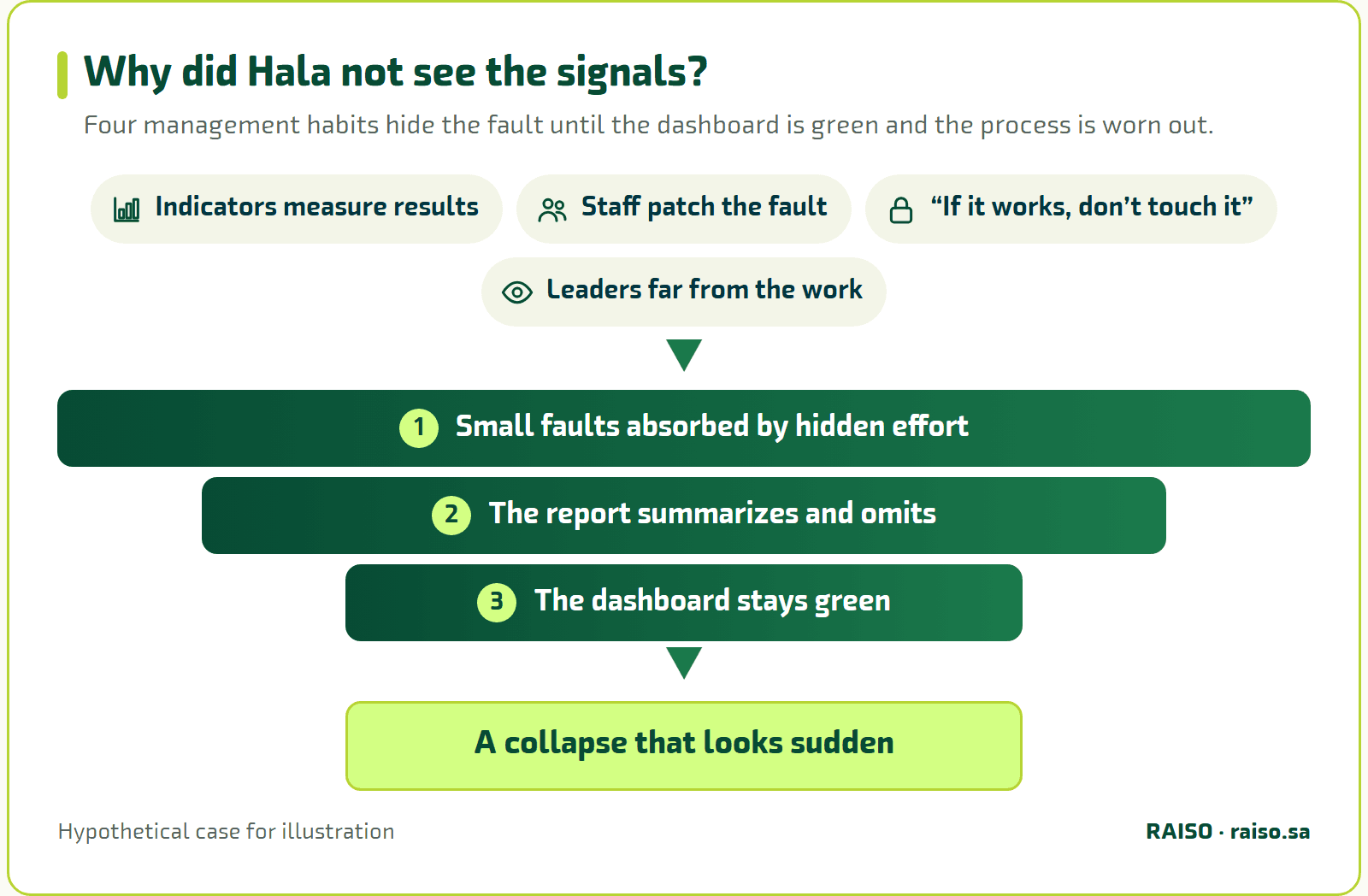
Fourth, there is distance. The higher we climb in an organization, the further we are from where the work happens, and the report becomes our only window. A report summarizes, smooths and omits. Leadership receives where the work ended up, but not what people went through to get it there.
The case now
Hala admitted something simple to her team: my dashboard tells me how much we finished, and not how we finished it. She then asked each supervisor to answer one question every week: what cost us more than usual this week? The answers were messy, but it was the first time she had seen the process from the inside.
“Write down one indicator from your dashboard that measures an outcome, and next to it a question that reveals the hidden effort behind it. For example, beside “on-time delivery” write “how many extra hours did we work to reach it?””
Processes wear down; they do not explode
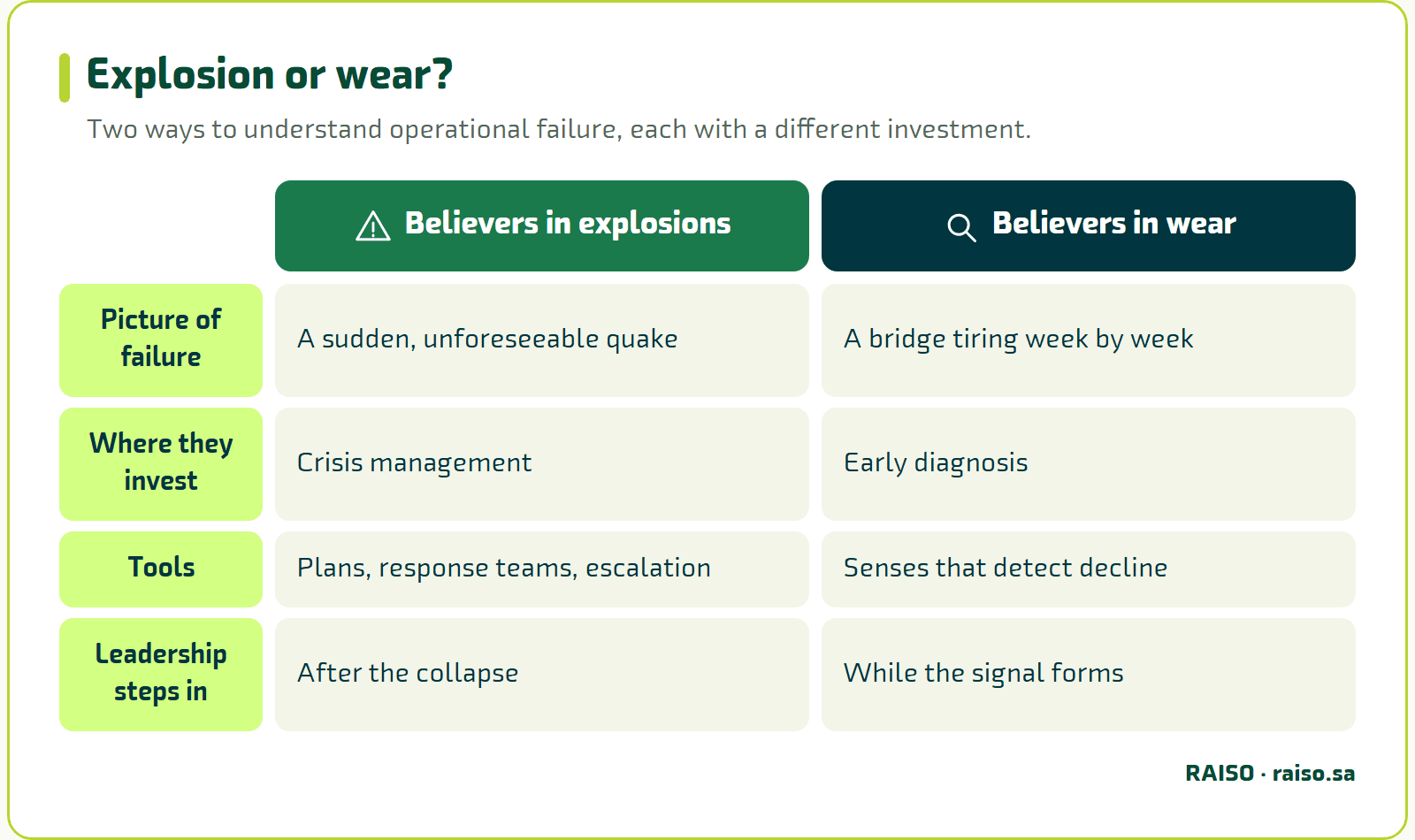
We tend to picture operational failure as an earthquake: sudden, violent, unforeseeable. The picture is comforting because it excuses leadership. But it is wrong. A process is more like a bridge that tires a little more each week. It loses its ability to absorb stress, until an ordinary truck crosses and it falls. The truck was not the cause. Everything before it was.
The difference between exploding and wearing down is not just wording. Those who believe in explosions invest in crisis management: emergency plans, response teams, escalation ladders. Those who believe in wear invest in early diagnosis: senses that detect decline before it reaches the point of no return. Both matter. Most organizations over-invest in the first and almost neglect the second.
This is why RAISO works with a diagnostic approach called CorexSight™. Its idea is simple. It does not predict the future. It directs leadership attention to the right signals at the right time. The way a body raises its temperature before it falls ill, a process raises its signals before it breaks. What matters is that the leader knows how to read the temperature.
Before we start on the signs, two terms will come up often. The first is cycle time: how long a piece of work takes from the moment it enters the process to the moment it leaves. The second is a workaround: any informal way an employee invents to get work done outside the approved procedure. You will find both in Hala’s case.
“A healthy process does not need heroes. It works because it was designed to work.”
Three signs inside the work itself
The first three signs sit closest to the work. They show up in what people do every day, and all they ask of you is to look at the work, not the report.
Sign one: rework and exceptions
The problem it reveals: the process no longer produces correct work the first time. When staff fix data entered wrongly, reprocess a rejected request, or adjust an output sent back from the next stage, a fault at the start of the road is being paid for by someone at the end. The same is true when the number of cases handled as an “exception” swells. An exception that keeps repeating is not an exception. It is a rule nobody wrote down.
How to check it: ask each stage how often it receives work it has already completed once, and how many cases this month were handled outside the procedure. Do not look for a perfect number. Look for a direction.
In Hala’s case, roughly a third of invoicing requests were sent back to the orders team because the address field was left incomplete. That figure appeared on no dashboard, since a returned order still counts as a completed order in the end.
Sign two: hidden workarounds
When an employee cannot get work done through the official system, they do not stop. They build a parallel system in the shadows: a personal spreadsheet, an informal messaging group, a desktop file that tracks what the software does not. Every workaround is a silent admission that the official procedure does not meet the need.
How to check it: do not ask “do you have workarounds?” The answer will be no. Ask: where do you keep what you need and cannot find in the system? And ask to see the desktop. Treat these workarounds as free information about where the process falls short.
At Hala’s company, Majid kept a sheet that told him which items were close to running out, because the system only warned after stock ran out. The sheet saved the warehouse for months, and nobody outside it knew. The day Majid is absent, half the knowledge goes with him.
Sign three: swollen and scattered cycle time
Cycle time is among the most honest measures of health. When it begins to stretch gradually for no clear reason, wear is forming. More dangerous than the average is the spread. When some cases finish in a day and others take two weeks, the process has lost the ability to predict itself.
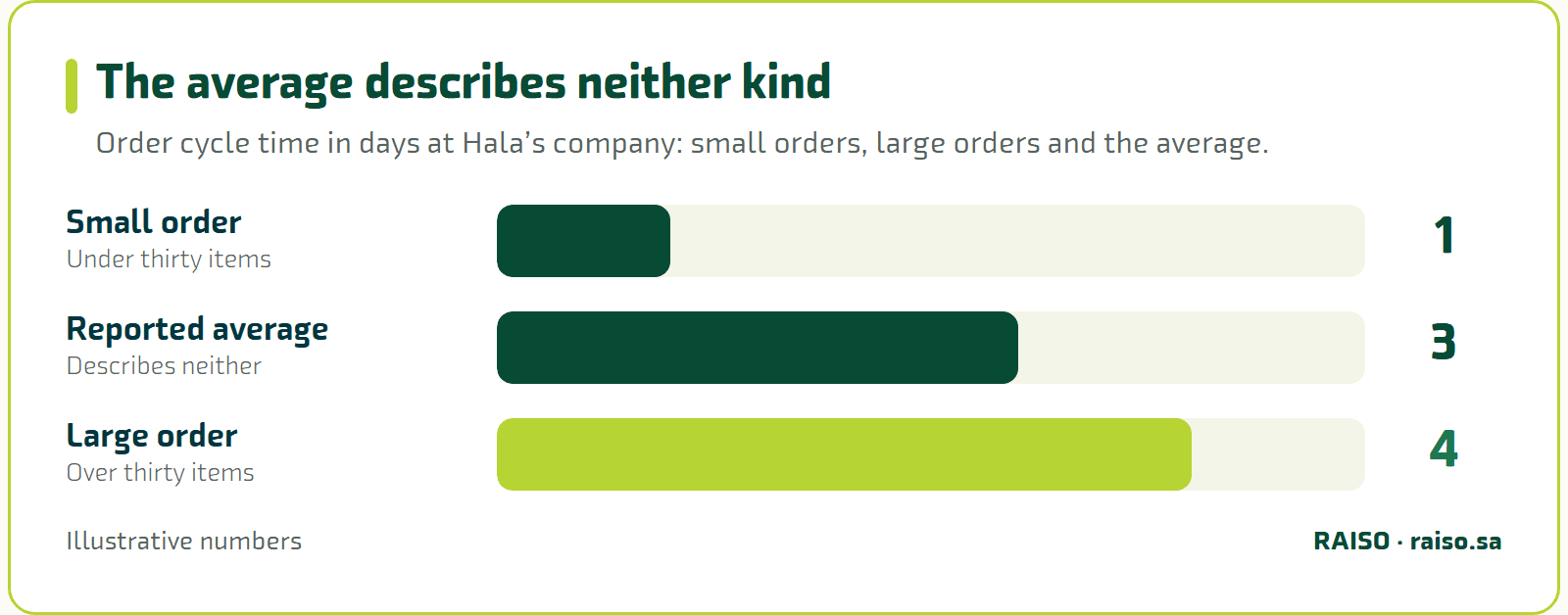
The common mistake is to settle for the average. The average hides the edges, and faults live at the edges. A process in which half the cases finish in a day and half in two weeks can show an “acceptable” average while really being two processes with one name. So read cycle time as a distribution: the fastest cases, the slowest, and what lies between.
When Hala re-read her data this way, she found that small orders finished in a day, while every order of more than thirty items took four. The average was three days, and it described neither kind.
The case now
Hala gathered her three observations on one sheet: a third of orders come back, one spreadsheet carries the warehouse’s knowledge, and large orders take four days. She did not need new software. She only needed to ask the three questions out loud.
“In the process you chose, ask one supervisor: which step gets repeated most? Where does the team keep what it cannot find in the system? What was the longest case this month? Write the three answers down exactly as given.”
Two signs between stages: queues and blame
The next two signs appear where stages meet. Nobody fully owns these places, which is why they are noticed late.
Sign four: piling queues and bottlenecks
Work that piles up at one stage can be seen with the naked eye if you look: files waiting for approval, requests stuck in an inbox that never empties, finished tasks waiting for someone to pick them up. A queue is where demand meets a stage’s capacity, and when the two are out of balance, work stacks up. A bottleneck rarely stays put. The struggling stage starves what follows it and floods what precedes it.
How to check it: walk the stages and count how many items wait at each one, and since when. You do not need software. Paper and pencil are enough the first time.
At Hala’s company the credit-review stage took only large orders, and a single employee ran it. When a big order arrived, everyone waited behind it, even small orders that needed no review.
Sign five: migrating blame
This is a cultural sign that never appears in the numbers. When a process stumbles, blame begins to travel between departments: orders blames the warehouse, the warehouse blames invoicing, invoicing blames the system. This is not just tension between people. It is a precise diagnostic symptom, saying that the process crosses boundaries between departments without anyone owning it from start to finish.
Worse, blame spends repair energy in the wrong direction. Instead of everyone understanding why the handover between two departments is failing, each side busies itself collecting proof of its own innocence. The broken process turns into a political arena, and the real fix usually lies in territory that neither of the accusers owns.
How to check it: listen for sentences that begin with “they” and “they always.” And ask: who owns this process from start to finish? If no single name comes back, you are looking at the sign.
The case now
Hala drew the process on a board and invited one representative from each department. She asked: who owns the order once it leaves your stage? Silence fell. Nobody did. The first decision that session made was to name one owner for the process from order to delivery, Hala herself, with the right to ask questions at any stage.
“Next to each stage of your process, write the name of who owns it, then the name of who owns the whole process. If a box stays empty, you have found the first thing to fix.”
Three signs in the people and the measures
Sign six: undocumented heroics
Every struggling process has a quiet hero: one or two employees who know how things actually get done, and who step in at critical moments to save what the process cannot. Leadership loves these people and leans on them. It does not realize that their very existence is the signal. A healthy process needs no heroics, and every heroic act you discover is a gap in the design plugged by one person’s ability.
How to check it: ask “if so-and-so were away for a week, what would happen?” If the answer is “work would stall,” you have a process hanging from a person. Majid in Hala’s case is a plain example: everything he knew about critical items lived in his head and his sheet.
Sign seven: rising escalations
Escalation, meaning raising a case to a higher level of management to resolve it, is a mechanism for exceptions. But when it turns into routine, and managers spend most of their time on cases that should have been settled at their own level, it means the process can no longer handle its ordinary work by itself. The number of escalations is a direct measure of the fault whose cost is paid by senior management in lost time.
How to check it: count how many times a week a case reached you that should have been decided without you, and compare the week with the one before. If you spend your mornings on “is this allowed?” calls, your process needs clearer decisions, not a faster manager.
Hala discovered she was getting more than ten calls a week about a single case: a large order that the warehouse did not know whether to pick in batches or all at once. Nobody was at fault. The rule did not exist, so the operations manager had become the rule.
Sign eight: when measurement goes silent
This is the most dangerous and the most cunning sign, because it is a sign by absence rather than presence. When an indicator is more stable than it should be, or complaints and reported errors vanish entirely, the likeliest explanation is not that the process is perfect. The likeliest explanation is that the measurement system itself has lost its sight.
Silence may mean data is no longer being collected. It may mean problems are fixed in the shadows before they are recorded. It may mean people have learned that reporting only brings them awkward questions, so they stopped. In every case, an indicator that never moves does not reassure you. It asks you: am I still measuring anything real?
On Hala’s dashboard, the indicator for item errors sat at zero for two months. It looked like an achievement. But when she asked Majid, he said: I stopped logging an error if I fixed it on the spot. The indicator was silent because everyone had stopped talking to it.
The case now
Hala now had eight signs, and it became clear that six of them had been present at least two months before the collapse. She had not lacked intelligence or a new system. She had lacked an order in which to look. What remained was to learn to read the signs together, not one at a time.
“Pick an indicator on your dashboard that has not changed in months, and visit whoever collects its data. Ask: what does not go into this number? The answer is more honest than the number.”
Read the signs together: from symptom to diagnosis
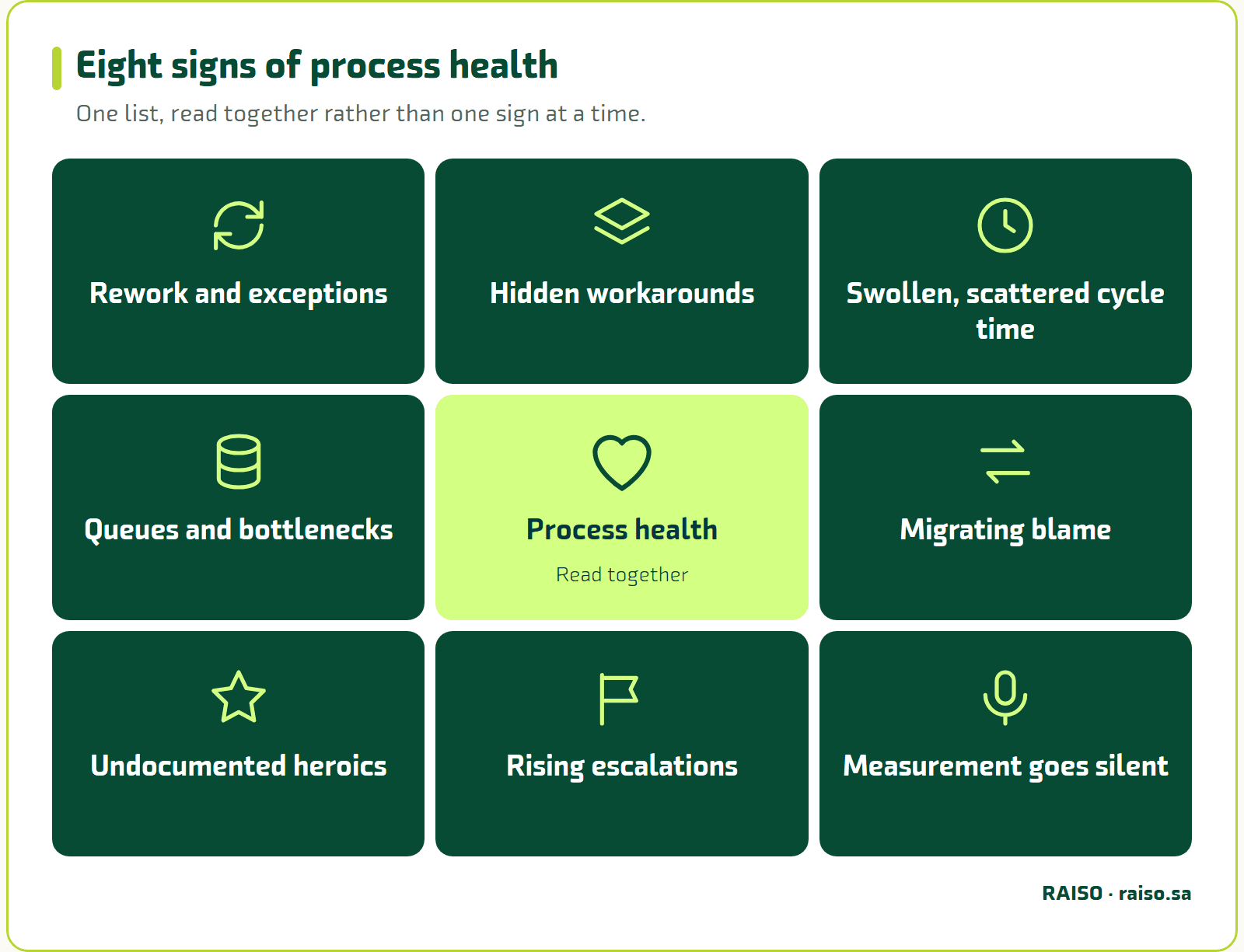
The biggest mistake in using any diagnostic list is reading the signs one at a time. Each sign alone may have an innocent explanation: a season that lifts demand, a new employee still learning, a bad day. The real value comes from the pattern: several signs together, their direction over time, and the way they reinforce each other.
Take Hala’s case. Rework alone may be passing. But when it comes with a workaround at Majid’s desk, then a scattered cycle time, then blame travelling between two departments, you are not looking at four problems. You are looking at four symptoms of one disease: order data enters incomplete at the very start, and nobody owns its completeness. A doctor does the same, never treating the fever alone but asking what comes with it.
| # | Sign | What do we ask? | Healthy | Watch | Alarming |
|---|---|---|---|---|---|
| 1 | Rework and exceptions | How often does each stage receive work it already completed? | |||
| 2 | Hidden workarounds | Where do you keep what you cannot find in the system? | |||
| 3 | Cycle time | What was the longest case this month? How wide is the spread? | |||
| 4 | Queues | How many items wait at each stage, and since when? | |||
| 5 | Migrating blame | Who owns the process from start to finish? | |||
| 6 | Undocumented heroics | What happens if so-and-so is away for a week? | |||
| 7 | Escalations | How many cases reached me this week that should not have? | |||
| 8 | Silent measurement | What does not go into this number? |
Review it weekly in ten minutes. The empty boxes are your blind spots.
This is where a systematic approach such as CorexSight™ adds something to managerial instinct. It does not just spot the signal. It helps you see it among other signals, and follow its direction rather than its moment. An isolated signal produces worry. A signal read within a pattern produces a diagnosis. The difference is the difference between a leader who puts out fires and a leader who prevents them.
Time matters just as much: the trend is more honest than the value. A bad indicator that is improving is less alarming than a good one that is steadily declining. Whoever reads only momentary values sees a still photograph of a moving process. Whoever reads the curve sees where it is heading, and that alone gives the time needed to act.
The health sheet: one page is enough
Put the eight signs on a single page for each process, and review it every week in ten minutes. Each sign gets one line with three things: what we looked at, what we found, and whether it is better or worse than last week. You need nothing more. What matters is the direction and the repetition of looking.
“Draw a table of eight rows with the names of the signs, and fill it in for your process with what you know right now, without researching. The empty boxes are your blind spots.”
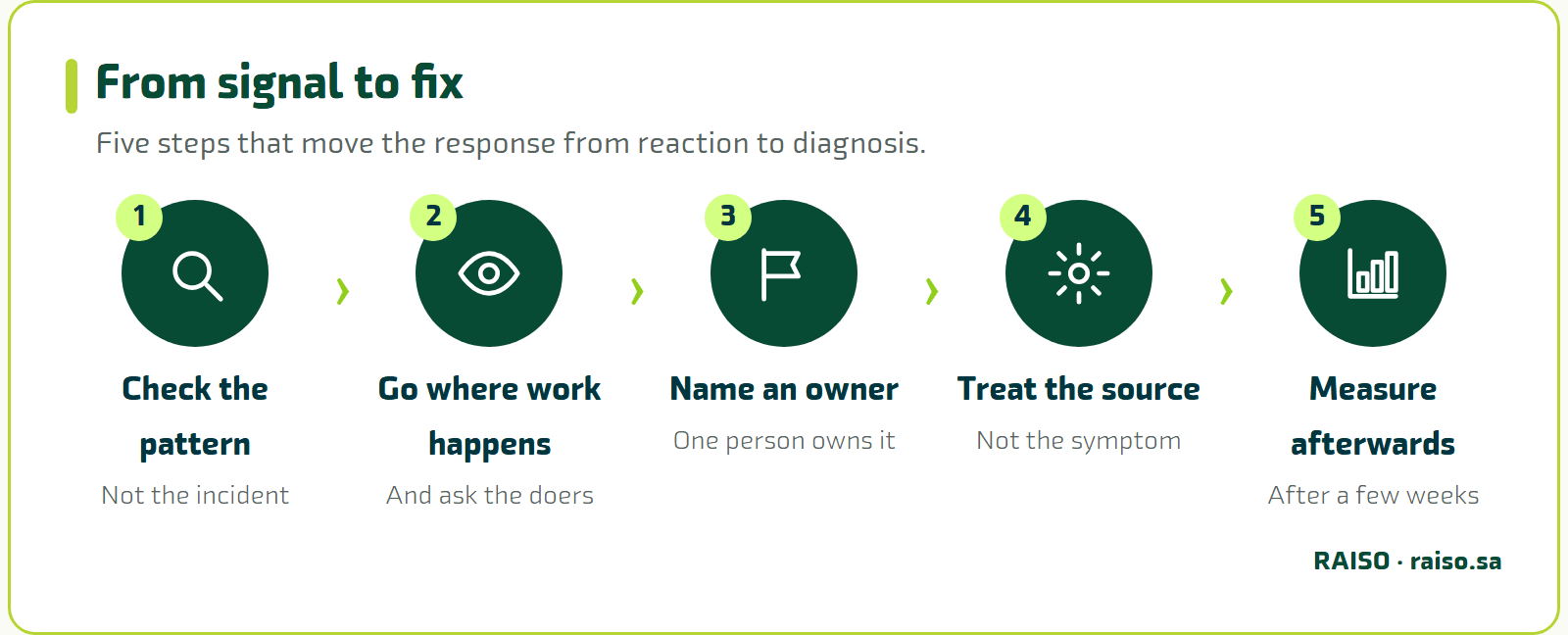
What do you do when you see a signal?
Seeing a signal without responding correctly is worse than not seeing it, because it turns the leader into a witness to decline rather than a barrier against it. The most common wrong response is to reward the symptom instead of treating the disease. When leadership sees that individual heroics are saving the process, and so honors the heroes and leans on them more, it never asks: why does this process need heroics at all?
The mature response begins with one rule: treat the signal as information, not accusation. The employee who built a workaround is not a culprit to catch. They are a sensor telling you the official procedure is letting them down. Once signals become material for blame, people learn to hide them, and the diagnostic system suffers its worst failure: manufactured silence. A leadership that punishes the bearer of bad news buys itself today’s comfort at the price of tomorrow’s collapse.
When a signal appears, follow this sequence:
- Check the pattern, not the incident
Ask whether the signal is isolated or part of a repeating direction, and whether other signals come with it.
- Go to where the work happens
Do not settle for the report. Go where the work is done and watch how it really runs. A real signal is seen, not told.
- Ask the doers with curiosity, not interrogation
People who work in the process every day know where it stumbles. Ask: what wears you out? Do not ask: who made the mistake?
- Name an owner
Every signal needs one person who owns following it until it is resolved, even if its cause spans two departments.
- Treat the source, not the symptom
If rework comes from incomplete data, fix the field at the point of entry. Do not add a person at the end of the road.
- Measure after the intervention
Return to the same signal after a few weeks and see whether it improved. A diagnosis that is not followed up ends in a drawer.
The thread through these steps is moving the response from reaction to diagnosis. A leader who waits for the collapse and then responds manages crises. A leader who reads the signal and steps in while it forms manages operational health. The difference between them is not competence. It is the moment each chose to look.
The case now
Hala started with a single sign: rework. She made the address field mandatory at order entry, wrote a clear rule for picking large orders in batches, and asked Majid to share his sheet with the whole team instead of blaming him for it. After six weeks, returned orders fell from a third to about a tenth, and escalation calls dropped to two a week.
Build a diagnostic muscle in your organization
Seeing early signals is not a talent possessed by one sharp leader. It is an institutional ability that can be built and trained like any muscle. An organization that relies on one person’s instinct to read its processes is as fragile as that person’s tenure. One that turns diagnosis into a system makes seeing early faults part of its daily work.
The first pillar is the indicators themselves. Add health measures to the outcome measures. Do not ask only how much we finished. Ask: with how many exceptions? How wide is the spread in cycle time? How many escalations did it take? These are the sensors that expose wear before it reaches the result.
The second pillar is culture. The most precise indicators will not help if people fear reporting what they reveal. Organizations that read their signals well have made early truth-telling safe and rewarded. Whoever raises an early flag is seen as a guardian of the process, not a spoiler of the peace. This cultural shift is harder than any technical one, but it has the deepest effect.
The third pillar is rhythm. Make reviewing the health sheet a fixed part of the operations meeting, even if only ten minutes. What is not reviewed regularly is forgotten, and a forgotten signal returns later in the shape of a crisis.
In the context of Saudi Vision 2030, with the high bar it sets for operational efficiency in both the public and private sectors, this muscle becomes a real competitive advantage. Organizations aiming at world-class levels cannot afford to wait until their processes collapse in order to learn. They need to see the fault while it is a whisper, and treat it while it is still cheap.
“Fix a weekly ten-minute slot, and name one person to fill in the health sheet for your process. Start with a single process only. The habit matters more than the breadth.”
What you carry with you
Processes do not collapse suddenly. This is the one idea that, once settled in your mind, changes the way you manage. The collapse that looked sudden to Hala was the end of a chain of signals nobody read. A leader’s responsibility is not to respond faster to disasters, but to read earlier what comes before them.
A summary of what we learned with Hala:
- Ask about health, not only results: how much hidden effort did this achievement cost us?
- Watch eight signs: rework, workarounds, cycle-time spread, queues, migrating blame, heroics, escalations, and silent indicators.
- Read signs together and follow their direction. A pattern produces a diagnosis, and an isolated signal produces worry.
- Treat a signal as information, not accusation, so people do not learn to hide it.
- Start with one sign, one process and a one-page sheet.
The question we leave with you: your processes right now, while running “normally,” what signals are they sending that you are not hearing? The process that will break tomorrow is talking to you today. The only question is whether you are listening.
Next step: practice diagnosing
What you have read here is the framework. Applying it to real processes from your organization, with a coach who helps you read the signs, connect them and turn them into an improvement plan, is what RAISO’s process management practice is for. Learn more and register at raiso.sa, or write to us at marhaba@raiso.sa.
The cases, names and numbers in this article are hypothetical, for illustration only, and do not refer to any particular organization.