



Best Practices Cannot Be Copied: Why Context Is Everything
In a meeting room at one company, a consultant put up a slide with a single title: “This is how a famous Japanese carmaker did it.” The audience was impressed, and the decision was nearly made before the slide ended. We will move the practice as it is, with its names, its terms and its forms. Eight months later the practice lay buried in a shared folder nobody opened, and the review meeting said: “the practice did not suit us.” The truth is that the practice never existed in the company. What was moved was its shell, not its substance.
This article takes a plain position: there is no best practice without context. A practice we call “the best” is not a universal recipe valid everywhere. It is a solution that matured in a particular environment with its own culture, systems, maturity level and history. Moving it as it is, copy and paste, is not a fast road to excellence. It is the fastest road to failure.
We will follow one case from start to finish: Noura, an improvement manager at a property-management company, and a practice she carried from a factory to the customer service center, where nobody used it. In each section we see why it failed, then how Noura rebuilt it. By the end you will understand what the phrase “best practices” hides, the four layers of context behind any successful practice, and a six-step method for localizing any practice to your organization’s culture, systems and maturity.
Noura and the button nobody pressed
“You will learn why transplanted practices fail, how to break any practice down to its effect, and how to redesign it to fit your context. At every step we see what changed in Noura’s case.”
Noura is the improvement manager at a company that manages residential and commercial buildings. Its customer service center takes maintenance requests from tenants: a leak, a broken air conditioner, a power cut. Things were getting shaky: requests were closed and then came back, and tenants called three times about the same fault. The company brought in a consultant, who presented a famous practice from the factory world: any worker on the production line may pull a cord and stop the whole line when they see a defect, and engineers come to solve the problem at its root before work resumes.
Noura liked the idea. She moved it into her center: a button in the system called “Stop Request,” which any employee presses when they spot a fault in a request before it goes to the technician, so the request halts and the response team is alerted. The procedures were written in the same form in which they were received, the team was trained in a single workshop, and the practice was launched with a short celebration.
Eight months later Noura reviewed the system. The button had been used three times. Meanwhile repeat requests stayed exactly as they were. She asked the employees why, and some spoke frankly while others offered a polite smile. She began to see that the trouble was neither the team nor the practice at its source, but something she had not moved.
“Nobody made a mistake in this story, and still the button did not work.”
“Noura, the company and the numbers in this article are invented for illustration and do not refer to any real organization.”
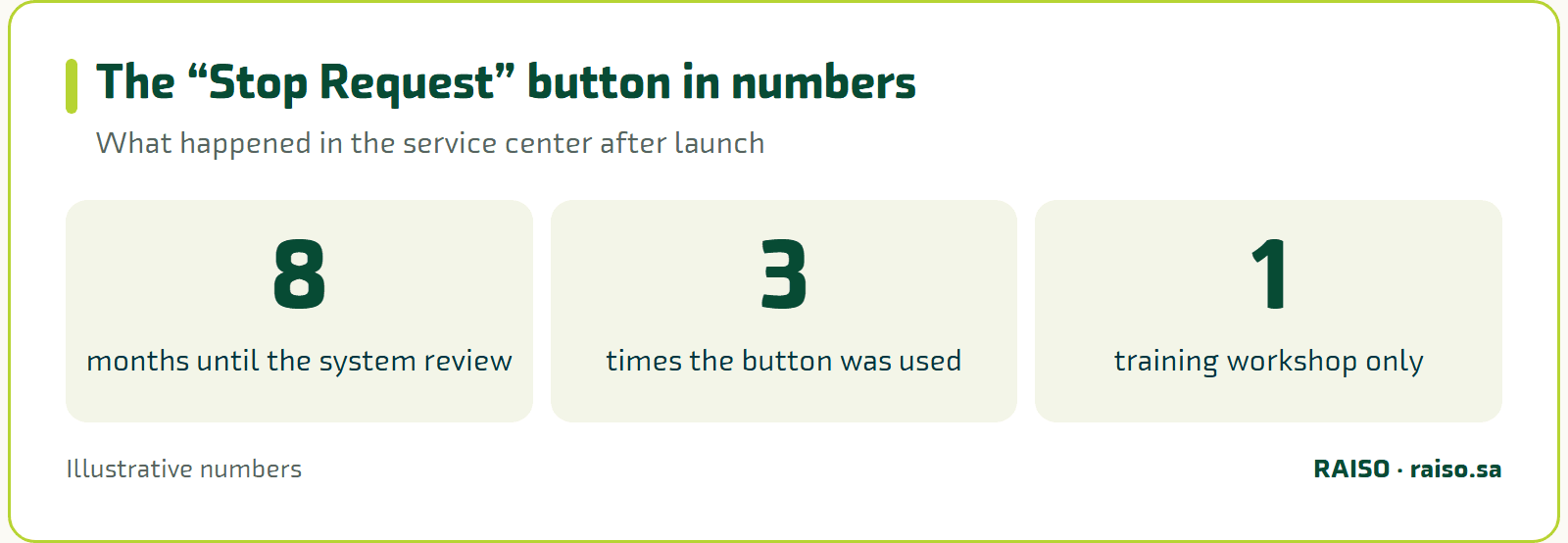
What happened to Noura happens to many. A practice that looks simple, a button, a form, a meeting, carries behind it things the eye cannot see. When the tool is moved and those things are left behind, the tool becomes an empty shell.
“Five minutes: recall a practice introduced in your organization because it worked for someone else. Is it still in use? Write an honest answer in one sentence. You will come back to it in the final section.”
The myth of the ready-made practice
The phrase “best practices” carries a tempting hidden promise: there is one right solution, discovered and tested, and all you need to do is adopt it. The promise is comforting because it spares the leader the burden of original thinking and turns excellence from effort into purchase. You look up the name of the practice, download the template, sign the consultant’s contract and wait for the results that were achieved somewhere else. But at its core the promise is not true.
A best practice is not a law of physics that applies everywhere like gravity. It is a conditional solution that worked because certain factors came together in a certain environment. When you tear it from its environment and plant it in one that lacks those factors, you are not moving the success but its outer shape. It is like taking a ripe fruit from one tree, placing it on the branch of another, and wondering why it does not grow. The fruit was not the fruit of the branch, but of roots, soil and climate, none of which moved.
More dangerous still, calling a practice “the best” silences the critical question. When an idea is presented as an opinion, we discuss it. When it is presented as “a global best practice,” we are embarrassed to object. Who dares say that what worked for great companies may not suit their own organization? That is how the phrase turns from a tool for learning into a tool for silencing. The first step toward real localization is to reclaim the right to ask: where did it work? With whom? Under what conditions?
“A best practice is not a universal law. It is a conditional solution that worked because specific factors came together in a specific environment.”
The case now
Noura went back to the consultant and asked three questions she had never asked before: where exactly did this practice work? What surrounded it that your slide did not show? And has it ever been tried in a place like a call center? He had no answer to the third. That alone was a lesson.
“When someone offers you a “successful” practice, ask three questions: where did it work? With whom? Under what conditions? Write the answers down before you agree.”
The iceberg: the hidden context behind every practice
Every successful practice is the tip of an iceberg. What we see, the tool, the form, the steps, the dashboard, is the part above water. The submerged parts are the context that made that tip possible: a culture that allowed it, systems that held it, operating maturity that carried it, and a history that paved the way. When we copy, we take the tip and leave the real cause behind.
Take the cord itself. The tool looks simple: a cord to pull or a button to press. But the tool is not the practice. The real practice is a culture that makes the worker certain he will not be punished for stopping, but rewarded for vigilance. It is a leadership that treats a stopped line as a chance to learn, not a disaster calling for a culprit. It is a response system in which engineers arrive within minutes. Move the cord without these layers and you get a cord nobody dares to pull.
The hidden context usually has four intertwined layers, which we must understand before we think about moving anything.
| Layer | What it covers | What Noura found |
|---|---|---|
| Cultural | Attitude to authority, tolerance of error, individual initiative | Staff saw stopping a request as admitting a mistake |
| Regulatory | Local laws, regulator and labor requirements | Mandatory response times; stopping risked them |
| Maturity | Process strength, data quality, team skills | No clear classification of defects |
| Historical | What was tried before and the trust or scars left | A past “report the fault” drive got two staff held to account |
What lies below the waterline, and what Noura found in each
The four layers, with what Noura found in each:
- The cultural layer
The relationship to authority, tolerance of error, the distance between leader and employee, and whether individual initiative is encouraged or risky. In Noura’s center the supervisor reviewed stopped requests, and employees felt that stopping amounted to announcing they had made a mistake.
- The regulatory layer
Local laws, regulators’ requirements and labor rules, which may make a practice fine in one country and unsuitable in another. At Noura’s company there were mandatory response times for tenant requests, and stopping a request risked missing the deadline.
- The maturity layer
How well established the basic processes are, the quality of data, and the skills of teams. An advanced practice requires an advanced base. The center had no clear classification of defects, so staff did not know when a fault counted as one worth stopping for.
- The historical layer
What the organization tried before and what it left behind in scars or trust. Two years earlier a “report the fault” initiative had been launched, and two employees were later held to account because of it. Everyone learned the lesson.
When any layer is missing, the practice becomes a hollow ritual. The steps are performed in form, the forms are filled, the meetings are held, but the effect the practice was created for never arrives. This explains a painful paradox: two organizations apply “the same practice” and get opposite results. The difference is not in the practice but in the soil.
The case now
Noura drew an iceberg on a board, wrote the word “button” above the water, and under it the four layers. Then she invited three employees and a supervisor and asked them to fill in what was under the water themselves. The answers were not surprising, but this was the first time they were written down.
“Choose a practice you are considering or adopted some time ago, and draw it an iceberg: the tool above water, and below it four boxes for culture, regulation, maturity and history. In each box write what the practice needs and what your organization has.”
Why is copy and paste the fastest road to failure?
Copying may look like a clever shortcut: why reinvent the wheel when someone else has done it? But this “shortcut” is often the longest and costliest road, because it fails slowly and at a double cost: the cost of applying it first, then the cost of retreating and repairing wasted trust. A fast, open failure is far kinder than a silent one that drains years. In this case there are four reasons.
The first reason is that copying imports the solution without the understanding. When you adopt a practice because others did, not because you understood why it works, you cannot adapt it when you hit the first local obstacle, and you certainly will. And since you hold no “model of the cause” in your head, you treat every deviation as a failure of the practice rather than an invitation to adapt. So you either abandon it entirely or force it on a reality that rejects it.
The second reason is that copying collides with the organizational immune system. Every organization has a culture, customs and entrenched balances of power, and it treats any foreign body imposed on it the way a body treats an incompatible implant: with rejection. Employees who were not part of the design, and see in the transplanted practice only a burden full of strange terms, resist it in the silent ways every organization has mastered: token compliance, delay, and organized “forgetting,” until the practice withers by itself.
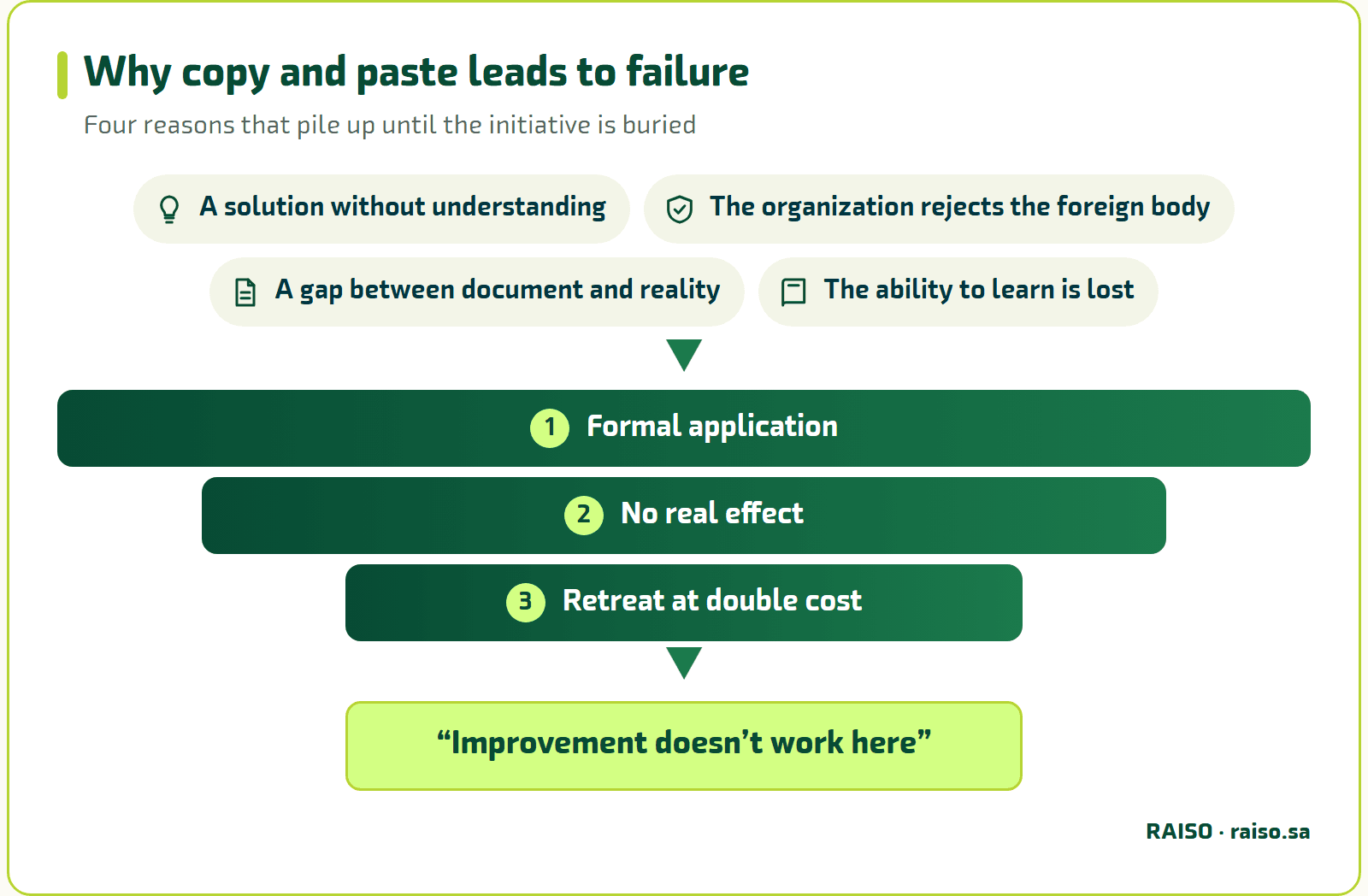
The third reason is that copying creates a gap between document and reality. New procedures are written in the language of the original environment, so they describe processes, roles and tools that may not exist in the receiving organization. The result is elegant documents on paper detached from the ground, and an exhausting duality: a declared way of working shown to auditors, and an actual way people work. That duality does not only weaken the transplanted practice. It weakens the organization’s trust in every improvement initiative to come.
The deepest reason is that copying kills the ability to learn. When a practice you localized yourself succeeds, your organization learns how to think, not only what to do. When a practice you copied fails, your organization learns only one destructive lesson: “improvement doesn’t work for us.” That false lesson costs many times more than the failed practice itself, because it inoculates the organization against every serious attempt that follows.
The case now
At the review meeting Noura heard the sentence she had dreaded: “Improvement doesn’t work here.” She did not answer defensively. She told the team: the practice did not fail. We did not give it what it needs to work. And I will need your help to understand what it was missing.
“Ask yourself: when did a transplanted initiative fail here, and what lesson did people keep from it? Write that lesson in their own words. It may need correcting before any new initiative.”
The Saudi context: doubled risk, doubled opportunity
Copying is risky in every environment. But in the Saudi context its risks double, and the opportunity doubles with them, which is the point. The Kingdom is living an exceptional moment of transformation under Vision 2030: giant projects accelerating, sectors being restructured, and organizations entering new markets and fields at an unprecedented pace. That accelerated setting tempts us to import ready-made solutions for speed, when it actually calls for deeper localization, not faster.
What first marks the Saudi context is its regulatory dimension. There is a body of local laws and regulations developing quickly, from labor and localization rules to sector regulators’ requirements and local-content conditions. A practice designed in an environment with different rules may collide with a local legal requirement or ignore an obligation that cannot be avoided. Localization here is not an optional improvement but a compliance condition that cannot be deferred.
Second, the human and cultural dimension. The workforce in the Kingdom is strikingly diverse, combining rising national talent with high ambition and expatriate expertise from many cultures. A practice that assumes one uniform cultural pattern in the relationship to authority, initiative and teamwork will meet a more complex reality. And an ambitious localization agenda makes building local capability and transferring knowledge an integral part of any successful practice, not a side effect.
Third, the dimension of ambition. Vision 2030 targets raised expectations in nearly every sector. That ambition is a blessing because it creates real will for change and rare leadership support. But it can be a trap when it pushes organizations to adopt practices far more advanced than their present maturity. Jumping to the top of the ladder without its rungs drops an organization rather than lifting it. The wise course is to match the speed of ambition to the reality of maturity: a solid base is built once, while a failed leap repeats its cost.
But the other half of the picture is bright. The Saudi context today has what many environments lack: clear leadership will for change, resources to invest in transformation, a generation of talent hungry to learn and build, and a national momentum that makes organizational excellence a public cause. An organization that localizes well in this environment does not merely avoid failure. It builds a competitive advantage that is hard to imitate, because the real advantage lies not in the transplanted practice but in the institutional ability to localize itself.
The case now
Noura noticed that her center includes staff of several nationalities and backgrounds, and that some had learned that the safest course is never to contradict the supervisor. That the company works within mandatory response times for tenant requests. And that it is ambitious, wanting to reach an advanced level within a single year. Each of these facts was a cause of failure, and none of them appeared on the consultant’s slide.
Localization is not translation
When localization is mentioned, the mind jumps to translation: we Arabize the terms, swap foreign examples for local ones, and change the company logo in the corner of the document. That is not localization. It is superficial disguise that leaves the foreign body unchanged and merely dresses it in local clothes. Real localization goes much deeper, reaching the substance of the practice and not its wrapper.
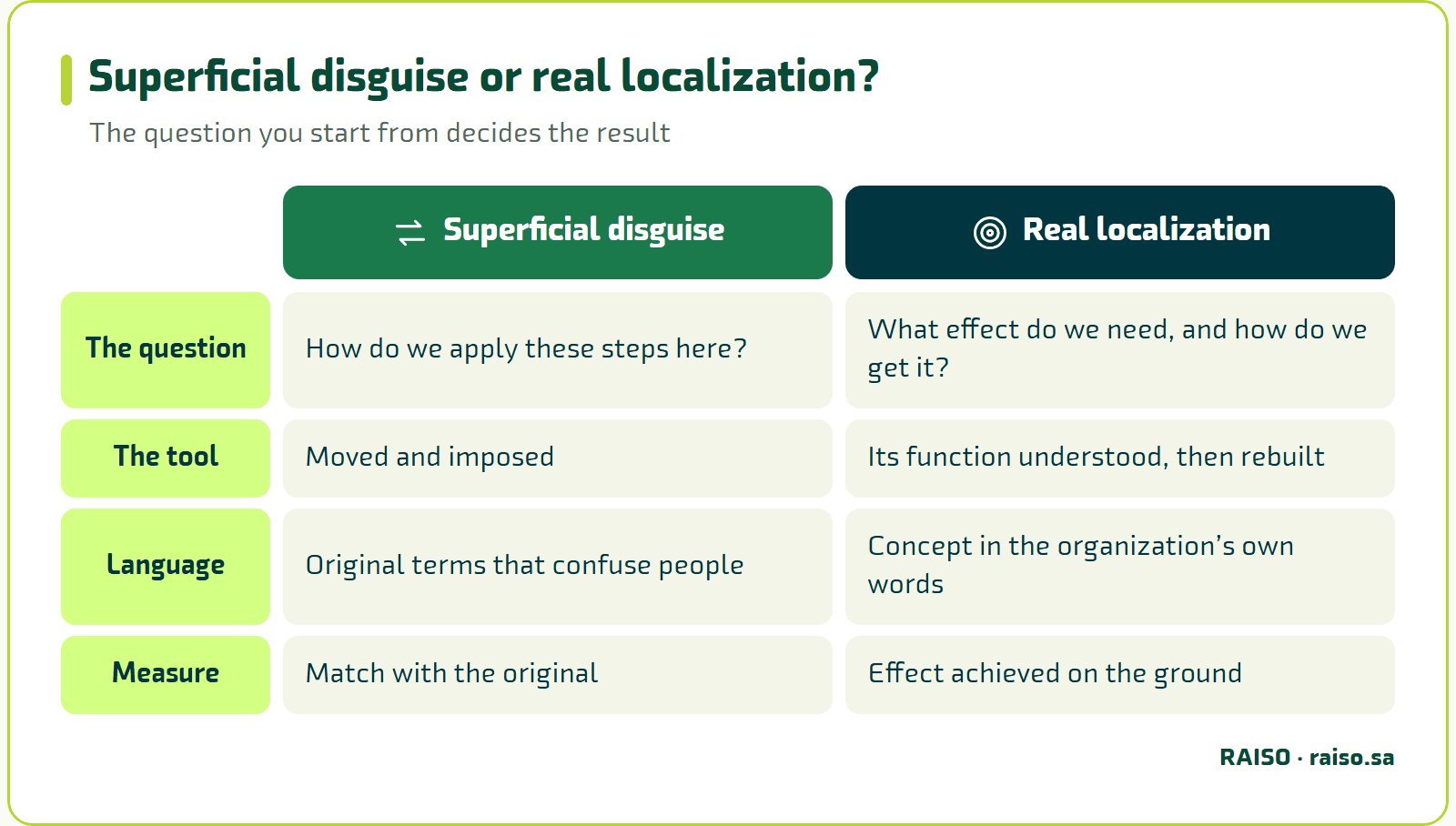
Localization is re-engineering the practice so it produces the same effect it produced in its original environment, with means that suit your own. The difference is fundamental: the aim is not to reproduce the form but to reproduce the effect. Tools, steps and terms may differ radically from the original and still be a faithful localization, as long as the purpose is achieved. The opposite holds too: every detail may match in form, and the application still betrays the practice because it fails to produce its effect.
To make the difference between superficial disguise and real localization clear:
- Disguise asks: how do we apply these steps here? Localization asks: what effect does this practice achieve, and how do we achieve it?
- Disguise moves the tool and imposes it; localization understands what the tool does and then chooses or builds what does it in its own context.
- Disguise keeps the original terms and confuses people with them; localization phrases the concept in the organization’s own language so people feel at home with it.
- Disguise is measured by how closely it matches the original; localization is measured by how far the intended effect is achieved on the ground.
This shift in the question, from “how do we move it?” to “what effect do we want, and how do we produce it in our reality?”, is the essence of localization. It demands a deep understanding of the original practice first, a deeper understanding of the local context second, and the ability to redesign third. It is creative engineering work, not mechanical pasting.
Six steps to localize any practice
Localization is not a mysterious art monopolized by the gifted. It is a methodical process that can be learned. Here are six steps that turn a transplanted practice from a ready-made shell into a solution rooted in your environment. They are not meant to be applied as a rigid template, which would be ironic, but as a thinking compass that is itself adapted to your context. We go through them with Noura, step by step.
Step one: break the practice down to its effect
The problem it solves: we cling to the tool and forget its function. How it is done: set aside the tool and steps, and ask: what core effect does this practice create? What problem does it solve in its own environment? Strip it of its shape until you reach its pure function. Quality circles, for instance, do not aim at weekly meetings but at a mechanism in which workers hold an influential channel for improving their own work. Meetings are an interchangeable means. The case now: Noura wrote the effect of the cord practice in one sentence: that an employee has a safe and fast channel that stops an error before it reaches the customer. The button is not the effect.
Step two: dissect the original context
The problem it solves: we do not know why the practice worked at home. How it is done: look for the hidden factors that made it succeed. What cultural assumptions was it built on? What systems held it? What level of maturity did it require? This step reveals the submerged layers of the iceberg, and often shows that the practice relies on an obvious condition in its environment that is entirely absent in yours. The case now: Noura learned from the consultant that the factory had an engineering team standing by at the line, that the worker is never held to account for a stop, and that defects are classified precisely. All three conditions were missing from her center.
Step three: diagnose your own context honestly
The problem it solves: we see our organization as we wish it were, not as it is. How it is done: turn the microscope on your organization with harsh honesty. What is our relationship to authority, error and initiative? What local rules govern us? What is our real maturity level, not the hoped-for one? What is our history with change initiatives? A large share of localization’s success is decided here, because a false diagnosis, flattering maturity or denying culture, produces adaptation built on illusion. The case now: Noura came out of her listening sessions with three facts: employees fear being held to account, there is no dedicated response team, and there is no classification of defects.
Step four: design the gap
The problem it solves: we ignore points of conflict, and they become deferred failures. How it is done: compare the practice’s original context with yours and pin down the gaps precisely. Where does the practice conflict with our culture? Where does it collide with our rules? Where does it exceed our maturity? Every gap you uncover is a needed adaptation point, and every gap you ignore is a deferred failure point. Gaps are not excuses to retreat but a work map for redesign. The case now: Noura wrote three gaps in a table: a culture of accountability, no response team, and no defect classification. Beside each one she wrote a question: what do we do about it?
| # | Step | The problem it solves | How it is done |
|---|---|---|---|
| 1 | Break it down to its effect | We cling to the tool and forget its function | Ask: what core effect? Name no tool |
| 2 | Dissect the original context | We do not know why it worked at home | Find the hidden factors: culture, systems, maturity |
| 3 | Diagnose your context honestly | We see our organization as we wish it were | Examine authority, error, rules and maturity bluntly |
| 4 | Design the gap | We ignore conflict points; they become failures | Compare both contexts and pin down the gaps |
| 5 | Redesign to achieve the effect | A transplanted practice that does not fit | Rebuild with means that suit you and cross the gaps |
| 6 | Try, measure and adapt | We expect the first design to succeed | Pilot in a limited scope, adapt to the real effect |
Each step fixes a specific problem
Step five: redesign to achieve the effect
The problem it solves: a transplanted practice that does not fit our reality. How it is done: this is where real localization happens. Rebuild the practice to achieve the target effect through means that suit your context and cross the gaps you found. You may swap a tool for another, adjust a step, add a missing preparatory layer, and phrase the concept in familiar terms. The governing test is one question: does this new design produce the effect we stripped out in step one? If yes, you have localized. If no, you have copied in new clothes. The case now: Noura changed the button from “Stop Request” to “Quality Note,” which flags the request without stopping it. She made its logging invisible by name to the supervisor. She assigned one on-duty employee per shift to answer notes within fifteen minutes. And she wrote a list of five defect types, any of which counts as a quality note.
Step six: try, measure and adapt
The problem it solves: expecting the design to succeed on the first attempt. How it is done: no localization succeeds the first time. Apply your localized version in a limited scope, watch the real effect rather than formal compliance, then adapt based on what you learn. Localization is a cycle, not an event, and the design deepens with every round until the practice takes root and becomes part of the organization’s identity rather than a foreign body planted in it. The case now: Noura began with one type of request, water leaks, and measured one thing: repeat requests. After six weeks, notes rose from three in eight months to forty a week, and repeat requests of that type fell by about half. Then she widened the trial to a second type.
“Take the practice whose iceberg you drew in the third section and apply step one only, today: write its effect in a single sentence that mentions no tool.”
The leader’s role: from consumer of practices to engineer of them
All of this places on leadership a responsibility radically different from what it is used to. The leader who chases best practices as ready-made goods turns the organization into a permanent consumer of other people’s solutions: paying the price, collecting the scars and building no capability. The leader who understands that there is no best practice without context treats every practice as raw material to be re-engineered, not a finished product to be installed.
That shift begins with changing the questions a leader asks. Instead of “what is the best practice in our field to apply?”, they ask: “what core problem do we want to solve, what practices have dealt with similar problems, and what do we learn from their contexts?” The difference between the two questions is the difference between a follower organization and a maker one. The first looks for a recipe; the second builds the ability to cook.
This shift also takes a particular kind of courage: the courage to refuse the easy temptation. When a consultant presents a practice that “has proven itself globally” and promises to transfer it in months, refusing, or demanding deep localization, is a hard decision that seems slower and costlier in the short term. But the mature leader knows that the false speed of copying is paid for twice over later, and that the apparently slower localization is truly the faster road to an effect that lasts.
Finally, a leader should build localization as an institutional capability, not an individual heroism. The goal is not for the leader alone to be skilled at adapting, but for the whole organization to learn how to break practices down, diagnose their context and redesign. When that mindset becomes the prevailing culture, the organization is freed from permanent dependence and owns the most precious thing in times of change: the ability to generate its own solutions instead of importing other people’s.
The case now
At the next meeting with the managing director, Noura did not ask for a new practice. She presented a method: how to break down any practice and rebuild it. The director agreed that a small group of supervisors be trained in it, so that localization would not remain a skill held by one person.
“Write three questions to replace “what is the best practice?” in your next meeting. Ask your team to stop you whenever you slip back to the old wording.”
What you carry with you
In the end the choice between copying and localizing is not a technical choice between two methods, but a choice between two fates. An organization that copies stays trapped in a vicious circle: it imports a practice, it fails, it blames the practice, it imports another, and it accumulates the scars of failure and a false belief that excellence belongs to others. An organization that localizes builds, with every cycle, an institutional muscle that makes it better able to face the next challenge.
In the Saudi context today this choice appears in its clearest form. The transformation the Kingdom is living under Vision 2030 opens many doors for organizations, and also puts before them the temptation of ready-made imports. The organizations that will make the real difference are not those that gather the most “best practices” in their presentations, but those that master turning global knowledge into solutions rooted in their own soil.
What we carry from Noura’s case:
- There is no best practice without context. Always ask: where did it work? With whom? Under what conditions?
- What we see of a practice is the tip of the iceberg. Beneath it lie culture, systems, maturity and history, which copying does not carry over.
- Copying imports the solution without the understanding, collides with the organizational immune system, and kills the ability to learn.
- Localization is not translation. It is re-engineering a practice to produce the same effect with means that suit your environment.
- Six steps: break it down to its effect, dissect the original, diagnose your context, design the gap, redesign, then try, measure and adapt.
“The most valuable thing an organization owns in times of change is not a list of best practices, but the ability to localize any of them and turn it into a solution that is uniquely its own.”
The question worth hanging in every meeting room is not “what did others do?” but “what suits us, why, and how do we build it?”
Next step: train your team to localize
What you have read here is the framework. Practicing it on real practices from your own organization, with an expert coach who helps you break them down, diagnose your context and redesign, is what RAISO’s corporate excellence practice is for. Learn more and register at raiso.sa, or write to us at marhaba@raiso.sa.
The cases, names and numbers in this article are hypothetical, for illustration only, and do not refer to any particular organization.