



Practice over content
The workshop ended, people applauded, and many wrote in the feedback form that it was among the best they had attended. On Sunday everyone went back to their desks. The inbox was as they had left it, the forms were the same forms, and meetings ran the way meetings always ran. Nobody had done anything wrong, yet nothing had changed. Anyone who has attended a training programme and then found no trace of it in their daily work knows this moment.
This article argues that the problem is not the quality of the workshop but what we asked of it. We asked it to transfer knowledge, and knowledge can be transferred in hours. Excellence is a capability, and it is built inside the work over months. We will follow one hypothetical case, Sara and her project to improve how customer complaints are handled, to see how a successful workshop becomes a practice that lasts. By the end you will have a clear definition of practice, five steps for building one in your own organisation, and a simple test for whether it has taken hold.
Sara and the workshop that worked
Sara is the training manager at a mid-sized service organisation. Leadership had noticed that complaints were slow to resolve and that replies varied from one employee to the next, so they asked Sara to fix it. She chose a capable trainer and ran a two-day workshop on handling customer complaints for forty people from customer service and the branches.
By every usual measure the workshop was excellent. Everyone took part in the exercises, acted out scenarios, and learned that listening comes before solving and that a sincere apology calms anger. The feedback averaged four and a half out of five. Sara filed the report and felt a quiet satisfaction.
Six months later she reviewed the complaint figures. Response times had not improved, and replies still differed from person to person. One employee who had attended told her plainly: I learned a lot, but I still do not know exactly what to do when a complaint lands on Sunday morning. That was when Sara understood the problem ran deeper than a workshop being good or bad.
“Everything in the workshop was right, and everything after it stayed the same.”
Where the case stands now
Sara has a handsome report, forty motivated employees, and figures that have not moved. She now sees that she does not need more content. She needs to understand what should have remained after the workshop and did not.
“Take five minutes now. Recall the last training programme you attended and write down three things that changed in your daily work because of it. If you find none, do not worry; you will need this answer at the end.”
What remains after the room empties
Let us ask plainly what the employees took away. They took away knowledge. They knew listening matters, they knew a few useful phrases, and they remembered some moving stories. All of this is real, but it sits in people's heads, and heads forget, get busy, and move on.
Knowledge is not a flaw. It is an indispensable starting point. But on its own it does not change how work gets done, because daily work never asks an employee what they know. It asks what they will do now, with which tool, who will review it, and what happens if they do not. If the employee finds no answer to these questions in the work environment, they go back to the old habit because it is the easiest.
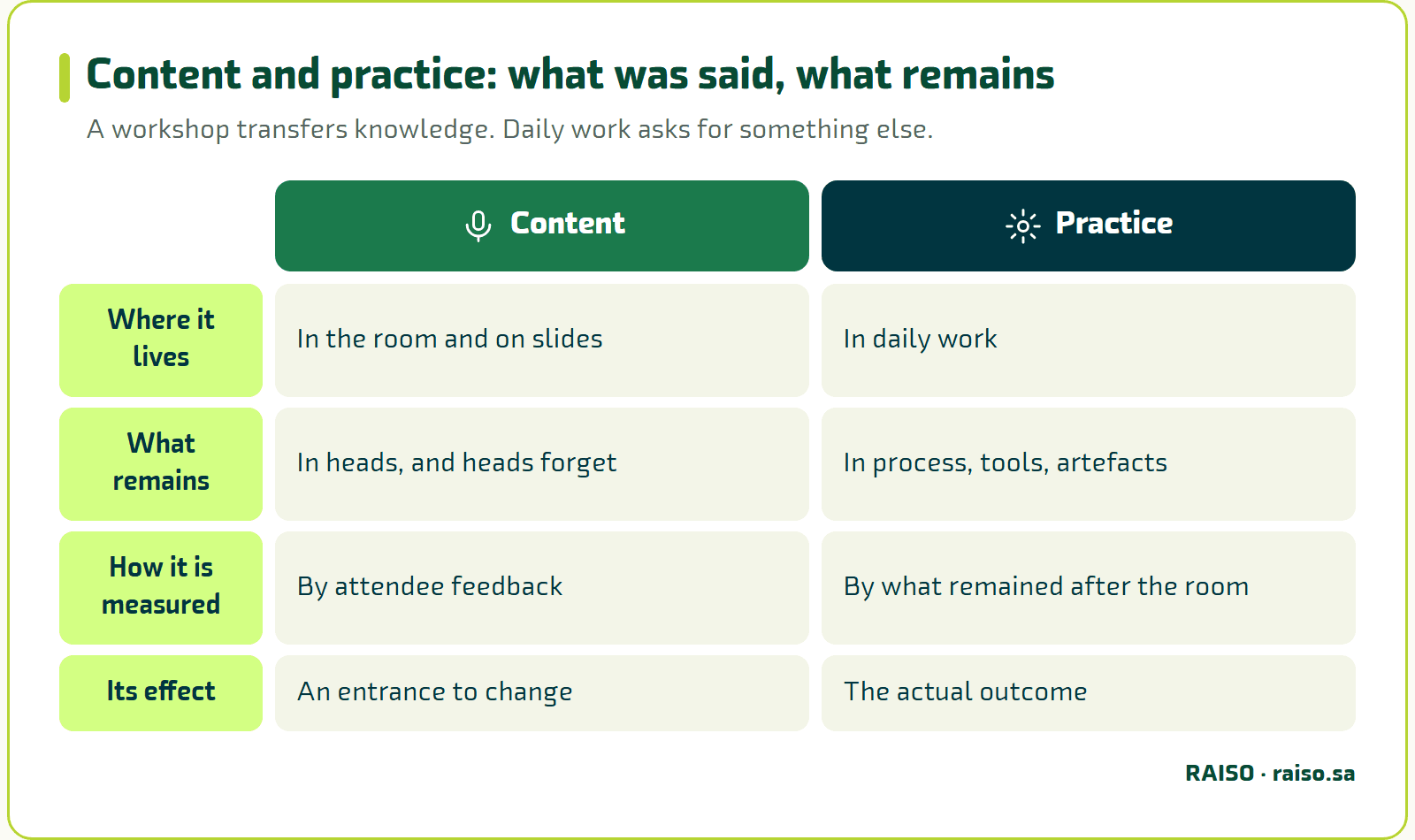
So this article separates two things. **Content** is what is said in the room and written on the slides. **Practice** is what remains in the work after all that is over. Content is only an entrance; practice is the actual outcome. Someone who measures training by what was said will be content with a good feedback score. Someone who measures it by what remained will ask very different questions.
The difference shows up in three simple questions:
- Can a new hire who never attended the workshop work in the new way? If not, the knowledge lives in people, not in the work.
- Is there something in the work environment that reminds the employee of the new behaviour at the moment it is needed? If not, they will forget it.
- Does the manager know exactly what to expect from the team? If not, nobody will follow up, and what is not followed up does not last.
Where the case stands now
Sara sat down with three employees who had attended and asked them the three questions. The answer was no every time. The new hire who joined after the workshop was learning the old way from colleagues. Nothing on the work screen reminded anyone of what they had learned. And the supervisors did not know what they were supposed to notice.
“Write the three questions above and answer them for a programme you ran or attended, one sentence each.”
Practice: seven parts working together
If practice is what remains in the work, what is it made of? It helps to think of it the way we think of any working system: it does not rest on one piece but on connected pieces, and if one is missing the others suffer.
We will list the seven parts and explain each in plain terms as it appears. You will notice that the workshop touched only the first, and that what was missing is the rest of the list.
These are the seven parts:
- Methodology
The way we think about the problem. In Sara's case: a complaint is information about a fault in the service, not an attack on the employee.
- Process
The sequence of steps from a complaint arriving to its closure. Who receives, who analyses, who replies, and when.
- Policy
Decisions made in advance that spare the employee from hesitating: what they may decide themselves and what they escalate.
- Roles
Who is responsible for what. Every step has a named owner, or it becomes everyone's job, which means no one's.
- Tools
The forms, screens and checklists people actually work with, not the ones recommended in theory.
- Artefacts
What proves the practice is happening: the complaint log, response times, examples of good replies.
- Behaviours
What people do when no one is watching. They are the visible result of the other six.
Notice that artefacts differ from tools. A tool helps you do the work; an artefact proves you did it. Many organisations own tools with no artefacts, so they never learn whether the practice is happening at all.
Where the case stands now
Sara drew a table of seven rows and wrote beside each what her organisation had today. Methodology: absent, so each person acted by mood. Process: present on paper but known to no one. Policy: no written decision on how much an employee may give a customer. Roles: vague. Tools: an old form no one used. Artefacts: nothing. Behaviours: inconsistent. She realised the workshop had added awareness only, and that she had to build the other six.
| # | Part | Sara's organisation today | Present and working | Present but ignored | Absent |
|---|---|---|---|---|---|
| 1 | Methodology | Absent: each person acts by mood | |||
| 2 | Process | On paper, but known to no one | |||
| 3 | Policy | No written limit on what an employee may give | |||
| 4 | Roles | Vague | |||
| 5 | Tools | An old form no one uses | |||
| 6 | Artefacts | Nothing | |||
| 7 | Behaviours | Inconsistent |
Mark each part for a training topic in your organisation.
“Draw the same table for a training topic in your organisation and mark each row: present and working, present but ignored, or absent.”
Step one: a single observable behaviour
The problem this step solves is vagueness. Saying we want to improve complaint handling is a fine goal that nobody can check. The employee does not know what is expected tomorrow morning, and the manager does not know what to look for.
The remedy is to choose one small behaviour that another person could see. An observable behaviour is one you can say of it: it happened or it did not. For example: the employee sends an acknowledgement for every complaint within two hours of its arrival. A sentence like that answers many questions at once: who acts, what they do, and when. Checking it needs no judgement.
Why one behaviour and not ten? Because change needs focus. Ask people to change ten things and they will change none. Choose one they find useful and easy, let it succeed, and its success becomes the reason to accept the second.
Test your chosen behaviour with these questions before you adopt it:
- Can I state it in one sentence that begins with a verb?
- Can someone else observe it without asking the employee about feelings or intentions?
- Is it within the employee's authority, so no one waits for permission?
- Does it connect directly to a real problem, here the delay in complaints?
| # | Question | Meets | Partly meets | Does not meet |
|---|---|---|---|---|
| 1 | Can I state it in one sentence that begins with a verb? | |||
| 2 | Can someone else observe it without asking about feelings or intent? | |||
| 3 | Is it within the employee's authority, with no permission needed? | |||
| 4 | Does it connect directly to a real problem? |
Test your chosen behaviour. If it fails any, rewrite it.
Where the case stands now
Sara met the customer service supervisor and, after discussion, they chose a single behaviour: send an acknowledgement for every complaint within two hours, naming the responsible employee and the expected date of reply. Why this one? Because it eases the customer's worry at once, guarantees every complaint has an owner, and is easy to count. They wrote it on one sheet and hung it in front of the team.
“Write one behaviour for a subject you work on and test it with the four questions. If it fails any, rewrite it until it passes.”
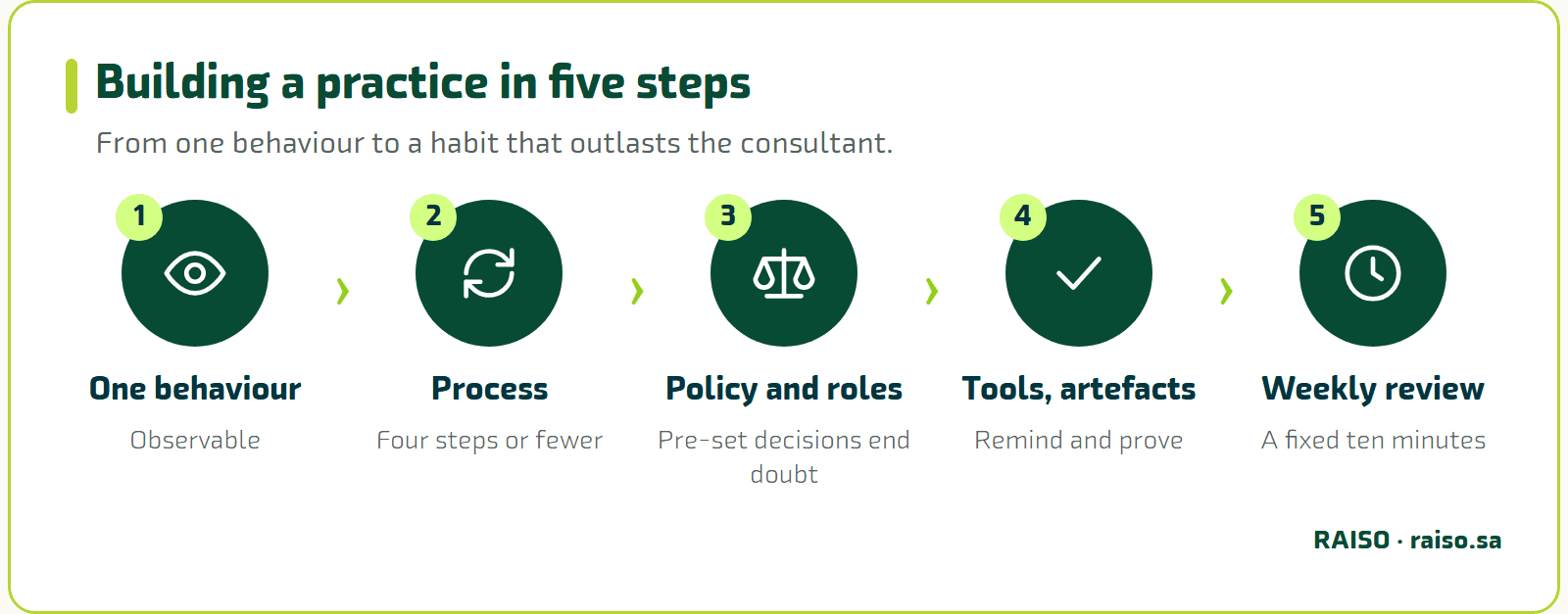
Step two: a simple methodology and a four-step process
The problem here is that a new behaviour stays an orphan if it has no road to travel. The employee knows she must send an acknowledgement, but not where to get the information, to whom to pass the complaint, or what to write in the message.
This is where methodology and process come in. We begin with methodology because it is lighter: a sentence or two that sets the way of thinking. In Sara's case: every complaint is information about a fault, and we handle it quickly and respectfully. This is not a slogan for the wall. It is a yardstick the employee returns to when no text tells them what to do.
Then the process, which is the actual steps. Keep it short, because the fewer the steps the better the chance of being followed. A good process names for each step its owner, its timing and its output.
This is how Sara built the complaint process in four steps:
- Receive
The front-desk employee logs the complaint and sends the acknowledgement within two hours.
- Classify
The supervisor identifies the type of complaint and assigns a responsible employee the same day.
- Resolve
The responsible employee analyses the cause and delivers a solution within three working days.
- Close
The employee calls the customer to confirm satisfaction, then the supervisor closes the complaint and records the lesson learned.
Notice that step four records the lesson learned. This small detail is what lets a practice learn from itself, and we return to it in the last section.
Where the case stands now
The employees now had a clear road. The word complaint no longer meant confusion; it meant four steps in which each of them knew their part. That clarity gave them a sense of safety, because people act with confidence when they know what is asked of them.
“Turn your chosen behaviour into a process of four steps or fewer, and write beside each step: who, what and when.”
Step three: policy and roles settle hesitation
The next problem is hesitation. An employee receives a complaint from an angry customer asking for a small compensation. Does she have the authority to give it? If she does not know, she asks her manager while the customer waits, the manager is busy, and the complaint stalls. This is precisely why complaints are slow in many organisations: not because staff are lazy, but because authority is unclear.
Policy in this setting is not a long document. It is a decision made in advance that answers a recurring question. A good answer often fits in a small table that sets the limits of each level. Roles work the same way: a name for each responsibility, and a deputy for each name when its owner is away.
These are Sara's decisions, written on a single page:
- The customer service employee grants compensation up to a set amount without consulting anyone, and records it in the complaint.
- The supervisor decides beyond that up to a higher ceiling and replies within four working hours.
- Anything above the ceiling goes to the department head with a written recommendation from the supervisor.
- Every employee has a named deputy who takes over their complaints when they are absent.
The amounts here are only an example. What matters is that the decision is now written and known, and that when the employee faces the customer she knows her limits without asking. This is what turns policy from a text that is kept into a tool that is used at the moment of need.
Where the case stands now
In the second week after the page was approved, an angry customer called an employee named Khalid. Khalid heard the problem, saw that the compensation requested was within his authority, granted it, sent the acknowledgement and closed the complaint in an hour. Before the page this took two days and three phone calls.
“Write one recurring decision in your subject where people hesitate today, and state who owns it and what its limits are.”
Step four: tools that remind, artefacts that prove
The problem here is forgetting. People forget, and however clear the decision, it fades after a few weeks unless it is in front of their eyes. A second problem follows: no one knows whether the practice is really happening, so everyone relies on impressions.
The remedy is a small tool that appears at the moment of work and a simple artefact collected without extra effort. The tool might be a six-item checklist on the complaint-logging screen, or a ready template for the acknowledgement that the employee only fills in. The artefact might be a column in the complaint log recording when the acknowledgement was sent, so everyone can see how many complaints received one within two hours.
Start with one tool and one artefact. Too many tools turn a practice into a burden, and burdens get dropped. A sign of a good tool is that the employee feels it saves time rather than adding work.
Where the case stands now
With the technology team, Sara added a field in the complaints system showing the deadline for the acknowledgement beside each new complaint, and prepared a template for its text. The supervisor now had a one-line weekly report: the share of complaints acknowledged on time. In the first week the share was modest, but for the first time it was a number one could talk about.
“Identify one tool that appears at the moment of work and one artefact you can collect without extra effort, and decide who will review it and when.”
Step five: follow the behaviour until it becomes habit
The last problem is that everything may look sound on paper and then slip after two months. That is natural, because old habits are strong. A new behaviour needs someone to notice it, encourage it, and correct its course in the first weeks.
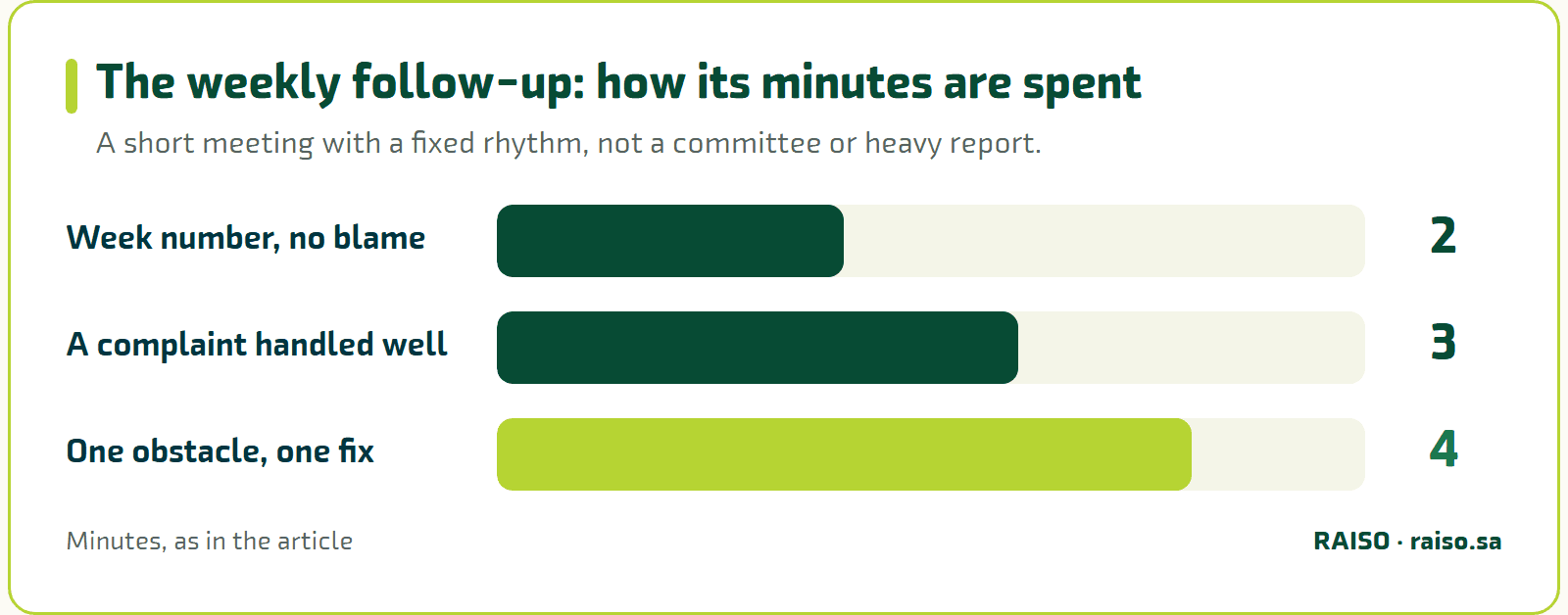
So building a practice needs a short, fixed rhythm of follow-up. We do not mean a committee or a heavy monthly report. We mean a ten-minute meeting each week in which the supervisor shows the week's number and asks two questions: what worked, and what got in our way? The team then leaves with one small adjustment.
This is how behaviours, the seventh part, turn from a goal into a result. When an employee sees a colleague succeeding in the new way and sees the supervisor notice and mention it, the new behaviour becomes the normal one, and going back to the old one is what needs justifying.
Keep the follow-up meeting short and steady in this form:
- The first two minutes: the week's number, without blame.
- The next three minutes: a short story of a complaint handled well, so everyone learns from it.
- The last four minutes: one obstacle and how we remove it this week.
Where the case stands now
After eight weeks of short meetings Sara noticed a quiet change. Employees were sending the acknowledgement without reminders. Some began suggesting improvements to the template. And the sentence once heard in corridors moved from do we need this acknowledgement? to did you send the acknowledgement?
“Put a ten-minute weekly meeting in your calendar to follow the behaviour you chose, and write the first three questions you will ask in it.”
The test of practice: what if the consultant leaves?
How do we know that what we built is a real practice and not a temporary activity driven by one enthusiastic person? There is a simple test: if the first driver disappears, does it continue? The driver might be the trainer who brought the idea, the consultant who helped design it, or Sara herself.
If employees keep sending the acknowledgement, the weekly meeting continues, the weekly number is still collected, and a new hire learns the method from colleagues and from the tool, then it is a practice. If it all stops when one person stops, it was an activity, however successful in its day.
That is why we recommend running the test for real. Ask Sara to skip the weekly meeting for two weeks and then review the numbers. What changed in those two weeks tells you where the fragile part is, and you can strengthen it.
“Real institutional excellence happens when a practice, not a presentation, outlives the consultant's departure.”
Where the case stands now
Six months after the first workshop, and three months into building the practice, Sara was away for two weeks on a long leave. When she returned she found the weekly meeting had carried on under the supervisor, the share was in the log, and a new colleague had joined and begun working the new way without attending any workshop. This was the difference she had been looking for: an organisation that operates differently, not one that talks about what it learned.
“Go back to your answer at the start about the programme you attended. Knowing what you know now, which part was missing? And which step would have moved it from content to practice?”
What you carry with you
To summarise Sara's journey: her workshop did not fail; it was not enough. Content transfers knowledge, and knowledge is a beginning. Excellence needs what comes after: a clear behaviour, a short process, decisions made in advance, tools that remind, artefacts that prove, and follow-up that turns all of it into habit.
This is what you carry with you:
- Practice is what remains in the work after the room empties. It consists of methodology, process, policy, roles, tools, artefacts and behaviours.
- Start with one observable behaviour, not a general goal.
- Build it a short process, settle its decisions in advance, and name their owners.
- Add a reminding tool and a proving artefact, then follow up weekly in a short rhythm.
- Test the result by asking: if the first driver left, would it continue?
Our invitation to you is practical. Pick a training programme or improvement initiative in your organisation, draw the seven-part table for it, choose the first missing row, and start on it this week. And if you want to learn to build practice step by step, with experts alongside you on your real case, explore RAISO's practice pathway and begin where the content ended.