



The Process That Cannot See Outside: PESTEL and Operations
Lama spent a full year improving her process. She cut delivery time, reduced hand-offs between teams, and redrew the driver’s route from the warehouse to the customer’s door. At year end she sat down with her dashboard, reassured: every internal number was better than before. Then three messages reached her in a single week, none of them connected to any metric she tracked: a new regulatory circular, a jump in fuel costs, and complaints from customers who wanted evening delivery. The process she had worked so hard to build had not broken. It had simply started serving a world that no longer existed.
In this article we follow Lama step by step. We will see how an inward focus leads to fragile processes, what a PESTEL analysis is, and how it can move from a document in a drawer to an early-warning system. You will leave with three simple tools: a register of environmental assumptions attached to every process, a link between performance indicators and outside signals, and a light quarterly review with a clear owner. Each step ends with a short exercise to try on a real process in your own organisation.
“Lama, her process and the figures in this article are a hypothetical case written for illustration only. They do not refer to any real organisation.”
Lama improves her process from the inside
Lama is an operations manager at an imaginary parcel delivery company. She owns one process, which we will call door-to-door delivery. It starts when a parcel leaves the warehouse and ends when the recipient takes it and the handover is recorded. At the start of the year she defined the problem clearly: average delivery took two days, and she wanted one.
She worked the way professionals do. She drew the process on a large board, counted the hand-offs between teams, and found where parcels sat waiting. She merged two steps, removed a signature that changed nothing, and redistributed zones among drivers so that fewer trips ran empty. Six months later delivery time had dropped noticeably, and her team applauded.
Everything Lama did was correct and necessary. But notice one thing: every question she asked sat inside the company walls. How many steps do we have? How long do we wait? What do we spend? She never asked: what is changing outside the company that could change the shape of this process? Without saying so even to herself, she assumed the world around her process would stay as it was.
Then came the three weeks. A regulatory circular required customer consent before photographing proof of delivery and storing the customer’s location, and her drivers had been photographing every parcel for months. Fuel costs rose, so the policy of a free second attempt began to drain the margin. And many customers began complaining because the driver arrived during working hours, when nobody was home. Lama’s process was not poor. It was brilliantly designed for a world that had moved on.
Where the case stands now: Lama knows that internal improvement alone is not enough, but she does not know where to start. The next sections answer that, and we will return to her board in each one to see what changes.
“Write down three things outside your organisation that changed last year and affected a process you know well. If you cannot find any, that is a finding in itself.”
Why do we not see the outside?
Had you asked Lama before those weeks which risks she watched, she would have named vehicle breakdowns, absent drivers, address errors and warehouse delays. All of them are internal or close to it, within sight and measured by a clear indicator. What was happening outside the company was not on her list at all.
The reason is not negligence but a very human tendency. What we control, we see, measure and improve. What we do not control seems distant, abstract and pointless, so we postpone it. And once the mind postpones something it believes it cannot change, it stops seeing it altogether.
The irony is that external risks are often the deepest in impact. An address error costs one parcel. One regulatory circular changes how the whole route works, and a rise in fuel prices changes the arithmetic of every trip. The effect is not marginal, fixable with a small tweak. It is structural, and it reaches the design of the process itself.
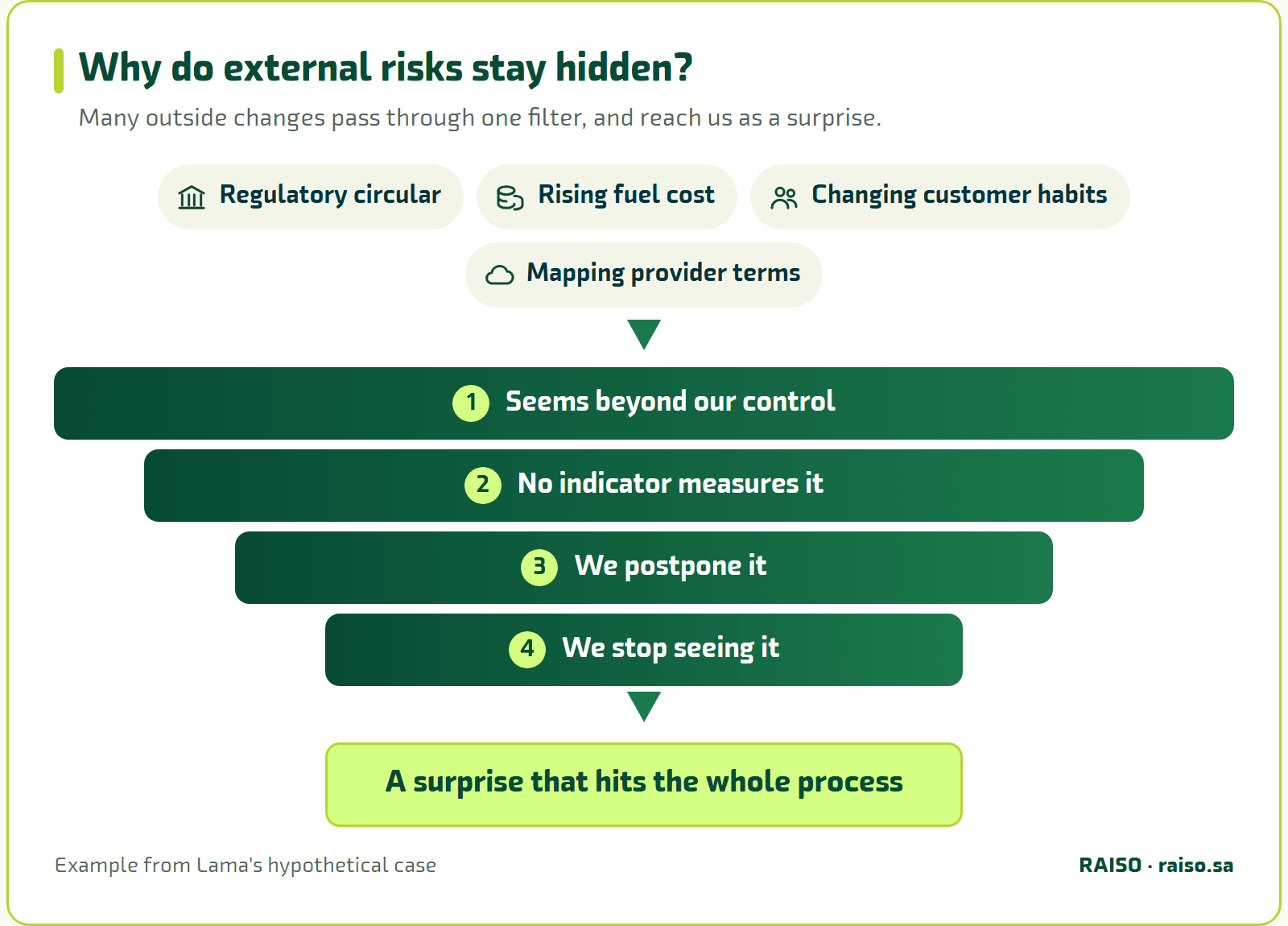
Nobody is asked to predict the future, because nobody can. What is needed is to pick up early signals before they become a crisis. The difference between an organisation that is surprised and one that is prepared is not that the second can read the future. It is that the second has a regular habit of looking outward.
“External risks go unmanaged because they seem beyond control, and that is exactly why they grow in the shadows until they surprise.”
Where the case stands now: Lama realised that the outside was missing from her risk list for a reason. She had not forbidden herself to look, but nothing in her work pushed her to look. She needs a tool that forces the question before she designs, not after she is surprised.
PESTEL: six questions about the world outside the door
The tool Lama needs is called PESTEL, an acronym for six words: Political, Economic, Social, Technological, Environmental and Legal. It is simply an organised list of six questions that pushes you to look in six directions beyond your own walls, so that you do not examine one and forget the rest.
PESTEL is usually known as a strategic planning tool. In operations, however, it is closer to the ground than it looks, because each dimension is a specific source of operational risk whose effect can be traced to steps in the process. Let us translate it into Lama’s language.
| Dimension | The question we ask | Example of change | What it touches |
|---|---|---|---|
| Political | Which government decision changes who may deliver? | Vehicle licensing or drivers' hours | Driver scheduling |
| Economic | What is changing in cost and demand? | Rising fuel cost | The free second attempt policy |
| Social | How are customer habits changing? | Customers away from home all day | Delivery window |
| Technological | Which new tool changes what is possible? | Lockers; new mapping terms | Route planning |
| Environmental | Which vehicle or emission limits apply? | Heavy trucks barred from city centres | Choice of vehicles |
| Legal | Which legal limits can we not cross? | A data protection circular | Photographing proof of delivery |
One question per dimension, an example of change, and the part of the process it touches.
The six dimensions as they appear in the delivery process:
- Political: government decisions that regulate delivery activity, vehicle licensing or drivers’ working hours. A single decision can change who may deliver and when.
- Economic: fuel costs, driver wages and the strength of demand. A process built in a boom may not survive a slowdown. A free second attempt, for example, is a policy with a price that moves.
- Social: changing customer habits and expectations. Someone who works away from home all day gains nothing from a fast morning service. They need an evening slot or a nearby pickup point.
- Technological: new tools that change what is possible, such as self-service lockers, more accurate maps, or changes in the terms of the mapping service the routing system depends on.
- Environmental: limits on heavy trucks entering city centres at certain hours, or emissions requirements that change which vehicles are allowed.
- Legal: personal data protection rules, limits on liability for lost parcels, and driver contracting terms. These are boundaries that no amount of speed can cross.
Notice that the dimensions do not work in isolation. Rising fuel prices (economic) push towards pickup points (technological and social), and a data protection circular (legal) changes how proof of delivery is captured (technological). Reading PESTEL is therefore not filling six separate boxes. It is understanding a network of forces pressing on the process from several directions at once.
In the Saudi context these forces move quickly. Successive regulatory updates, the large economic shifts tied to Vision 2030, and changing public expectations of service mean that the political and legal dimensions alone can reshape a whole sector’s processes within months. Those who read them regularly move with the wave, and those who ignore them chase it late.
Where the case stands now: Lama sat with two colleagues for one hour and answered six questions, one per dimension. What is changing in this area that could touch door-to-door delivery? She came out with a list of eleven items, some certain and some only possible. For the first time she saw that the three surprising weeks had all been on the list, had the questions been asked earlier.
“Pick one process from your work and draw a table of six cells labelled with the PESTEL dimensions. In each, write one change that is happening or expected, and a question mark: do our processes know about this? It need not be exact. The aim is to start looking.”
From an annual exercise to an early-warning system
Lama asked a colleague in strategy: have we not done a PESTEL before? He smiled and said it is done every year at the planning session. The managers meet for a full day, fill in the list of factors, attach the list to the plan, and forget it until the next session.
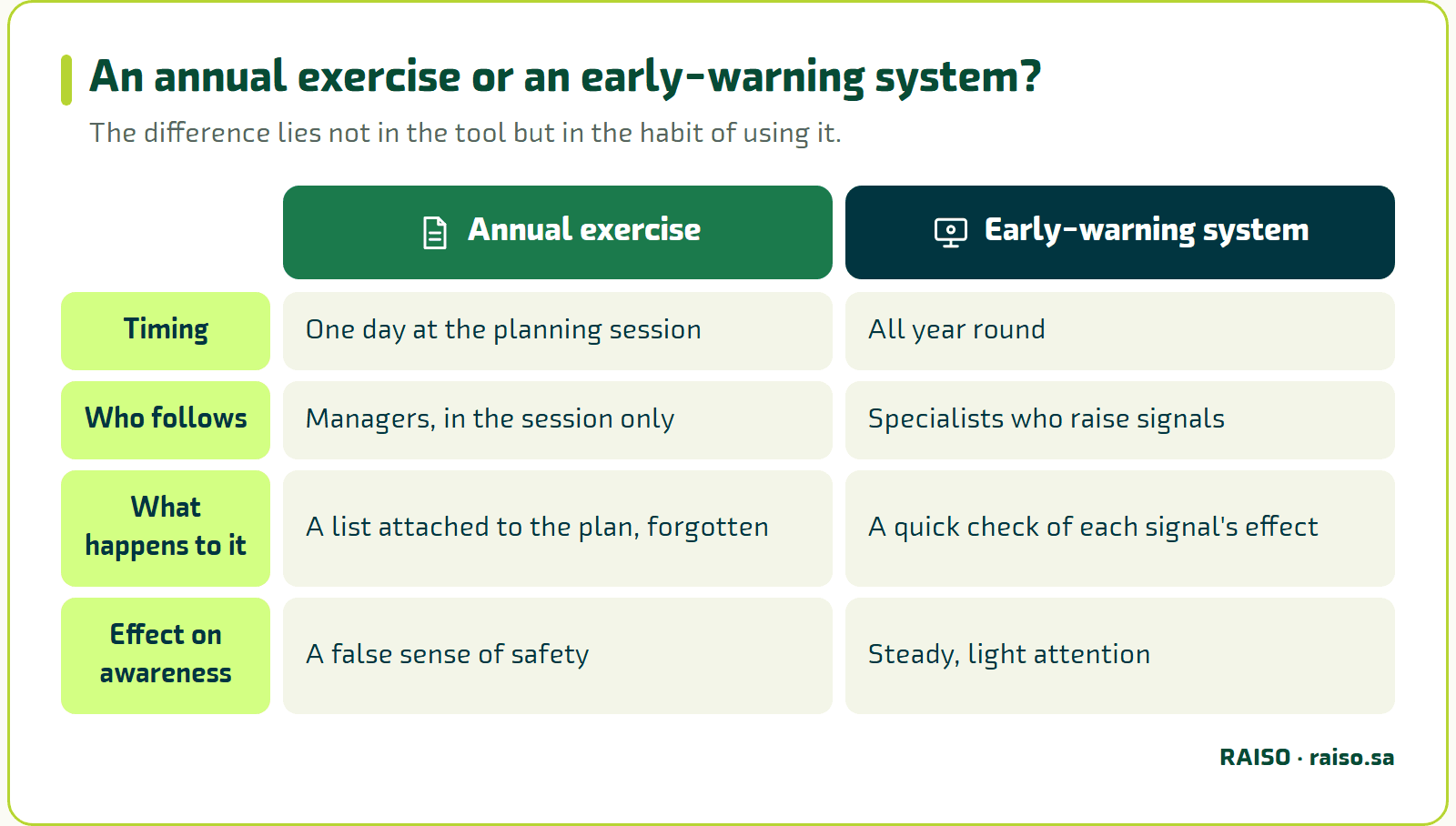
This is the seasonal trap. A seasonal analysis gives you seasonal awareness. The map drawn in January may have been accurate that day, but by June it no longer matches reality. External risks do not follow our meeting calendar. They appear all year, while our attention to them is confined to a single week.
Worse, the annual exercise gives a false sense of safety. We tell ourselves we have done our duty towards the outside, and relax our vigilance for the rest of the year. The analysis turns from a tool of awareness into a sedative, which is sometimes worse than never doing it at all.
The answer is not a daily analysis that exhausts people and cannot be sustained. The answer is a light system running in the background: specialists raise a signal when they notice movement in any dimension, and the signal goes into a quick assessment of its effect on existing or planned processes. We want continuous monitoring at low cost, not a huge analysis done rarely. That is what we mean by an early-warning system.
Why does this matter more in operations than in strategy? Because a strategic mistake costs a season, while an operational mistake costs every day: in every parcel, every customer and every working hour. A process pays for its wrong assumptions daily.
Where the case stands now: Lama decided not to wait for the annual session. She opened a single sheet called the external signals map, with six rows, one per dimension, and under each the sources she follows: regulatory circulars, fuel prices, customer complaints, announcements from service providers. She did not build a complex system, only a sheet that gets reviewed and updated.
“List three sources you could follow regularly without much effort, such as a regulator’s bulletin, a market report or a complaints log. Then decide who will follow each one.”
Step one: write down the assumptions your process is built on
The problem facing most organisations is not that they never run a PESTEL analysis. Some run it very well. The problem is that its results never reach the table where processes are designed. The analysis stays in an elegant document, and the process designer goes to work without reading it. This is a silent gap, and we will call it the missing link.
| Dimension | We assume that… | We review the process if… |
|---|---|---|
| Economic | Trip costs stay within a known range | Fuel costs pass an agreed limit |
| Legal | Photographing proof of delivery needs no prior consent | Any data protection circular is issued |
| Social | Most customers are home in the morning | Timing complaints pass an agreed limit |
Each item is one sentence: we assume X, and review the process if X changes.
The first bridge is very simple: written assumptions. Every process was designed assuming things about the world, whether stated or not. Lama’s process assumed fuel at a certain price, customers at home during the day, and that photographing proof of delivery needs no permission. The trouble was that these assumptions lived in her head alone, and nobody knew one of them had fallen.
So we add a small section to every process design document titled environmental assumptions. Each item is one plain sentence: we assume that X, and we will review the process if X changes. When assumptions are written, it becomes easy later to know which one fell and which process must be reviewed because of it.
An example from Lama’s register, reduced to three items:
- An economic assumption
We assume trip costs stay within a known range, so we offer a free second attempt. If fuel costs pass a limit we agreed, we review the policy.
- A legal assumption
We assume photographing proof of delivery is allowed without prior consent. We review the process as soon as any data protection circular is issued.
- A social assumption
We assume most customers are home in the morning. We review the delivery window if complaints about timing rise past an agreed limit.
Where the case stands now: Lama added the section to her process document and wrote nine assumptions. While writing she found two more for which she had no evidence at all, and that alone was a gain: she now knew where she was standing on uncertain ground.
“Take a process you work on and write five assumptions about the outside world it was built on. Next to each, one question: what, if it changed, would make me think again?”
Step two: link signals to performance indicators
Written assumptions are good, but they remain paper unless something wakes them. We need a second bridge between what happens outside and what we measure inside. The idea is to take each core performance indicator and ask which outside variable affects it, then decide in advance what we will do if that variable moves.
Lama’s most important indicator is the share of parcels delivered on the first attempt. What affects it from outside is when the customer is at home, which belongs to the social dimension. So she linked it to a simple variable: the number of complaints mentioning delivery timing. And she decided in advance that if those complaints rise above a set level, the team trials an evening delivery window in one zone before rolling it out.
The strength of this link is that it moves monitoring from individual vigilance into the measurement system. The matter no longer depends on a colleague noticing a change. Detecting change becomes part of the dashboard itself, and the response becomes a known action instead of a discussion that starts from zero.
There is another half to this bridge: flexibility in the design. If you know a certain assumption may fall, design the process so that the affected part can be adjusted without tearing down the rest. Lama made the delivery window adjustable through one setting in the dispatch system, instead of being built into every route. Flexibility here is an engineering decision taken at design time, not a patch applied later.
Where the case stands now: for each core indicator Lama now has an outside variable, a threshold and an action. When complaints rose two months later she did not call an emergency meeting. She opened the action sheet and began the trial in one zone.
“Take one indicator you depend on. Write the strongest outside variable affecting it, the threshold that would worry you, and the first action you would take if it were crossed.”
Step three: name an owner and hold a light quarterly review
Any system without an owner stops. If watching the outside is everyone’s job, it is in practice nobody’s, because each person assumes a colleague is following. So a clear role is needed: someone responsible for following outside signals and translating them into the language of the operations team. It need not be a full-time job, but it must be a specific name that does not evaporate between departments.
Alongside the owner, a regular review is required. Not a heavy annual session, but a short quarterly one, an hour every three months, answering only three questions. What changed in any of the six dimensions? Has any assumption in our register fallen? Does an existing process need adjusting because of it? A light review often beats a huge one rarely held.
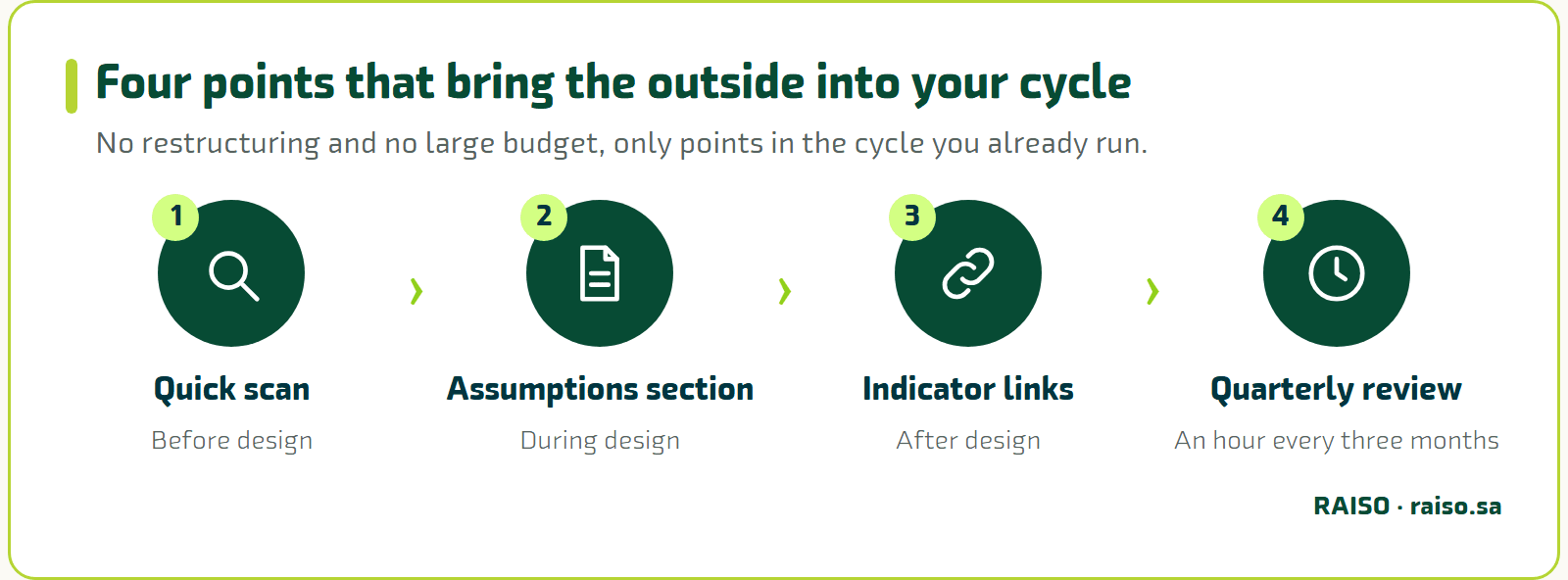
The good news is that this model asks for no restructuring and no large budget. It brings the outside into four specific points of the improvement cycle you already run: before design with a quick scan of the most relevant dimensions, during design with the assumptions section, after design with the indicator links, and then the quarterly review. Four points are enough to move a process from closed to attentive.
The first time, you need not scan all six dimensions in equal depth. Choose the ones that affect your process most and go deep enough on them. Lama’s delivery process is influenced by the economic, social and legal dimensions more than the political, so she began there.
Where the case stands now: Lama named Anas, an operations analyst, as owner of external signals for five hours a week, and booked a fixed quarterly review in the calendar. In the first review a new signal appeared: the mapping provider had announced a change in its terms of use. The company dealt with it before it became a problem.
“Name one person as owner of external signals for your process, and put the date of the first quarterly review in the calendar now.”
Two traps to avoid
Before we go on, a short warning. There are two mistakes that enthusiastic beginners make, and both rob the system of its value.
The first is excess: letting the light system become a giant project needing a team, dashboards and reports. People tire of it and abandon it within months. If the system cannot be sustained on a few hours a week, it is heavier than it should be.
The second is confusing a signal with a forecast. Nobody is asked to say exactly what will happen. It is enough to say: we noticed movement here, its likely effect on the process is this, and we need to watch it or act. Whoever turns every signal into a firm prediction loses credibility at the first miss.
Where the case stands now: Lama remembered both warnings when a manager asked her for fifty external indicators on a single dashboard. She agreed with him on twelve only, and on calling a signal a signal rather than a forecast in every report.
From reacting to anticipating
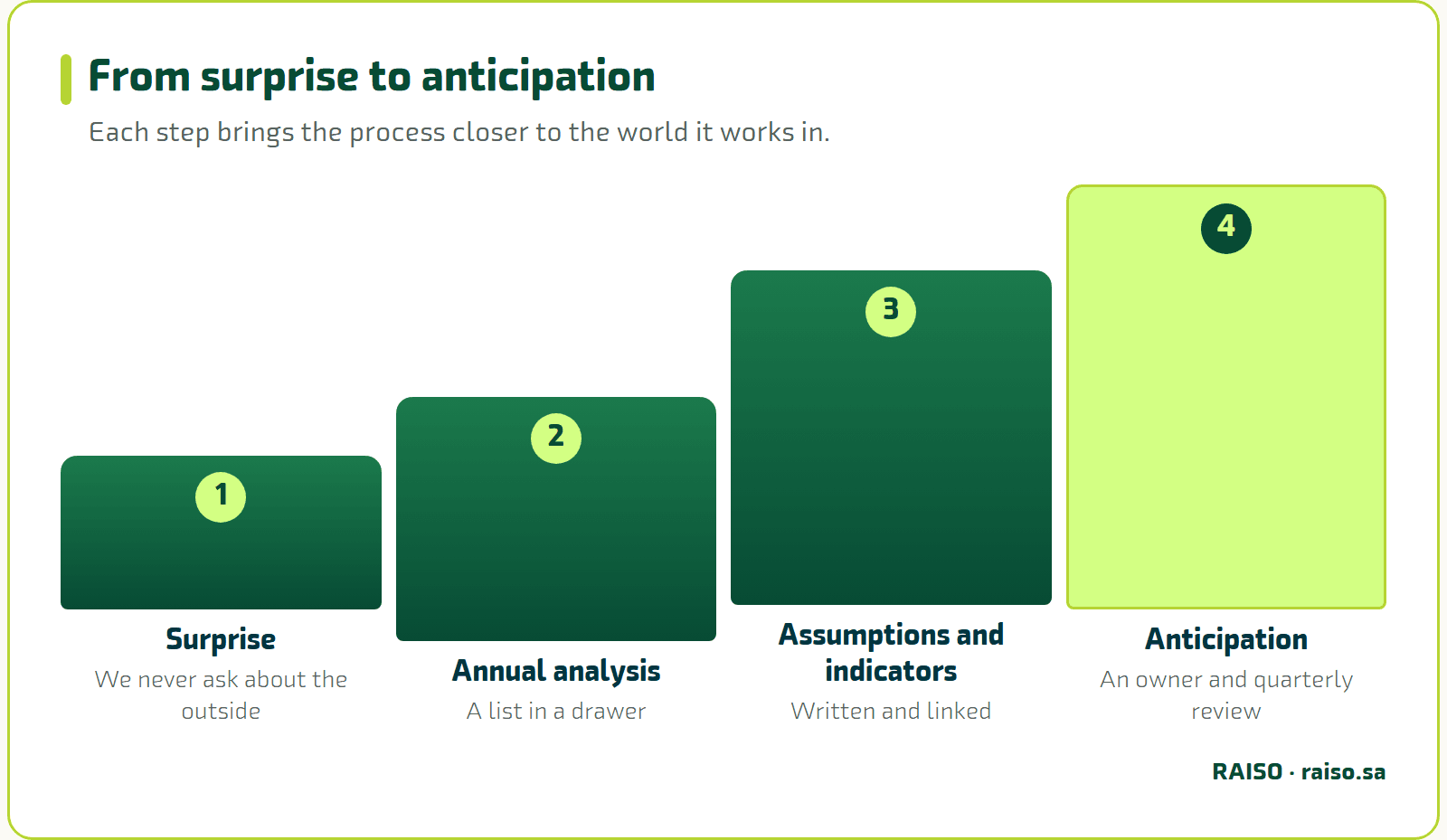
Three months into this approach, something changed in how Lama’s team thought. What has changed outside since we last designed this process? became the first question in every improvement meeting. It was no longer a strange question asked out of politeness but a normal opening.
Here the difference between a reacting organisation and an anticipating one shows. The first waits until change becomes an urgent necessity and pays double for the delay: an expensive quick fix and an angry customer. The second moves while the change is still young, so the cost of adapting is small. The difference is not size or resources but the structure of information about the outside.
And once this attention becomes a collective habit, the picture of operational maturity changes. Maturity is no longer having a fast process today, but staying effective when the world changes. Lama’s process is not more complicated than before, but it is more aware of its surroundings. That is what makes it more resilient.
Where the case stands now: when a new circular on location data was issued in the fourth quarter, Lama had already read its draft in a source she follows, added an item to the assumptions register, and trialled the consent step with a small group of customers. The official circular arrived and her process was ready. She was not smarter than others. She was looking.
Compare this with what happened to her at the start of the story. Nearly the same process, the same kind of surprise, but this time the question was asked early. That is the meaning of anticipation: the news reaches you after you have begun preparing.
“Before we improve how we work, let us first understand which world we work in.”
What you carry with you
We began this article with Lama admiring excellent indicators in a world that had changed. We end with Lama asking about the outside before every decision. She did not add much work. She added a different order: ask about the world first, then improve.
The ideas we hope you take with you:
- Efficiency alone is not enough
A fast, polished process may be designed for a world that has moved on. Awareness of the surroundings is part of a process’s quality.
- PESTEL is a filter, not a document
Six questions on the political, economic, social, technological, environmental and legal, through which every process passes before it is designed or developed.
- Assumptions must be written
An environmental assumptions section in every design document makes the fall of an assumption visible.
- Link the signal to the indicator
Each core indicator has an outside variable, a threshold and a pre-agreed action.
- Owner and review
One name responsible for signals, and a light quarterly review. This is what keeps the system alive.
The next step is simple: choose one process you work on now, and open a sheet with six rows and three assumptions. If you want to practise these tools with specialists and on cases from your own sector, we recommend RAISO’s process development and environmental analysis courses, where we build the assumptions register and signals map with you for a real process from your organisation, not a hypothetical one. A process that sees the outside always develops in the right direction, because it looks at the horizon before turning the wheel.