



AI vs. Traditional Automation
On an ordinary morning, Nada opens the procurement system and finds fifty reminder messages sent automatically to suppliers. The system works exactly as designed: if three days pass with no reply, a message goes out. But among those fifty is a supplier Nada knows is on a public holiday, another who replied by phone yesterday and was never logged, and a third whose contract ends next week and whom nobody cares to chase. The system knows none of this. It executes the rule with great precision, but it does not understand.
This article follows Nada as she discovers the difference between automation that executes and artificial intelligence that understands and recommends. You will leave with five things: a clear definition of the limits of traditional automation, a five-stage model for understanding an intelligent process, a rule that stops you speeding up a broken process, a principle that keeps humans in charge rather than in the machinery, and a list of eight pillars to test your process’s readiness. Each section ends with a short exercise to apply to a real process of yours.
“Nada, the suppliers and every detail in this article form a hypothetical case for illustration only. They do not refer to any real organisation.”
Nada and the rule that does not understand
Nada is a procurement supervisor at an imaginary company supplying office and technology equipment. For years her company has relied on an automated system: it opens a request, sends it to three suppliers, reminds them, collects the quotes into a table and forwards it to her manager. Nobody denies its value. It turned paper into digital records, ended lost requests, and made sure reminders always go out on time.
But in recent months Nada noticed that her time was not shrinking. The table the system produces needs two hours from her each time just to make sense of it. Why did one supplier quote so low? Are the warranty terms different? Which supplier delivered late last time? The system finished the collecting but not the understanding. The understanding stayed with her.
Where the case stands now: Nada is not complaining about a lack of automation. She is complaining that automation reaches a point and stops. And that point is exactly where the hard work begins. The next section explains why.
“Pick an automated process in your organisation and ask the person who runs it: where do you have to step in every time because the system does not understand? Write down three places.”
Where does traditional automation stop?
Traditional automation runs on a simple, strict logic: if condition A is met, perform action B. This works superbly in stable settings where inputs are known and paths are fixed in advance. Real business processes are not like that. They contain exceptions, missing information and human contexts that do not fit inside condition A.
Nada’s system sends the reminder on time, but it does not know the supplier is on leave. It sorts the quotes by price, but it does not learn that the cheapest supplier was late on the last three deals. It acts fast, but it cannot foresee that a particular supplier will back out because its stock is running low. The gap is not in speed or accuracy. The gap is in perception.
This is not an execution flaw that an update can fix. It is a limit of philosophy. Traditional automation tells the machine: do. An intelligent process tells it: understand, then recommend. The difference is not one of degree but of kind. We do not want a machine that is faster at carrying out what we dictate. We want one that shares in deciding what should be done.
In an environment where markets swing, data is scattered and customer expectations climb, this limit stops being an operational nuisance and becomes a strategic gap. And there is a greater danger worth naming early: if the process is flawed to begin with, automation alone speeds up the flaw. Whoever accelerates a broken process does not fix it. They multiply the effect of the break and raise its cost.
Where the case stands now: Nada understood that her problem is not her current system but that it stops at the border between execution and understanding. So she began asking what could cross that border.
The cognitive layer: what does AI actually add?
AI does not replace automation. It adds a new layer on top, which we call the cognitive layer. Automation stays underneath, executing with speed and consistency, and above it sits a layer that interprets context, learns from experience and recommends the decision. It does not cancel what automation does well. It gives automation eyes to see and a mind to weigh.
The essential difference lies on three axes. The first is handling ambiguity. When traditional automation meets a case it did not expect, it stalls or errs. The cognitive layer classifies the case, estimates how ambiguous it is, and proposes the best available path. Imagine a supplier’s quote arriving in a different format from the usual: automation rejects it, while the cognitive layer reads it and puts it in its place.
The second axis is learning from data. Traditional automation repeats the same rule with the same result however often it runs. The cognitive layer watches the outcomes of its earlier decisions and adjusts its weights. If a supplier is late on three deals in a row, the system learns to raise the likelihood of delay on the fourth.
The third axis is predicting instead of reacting. Traditional automation responds to an event after it happens. The cognitive layer tries to spot its precursors: stock approaching zero, a supplier contract about to expire, the price of a material moving in the market. These are signals that come before the need, and whoever catches them prepares before being asked.
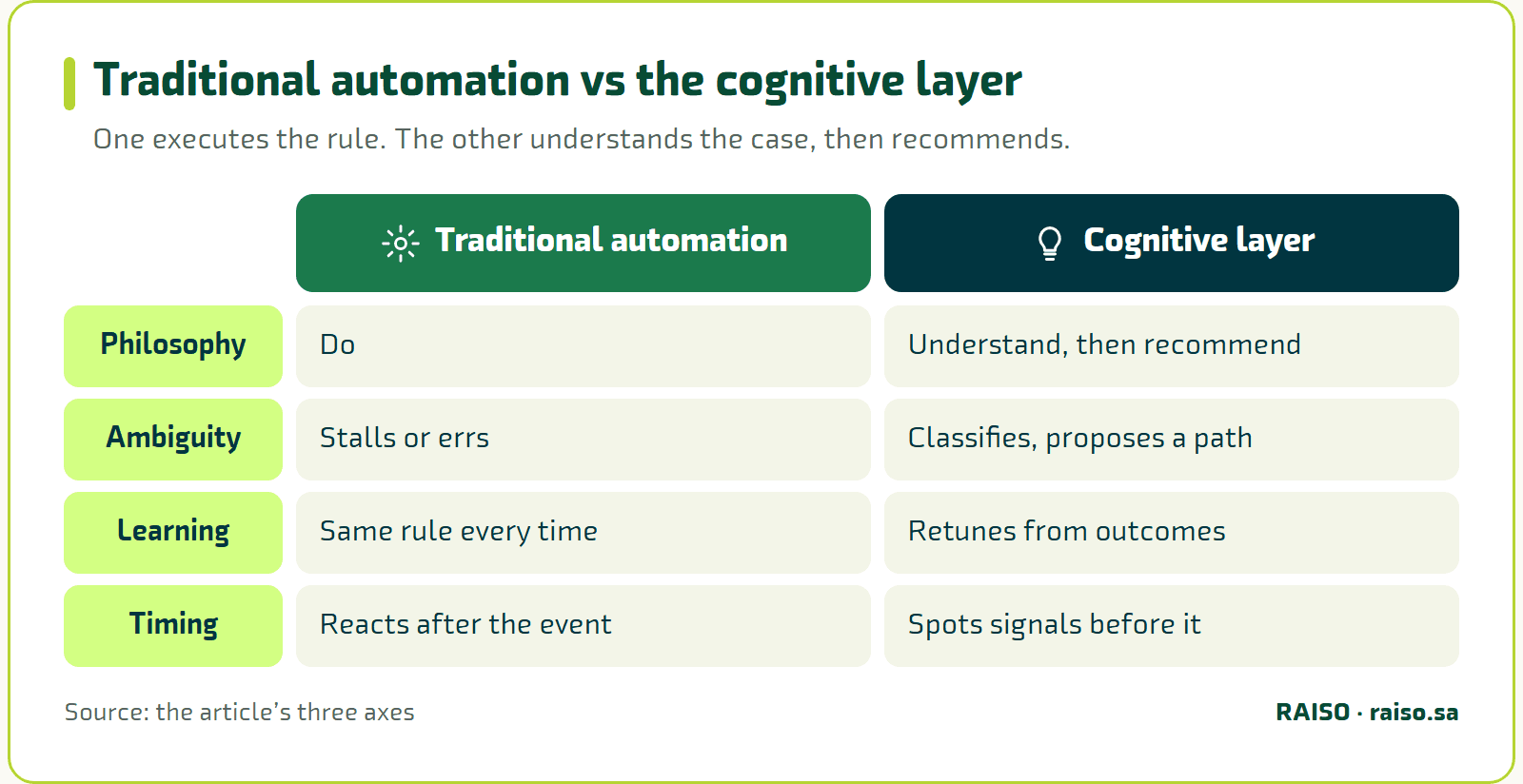
“Traditional automation tells the machine “do”. An intelligent process tells it “understand, then decide”.”
Where the case stands now: Nada drew a table with two columns. In the first, what her system does well today: sending, collecting, reminding. In the second, what she wishes it did: suggest who is the best fit, warn her when a quote looks illogical, predict delays. The second column is the cognitive layer.
“Draw a two-column table for a process of yours: what does automation do well now? And what still needs human understanding every time?”
The five-stage model: how an intelligent process works
To understand the intelligent process as a complete system, we use a model of five connected stages. Its value lies not in the stages individually but in the loop: each stage feeds the next, and the last returns to improve the first. It is a life cycle, not a straight line.
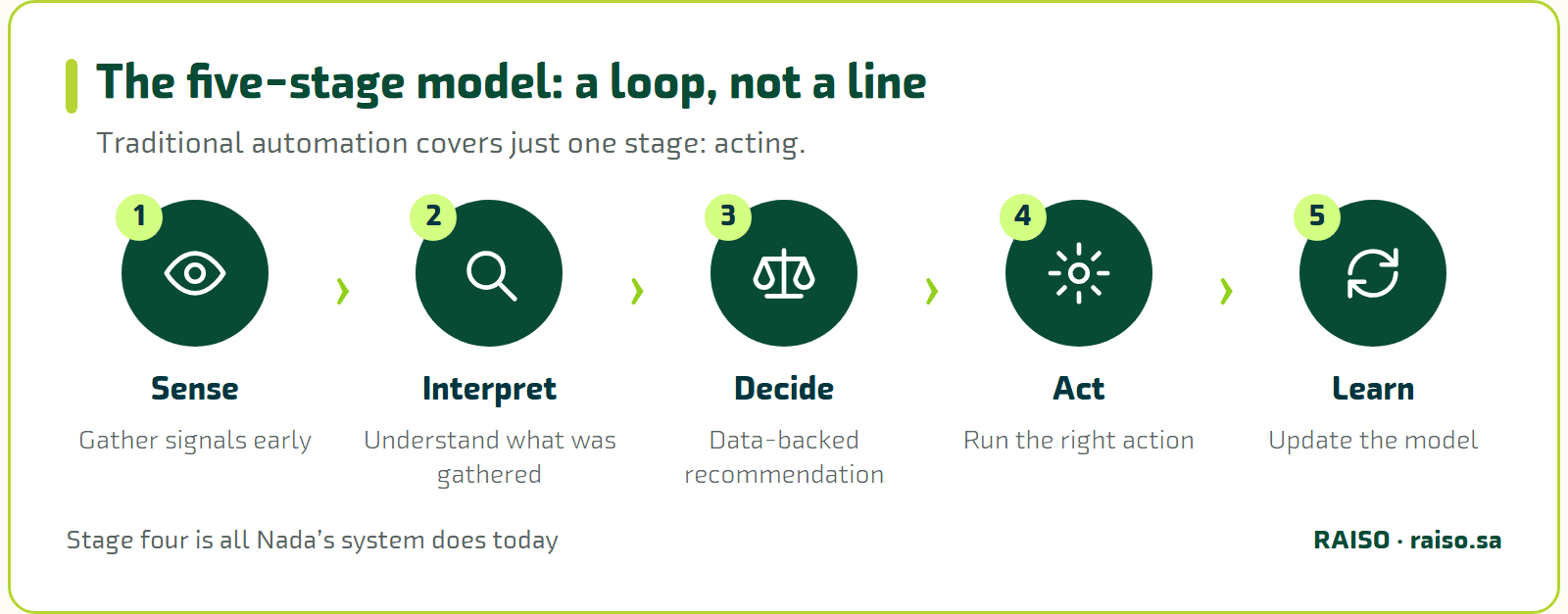
The five stages, applied to Nada’s purchasing process:
- Sense
Gather signals from their sources: stock data, consumption reports, and supplier contracts nearing their end. The system does not wait for the request. It picks up the need while it is still forming.
- Interpret
Analyse what was gathered and extract its meaning. Not just reading numbers, but understanding that this item is consumed faster at quarter end, and that this supplier is slow in peak seasons.
- Decide
Produce a data-backed recommendation or forecast: which supplier, what quantity, when. This stage does not replace human judgement. It feeds it with sharper information.
- Act
Run the right action. It may be fully automatic for a small decision, or with human review for a large one, depending on its impact.
- Learn
Record the outcome and update the model. Did the shipment arrive on time? Did quality match the promise? This stage is what makes the process improve with every transaction instead of staying as it is.
Read the five stages again and notice one thing: what traditional automation offers is only the fourth stage, acting. AI does not add a single new stage so much as fill in what surrounds it: before action, the sensing, interpreting and deciding; after action, the learning. That is how an organisation moves from executing to learning.
Where the case stands now: Nada drew a simple mark under the five stages for what already exists in her system: acting, and some sensing. Interpreting, deciding and learning all sat on her shoulders alone.
“Take one process and write beside each of the five stages: who performs it now? A machine, a person, or nobody? You may be surprised how many stages have no owner.”
Before the intelligence: redesign the process
At this point Nada gets excited. She proposes to her manager that they buy an AI tool to sit on top of the current system. Before he agrees, the manager asks for something unexpected: that she draw the current process as it actually runs, from the moment a need is spotted to the moment the supply is received.
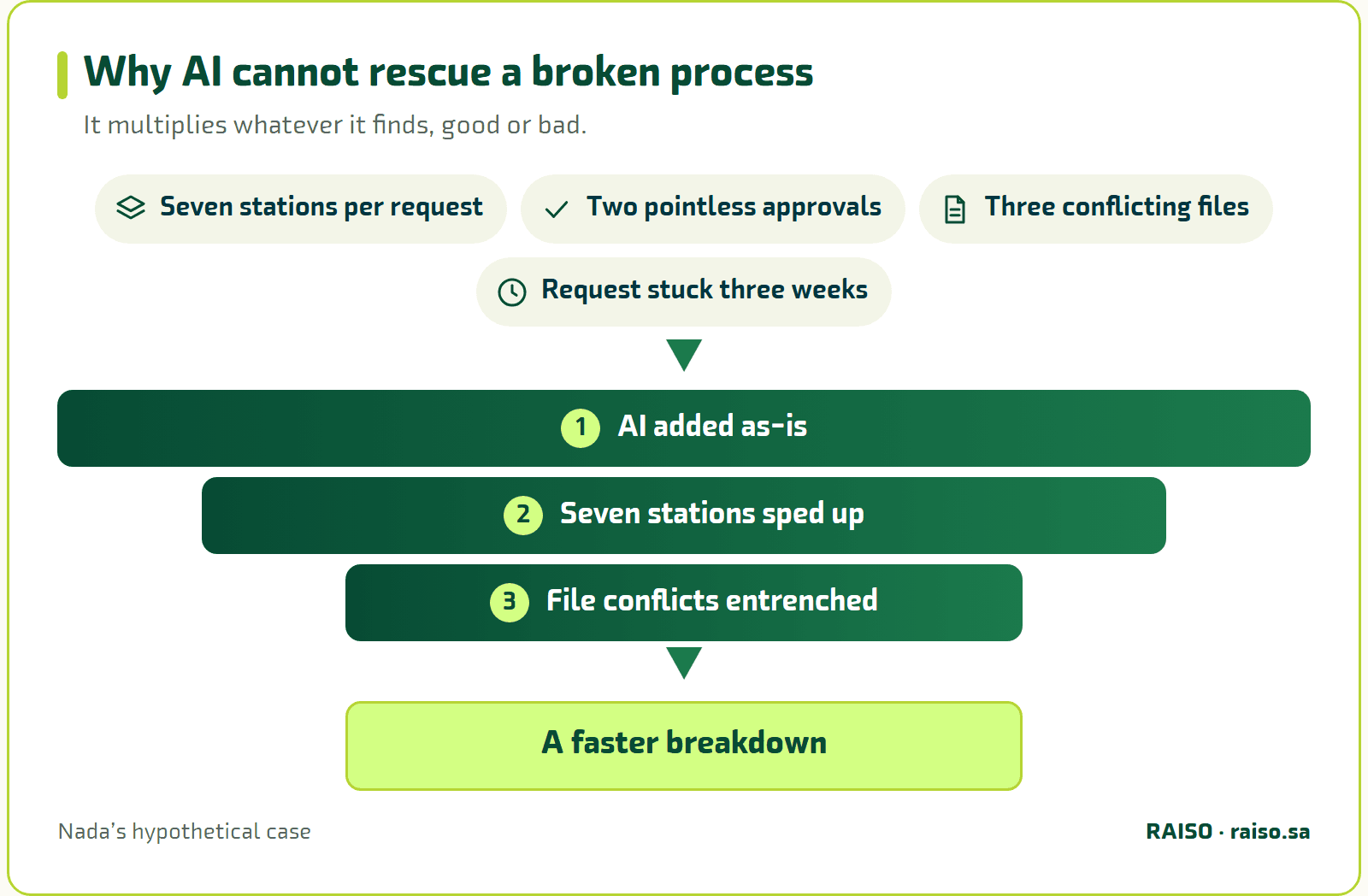
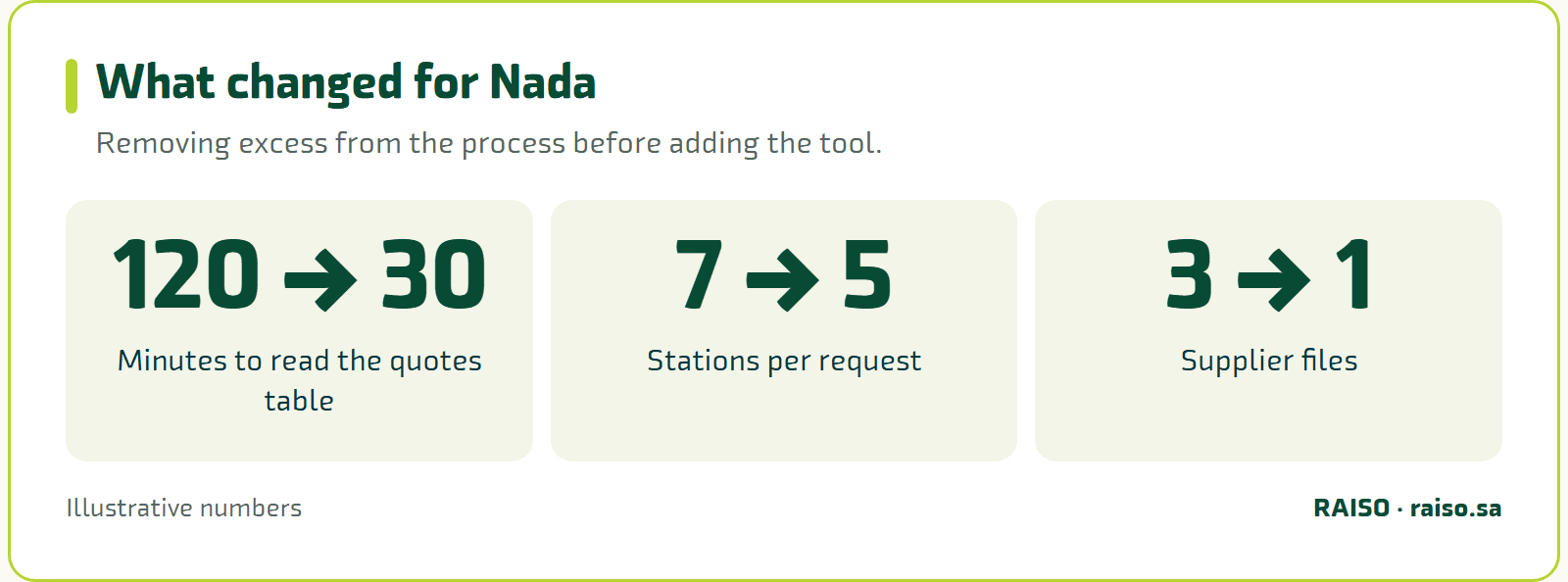
When she drew it she found things she had never seen. A single request passes through seven stations, two of them approvals that change nothing. Supplier data is spread across three files whose names do not match. And the oldest pending request is three weeks old because nobody knew it was stuck. Had AI been added to this process as it stood, it would have sped up the seven stations and entrenched the file conflicts.
This is the most important rule in this article: AI does not fix bad processes. It accelerates their breakdown. It cannot tell a healthy process from a sick one, so it multiplies whatever it finds, good or bad. Many initiatives start from the technology and then search for a problem, when the right order is to start from the process and then call on technology to serve it.
This explains why so many fall into what we call the over-optimism trap. They put intelligence on a process nobody reviewed, see some early improvement, and celebrate the technology while the original defect stands. Money is spent and the root of the problem is left untreated.
There is a close cousin, the data trap. AI feeds on data, and if the data is incomplete, biased or contradictory it produces biased decisions faster and with more confidence than one human could. That is more dangerous than human error, because a wrong decision arrives with the prestige of the machine and nobody dares question it.
Where the case stands now: Nada postponed buying the tool by two weeks and worked with her team on three things. She removed the two approvals that changed nothing, merged the supplier files into one register with consistent names, and began counting pending requests and their ages. When she returned to the tool, the process was ready to receive intelligence rather than be broken by it.
“Before you think of any AI tool, draw the process as it runs now, and circle every step you would not defend in front of a customer. Those go first.”
The human in charge, not in the machinery
A colleague of Nada’s asked in the same meeting: will this tool take my job? It is an understandable and legitimate question, but it frames the matter wrongly. The more accurate question is not who will do the work, but who will set the rules and govern them. Once the question is reframed, the picture changes.
In intelligent processes the human role does not shrink. It shifts. People move from executing steps and entering data to designing rules, assuring quality and governing the machine. This is a higher-value role, but it demands different skills. Value no longer lies in repeating the task but in designing the system that performs it and setting its limits.
This is the deeper meaning of the principle called human-in-the-loop. An algorithm is good at comparing and weighing, but it has no conscience, no accountability and no grasp of ethical context. Those stay with people. People are the ones who ensure the machine stays in service of the organisation’s purpose and does not drift from it.
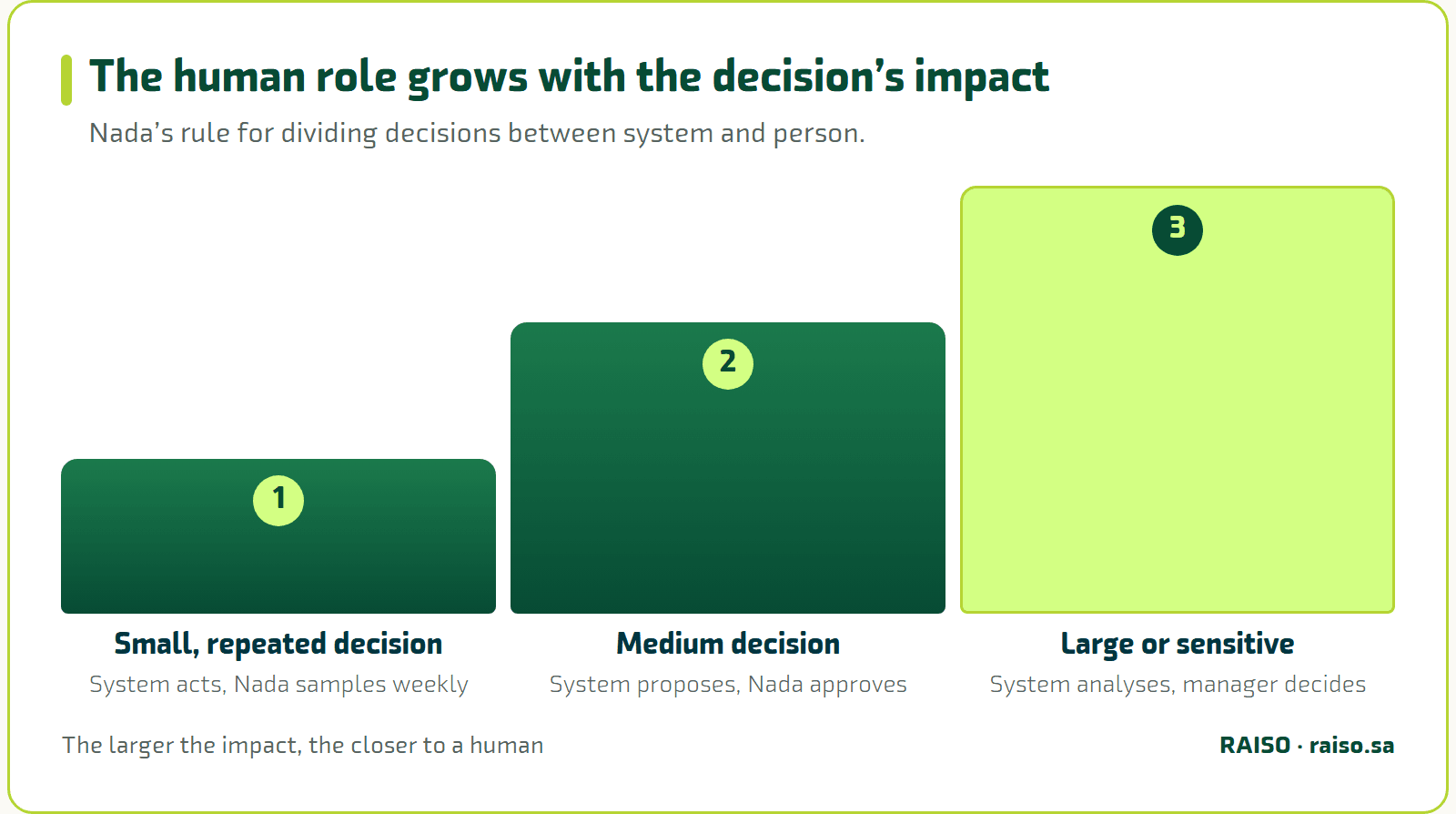
In practice, the human role is set by the size and impact of the decision. Small, repeated decisions, such as choosing an item from an approved list at a price within the agreed limit, can be left to the system with periodic audit. Large or sensitive decisions, such as contracting a new supplier, ending an existing contract, or anything with major legal or financial effect, always need human review before execution.
A simple rule Nada set for dividing decisions:
- Small and repeated decision
The system carries it out automatically within written limits, and Nada reviews a sample each week.
- Medium decision
The system proposes it with a clear justification, and Nada approves or rejects within a day.
- Large or sensitive decision
The system offers analysis and options only. The procurement manager decides personally and records the reasons.
Where the case stands now: Nada’s day changed. She no longer spends two hours decoding the table. She spends half an hour reviewing the system’s recommendation and testing its assumptions, and the rest of her time building better relationships with strategic suppliers. She has moved from gathering information to making good use of it.
“Sort ten decisions in your process into small, medium and large. Which could a system with written rules take over? And which must stay human, however clever the tool?”
The new unit of value: from task to decision
When Nada’s manager reflected on this change he asked her: how will we measure your performance now? For years organisations measured productivity by task count: how many requests processed, how many reminders sent, how many quotes collected. That made sense when the biggest constraint was the scarcity of execution, the number of hands that could do the work.
Today a machine can carry out thousands of tasks a second. What has become scarce is the wise decision: which task to do, why, and by which values. So the unit of value shifts from the task to the decision. Traditional automation asks: how do we finish this task faster? An intelligent process asks: how do we choose the right task, at the right time, in the right way?
This is a move from efficiency to effectiveness: from mastering doing things to mastering choosing the right things. The organisation that wins is no longer the one with the fastest machines but the one with the best decisions. The difference may not show in the number of transactions, but it shows plainly in the quality of the path each organisation chooses at every fork.
| # | Pillar | Question it tests | Met | Partly met | Not met |
|---|---|---|---|---|---|
| 1 | Clarity of target value | Do we have a specific, measurable business question to answer? | |||
| 2 | Process redesign | Did we draw the process and cut excess steps before choosing a tool? | |||
| 3 | Data quality | Is our data unified, complete and trustworthy in one register? | |||
| 4 | Smart decision points | Have we placed AI where it adds most value, not in every step? | |||
| 5 | Human governance | Do sensitive decisions pass through a person who owns them? | |||
| 6 | Workflow integration | Is the AI built into the daily system the team already uses? | |||
| 7 | Continuous learning | Do we measure recommendation outcomes and retune the model regularly? | |||
| 8 | Governance, risk, compliance | Have we documented privacy, bias and security risks and how we handle them? |
Score your process honestly on the eight pillars, then start with the weakest.
Where the case stands now: Nada agreed new indicators with her manager. Instead of the number of requests processed, she now measures the share of recommendations that matched the human decision, the share of shipments from recommended suppliers that arrived on time, and decision time from the moment the need appeared. These indicators measure the quality of decisions, not the quantity of work.
Eight pillars to test your process’s readiness
Before Nada began her trial, she and her team assembled a checklist to test the process. Not wanting a list whose boxes get ticked and forgotten, she thought of it as eight pillars in a single structure: if one falls, the others shake.
The eight pillars, and what Nada said about each in her own process:
- Clarity of the target value
We start with a specific, measurable business question: we want to cut supplier selection time and reduce late delivery. Without a goal like that, the initiative becomes an isolated experiment.
- Redesign the process before the intelligence
We drew the process and removed the excess before installing any tool. This pillar cannot be skipped.
- High-quality data
We unified the supplier register. Weak data produces intelligence that magnifies problems rather than solving them.
- Smart decision points
We put intelligence where it gives most value: classification, delay prediction, prioritising and recommending. Not in every step without distinction.
- Human governance
Sensitive decisions go through a person, especially in financial, legal and ethical matters.
- Intelligence built into the workflow
Intelligence that lives outside the daily system will not be used. We built it into the procurement platform itself.
- Continuous learning
We measure the outcomes of recommendations each month and retune the model when it drifts from reality.
- Governance, risk and compliance
Intelligence brings new risks: privacy, bias, security. We do not avoid it. We adopt it responsibly and document how we handle each risk.
Nada noticed that the second pillar was the hardest. It is the only one that needs no budget but needs courage: telling your manager that some of what you do has no purpose. The other pillars are mostly familiar technical and organisational decisions.
Where the case stands now: Nada gave each pillar a score out of five. Her total was weak on the second, third and seventh pillars, so she decided to start there before any technology. The fifth and eighth she placed on a review schedule with risk management.
“Give your process a score out of five on each of the eight pillars, honestly. The pillars scoring under three are what you should fix before any investment in a tool.”
The dual professional and silent resistance
Despite all this, Nada noticed something in her team. Some colleagues nod in meetings, then return to their old way once the door closes. Nobody objected openly, but a quiet worry was working in the background: what will be left for me if the system decides?
This is institutional resistance, the fourth challenge facing intelligent processes after data, explainability and over-optimism. If it is not handled with clarity and honesty it turns into silent resistance that blocks adoption and hollows out the initiative. It is not cured by denial or general promises, but by each employee seeing for themselves what their new role will be.
The third challenge we should not forget is explainability. Some models behave as black boxes, giving recommendations that cannot be justified. In sensitive decisions the lack of explanation weakens trust and exposes the organisation to legal and ethical risk. So Nada required that every recommendation come with its reasons in plain language: why this supplier, and which criteria tipped the balance?
Here appears what we call the dual professional, or Ops-Tech Professional. This is someone who holds deep expertise in their own field and also enough technical understanding to partner with AI rather than merely use it. A procurement officer of this kind does not just operate the platform. They design the supplier evaluation criteria, review recommendations with a critical eye, and re-engineer the process when the data reveals an opportunity.
The difference is clear: the traditional employee uses technology to do their tasks as they are, while the dual professional uses it to redefine the tasks themselves. That does not mean every employee becomes an engineer or data scientist. It means every professional develops a measure of intelligent literacy: understanding what AI does, what it cannot do, and how it shapes the decisions that touch their work.
Where the case stands now: Nada appointed two enthusiastic colleagues as referees for the trial. For a full week they reviewed every recommendation and noted their objections. The worry moved from something hidden to data that could be discussed, and the two colleagues became the first to defend the system once they saw that it accepts correction.
“Ask yourself and your team a frank question: what do we fear will change in our roles? Write the answers without debate. They are the map of resistance you will need.”
What you carry with you
We began with Nada looking at fifty reminders that understood nothing. We end with her reviewing a recommendation that the system understood and justified, and deciding for herself. She did not abandon automation, which still guarantees speed and consistency in execution. She added what automation alone cannot offer: understanding, adaptation and prediction.
What we hope you carry away from this article:
- Automation executes, intelligence understands
The first masters the rule, the second handles ambiguity, learns and predicts. The winning formula is to combine them.
- Five stages in a loop
Sense, interpret, decide, act, learn. Automation alone covers only acting.
- Process before tool
AI does not repair a broken process, it speeds up the breakage. Redesign the process and clean its data first.
- The human governs
Sort decisions by impact, leave the small and repeated to the system, and keep the large and sensitive human.
- Measure decision quality
The new unit of value is the good decision, not the number of tasks completed.
The question is no longer: do we have AI? It is: have we become a learning organisation? Technology is available to everyone, but the ability to weave it wisely into a process that improves with every cycle is what makes the difference. The learning organisation will not always be the biggest or the fastest, but it will be the smartest.
The next step is simple: take one process of yours, score it on the eight pillars, and start with the weakest. If you want to try these tools with specialists on a real process from your organisation, we recommend RAISO’s courses in process development and digital transformation, where we help you design a process that is ready for intelligence before you buy any tool, and build the dual-professional skills in your team.