



Why Your Organization Does Not Need More Procedures
An error occurs while processing a request, a customer gets angry, and the matter reaches management. In the meeting someone asks the question everyone already knows the answer to: "Which procedure are we missing?" An employee is assigned to write it, and a week later a new procedure appears with an extra form, an approval field, and a second signature. The storm calms and everyone feels something moved. Two months later the same error returns.
This article argues that your organization's problem is usually not a shortage of procedures but their misuse. You do not suffer from too little documentation; you suffer from too much of it. Every new procedure is added to a pile nobody reads and nobody owns, and instead of creating order it adds another layer of fog. We will follow one case from start to finish: Noura, an operations director at a hypothetical maintenance company, and a single customer complaint. In each section, a question or a step changes what Noura does. By the end you will have a practical way to sort your own procedures: what to delete, what to merge, what to keep alive, owned, and understood, and how to ask a different question at every failure.
Noura receives the complaint
Noura is operations director at a hypothetical company that provides maintenance services to businesses. On Sunday morning an angry email arrives from a customer: the maintenance request he filed was closed as "completed" while the problem is still there, and nobody called him. Noura opens the request and finds that the technician logged the closure, that the customer's details in the system were outdated, and that the shift supervisor was absent that day.
In the afternoon management meeting the director says, "This is the third similar complaint this quarter. Write a procedure that prevents it from happening again." Noura returns to her desk knowing what comes next: she will write a procedure titled "Verifying Request Closure," with a review form and a second signature. She has done it twice before.
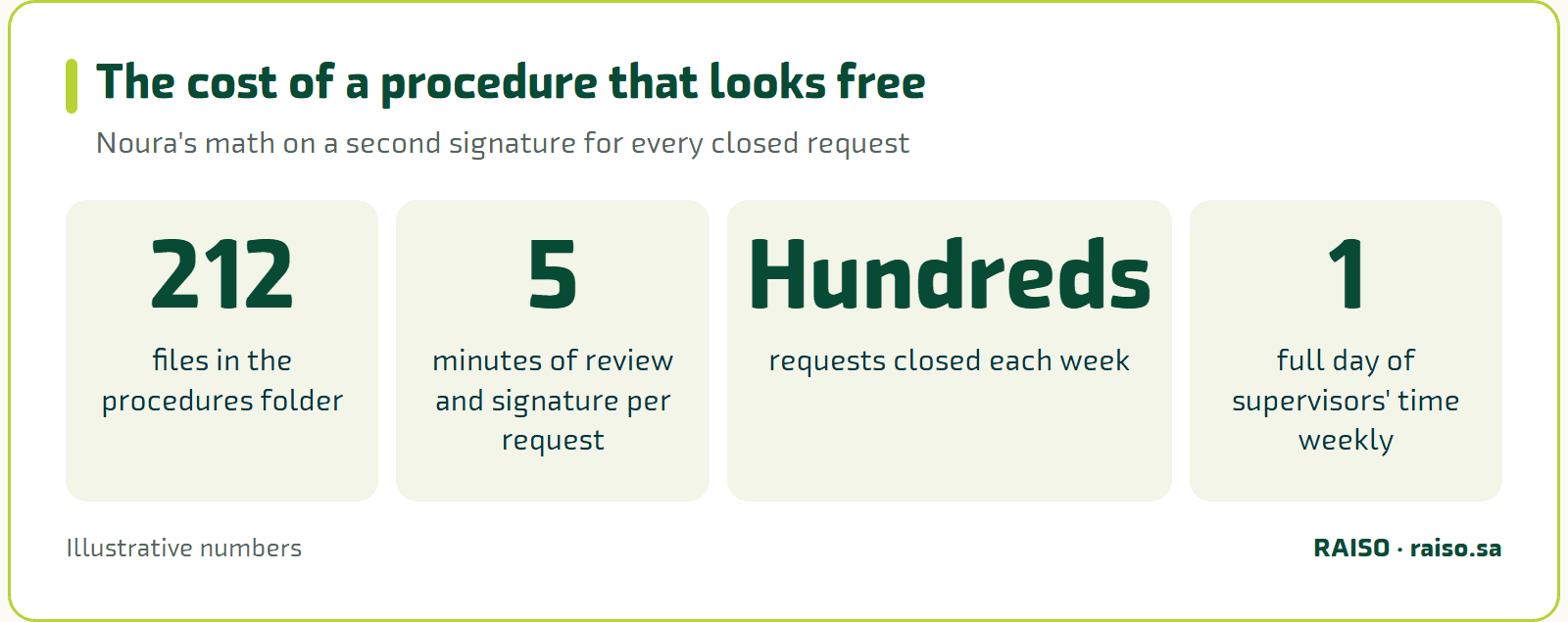
This time she pauses. She opens the procedures folder on her computer and counts what is in it: two hundred and twelve files. She tries to remember the last time an employee opened one to find out what to do, and cannot. The story is hypothetical and its numbers are only illustrative, but the scene is familiar. Noura's first question is: why do we write a procedure at every failure in the first place?
“A new procedure makes us feel we did something. That is exactly why it is dangerous.”
Why do we write a procedure at every failure?
Before saying why your organization does not need more, we have to understand why it produces more with such appetite. The instinct has three reasons, and all of them are understandable.
The first is psychological. Writing a procedure is a visible act that gives a sense of control. When the director asks, "What did you do?" the easiest answer is, "We issued a new procedure." A document is tangible proof that someone moved, even if nothing changed in reality. Documentation here is not managing the problem; it is performing management for an audience.
The second is defensive. A written, signed procedure is liability insurance against blame: as long as it exists, responsibility for the error shifts from the organization to the individual who "violated the procedure." The more fear of accountability there is in an organization's culture, the more procedures it produces that protect their writer more than they serve their user.
The third is institutional. In many organizations, management maturity is measured by how much is documented, so the number of procedures and forms is displayed as evidence of discipline and audit readiness. Documentation becomes a goal rewarded for its own sake. An organization with five hundred procedures looks more mature on paper than one with fifty, even if the first is paralyzed by its procedures and the second is agile with them.
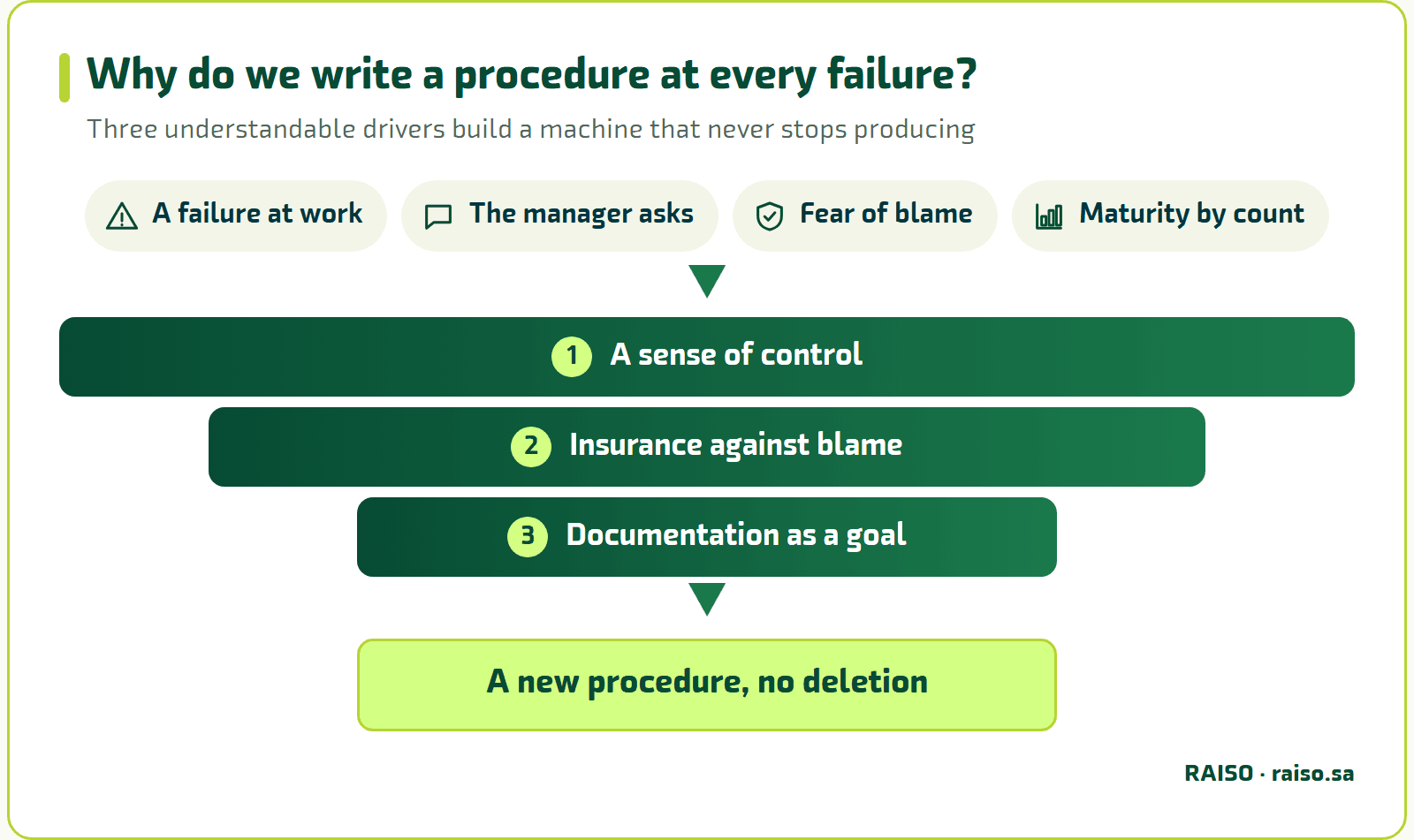
Together these reasons build a machine that never stops producing and has no mechanism for deleting. Adding is easy and rewarded; deleting is hard and frightening. The outcome of any system that adds without limit and never removes is bloat, then suffocation.
Noura now: she asks herself honestly why she was about to write the procedure. She finds all three reasons: she wants to tell the director she did something, she wants the company to have a document it can hold against the employee who erred, and she wants the procedure count to rise in the audit report. None of these reasons has anything to do with the angry customer.
“Recall the last procedure you wrote or asked for. Write one honest reason: was it to correct the work, to show that we moved, or to protect someone from blame?”
When the medicine becomes the disease
Procedures are medicine at their core. They exist to reduce ambiguity, unify performance, transfer knowledge, and protect quality. But medicine taken without measurement turns into poison. When documentation passes the limit a person and an organization can absorb, its effect reverses entirely: it creates ambiguity instead of dispelling it, it scatters performance instead of unifying it, and it chokes quality under the weight of formal compliance. Excess documentation has three signs you recognize the moment you look for them.
The first sign is conflict. When procedures pile up over years, written by different hands with no comprehensive review, some are almost certain to contradict others. One says do, an older one says do not, and a third describes a step in a system no longer in use. Facing this, the employee either freezes or ignores all procedures and works by instinct. In both cases the organization has lost the purpose it documented for.
The second sign is collective neglect. There is a truth everyone knows and nobody says: in organizations loaded with procedures, nobody reads the procedures. The new hire opens them once in his first week, then learns the job from a colleague, not from the document. And an unread document is not neutral but harmful, because it gives leadership the illusion that work is disciplined since it is documented, while the real work happens somewhere else.
“A document nobody reads is not neutral; it gives leadership the illusion of discipline while the real work happens somewhere else.”
The third sign is slowness. Every extra approval, signature form, and mandatory field added "for more control" is a tax paid every time the work is done. Alone each looks trivial, but together they slow the organization to a crawl. In a time when entities are judged on agility and speed of response to the beneficiary, this slowness is a direct burden, not just an internal annoyance.
Noura now: she asks two employees, one veteran and one who joined a month ago, to tell her how a maintenance request is closed. The veteran gives one answer, the new hire gives a different one, and a third procedure in the folder gives a third. She puts the three answers side by side: three ways to close the same request, all of them "approved."
“Choose one process and look for every procedure that touches it in your organization. Do they agree on the same steps? Write down every conflict you find.”
Why a new procedure does not fix the chaos
Back to the heart of it. Why will a new procedure not solve the chaos it was written for? Because most operational chaos is not a problem of knowing what to do, but of being able to do it. When a request is late, it is rarely because the employee does not know the steps. More often the system is slow, the load is excessive, the approver is absent, or two contradictory steps collide. A new procedure addresses knowledge while the flaw is in capability. It prescribes a cure for a disease the patient does not have.
Worse, it does not stay neutral in its failure; it aggravates the illness from three sides. It adds a new operational load to an already burdened system, slowing what was slow. It raises the chance of conflict with what exists, increasing the ambiguity it came to dispel. And it spends from employees' limited stock of attention, pushing them one more step toward ignoring procedures altogether.
Look at the usual pattern. A customer complains about an error in processing his request. A quick investigation concludes that an employee "did not follow the steps." Management issues a procedure that adds a verification field, a review form, and a second signature. The storm calms. Months later the complaint recurs, because the real cause was never a missing step. It was that the system displays outdated data, that the employee is assigned more than his capacity, and that nobody owns the whole process to see the flaw at its root. The procedure treated the symptom and added two steps that will break at the first pressure.
Noura now: she asks about the request that was wrongly closed: why did the technician close it? Ten minutes with him and he explains that he was carrying fourteen requests that day, and that the system screen does not show him the updated customer number, so he called the old number, nobody answered, and he closed the request to move on. The problem was not ignorance of the steps. It was load, system, and outdated data.
“When the next failure happens, do not ask "which procedure are we missing?" Ask "which capability broke?" and write the answers: load? system? skill? incentive? absent decision-maker?”
Work as imagined and work as done
At the heart of the misuse of procedures is a gap we often ignore: the difference between work as imagined in the document and work as actually done. A written procedure is an idealized, simplified representation of how work is performed when every resource is available and no exceptions appear. But reality does not work that way: there is time pressure, missing information, systems that do not talk to each other, and cases the writer never imagined. The capable employee is the one who bridges this gap with judgment every day, not the one who follows literally a text that was not designed for his reality.
When an organization does not recognize this gap, it misdiagnoses every failure. It sees a deviation from the procedure and takes it for a violation, when it is really a clever adaptation to a flaw in the procedure's own design. Its instinctive response is a stricter procedure that sends people back to the idealized text. It fights the best thing its employees have, their ability to keep work alive despite design shortcomings, and punishes them for rescuing it.
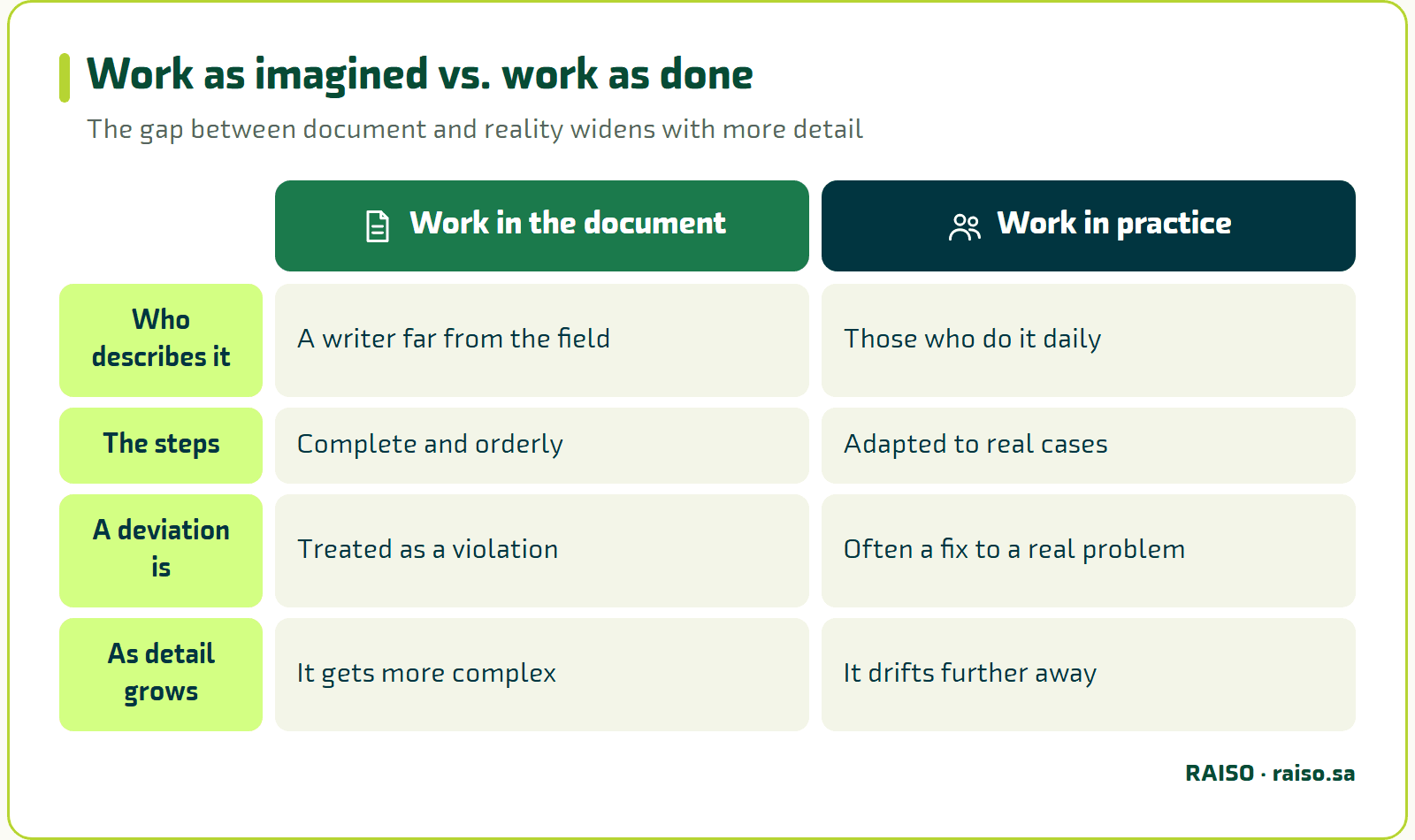
Here lies a dangerous paradox: the more detailed and strict procedures become, the wider the gap grows instead of narrowing. An over-detailed procedure is farther from the flexibility of reality, so it is abandoned faster, and the real work turns into an invisible system living in people's heads. Then leadership loses the ability to see how the organization really works. Excess documentation does not produce more transparency; it produces deeper darkness.
Noura now: she sits with the same technician while he shows her how he really works. He opens the system, skips two screens because they do not show what he needs, and opens an old spreadsheet on his phone to confirm the customer number. You will not find these steps in any procedure, but they are the real work. And Noura understands that what she lacks is not another document, but a true picture of what happens.
“Sit with an employee who has spent years on one process and ask him to show you how he does it, not to tell you. Write down every step he takes that is not in the procedure.”
The cost that appears in no budget
A procedure is written as if it were free. This silent assumption is the hidden engine of excess documentation: as long as adding has no visible cost, why hesitate? But every procedure has a real cost even if it appears in no financial line. There is the cost of creation, the smallest and the only one we notice, and there are three far larger costs that stay hidden.
The first is the cost of repeated compliance. A procedure is written once but executed endlessly, and every minute in it multiplies by the number of times and the number of people. A procedure that adds just five minutes to a transaction repeated a hundred times a day consumes roughly eight hours daily, the time of a full-time employee, and nobody notices this bleeding because it is spread across everyone.
The second is the cognitive cost. Every procedure occupies space in the employee's attention and memory, and human attention is a limited resource that does not stretch as the number of documents stretches. When we flood an employee with hundreds of procedures we do not increase his commitment; we exhaust his ability to tell the important from the marginal, so he treats everything with the same indifference. Bloat does not create discipline; it creates numbness toward everything written.
The third is the cost of maintenance. Every procedure becomes a permanent obligation to update it whenever a system, policy, or structure changes. Organizations mostly do not, so outdated procedures accumulate and describe a world that no longer exists. With each neglected procedure the whole system loses a little credibility, until employees reach a deadly conviction: procedures do not keep up with reality, so there is no need to care about them.
Adding up these three costs makes it clear that the right question before writing any procedure is not "will it help?" but "does its benefit exceed its full cost across its entire life?" Most of what we write would not pass this test if we applied it honestly.
Noura now: she calculates the cost of the procedure she was going to write: five minutes of review and a second signature on every closed request. The requests closed in a week number in the hundreds. She arrives at a figure equal to one full day of the shift supervisors' time every week, for a signature that would not touch the real cause. She decides not to write it.
“Pick one step in an existing procedure and calculate: how many minutes does it take? How many times a month is it repeated? How many people perform it? Multiply the three and look at the result.”
Pruning: delete before you add
If the answer is not more procedures, what is the alternative? The first step is the opposite of our habit: pruning instead of piling up. Before you write a single new procedure you have to face what you already have. Most organizations do not even know how many procedures they own, or which are alive and which are dead. A comprehensive review of the procedure inventory is not an organizational luxury but the first condition of any real reform.
Pruning begins with a blunt question asked of every procedure: what happens if we delete it? If the answer is "nothing" or "nobody even knows it," it is a dead procedure that should be buried, not preserved out of respect for its writer's effort. If the answer is "real work will stop," it is alive and deserves care. This sorting alone, done honestly, usually reveals that a large share of the inventory can be cancelled without anyone feeling the loss.
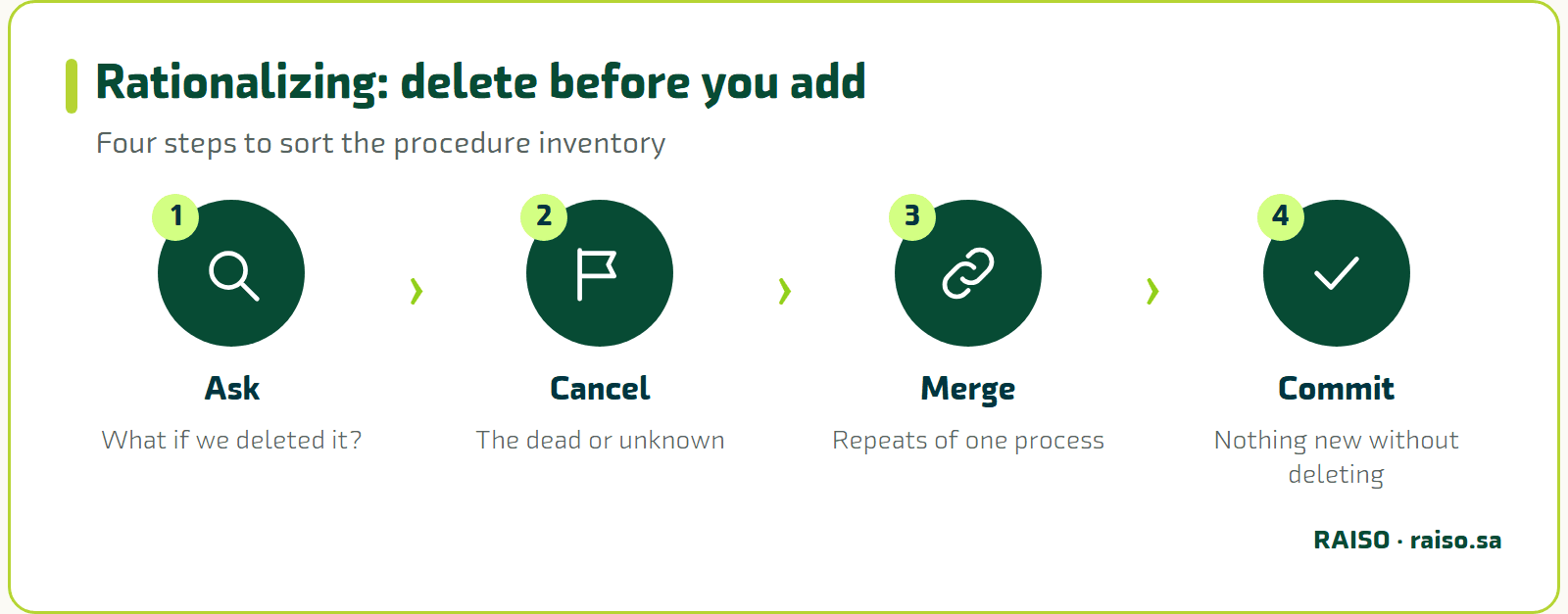
After cancelling comes merging. Many separate procedures are parts of one process that were split for organizational or historical reasons. Merging them into a single coherent procedure that serves the whole process reduces the count, repairs the conflicts, and closes the gaps between departments. After merging comes simplifying: removing every approval that adds no value, every field nobody reads, every ceremonial signature. Everything removed here is pure gain in speed and clarity.
Pruning is not a project done once and finished but a continuing discipline. Its golden rule is simple: no new procedure enters until it is shown that no existing one can be amended to serve the purpose, and ideally an old one leaves whenever a new one arrives. An organization with fifty living, understood procedures is far stronger than one with five hundred dead ones.
Noura now: she spends two weeks with her team sorting the folder. Of the two hundred and twelve procedures she finds that a large number are not used, and that many describe the same thing in different forms. The dead are cancelled, the repeated are merged, and three procedures for closing a request become one procedure on a single page. Then she sets the transitional rule: no new procedure without deleting or merging an existing one.
“Ask for the list of procedures in one department. Next to each, write one of three choices: live, merge, delete. And do not accept "I don't know" as an answer; ask the person who performs it.”
A procedure that is alive, owned, and understood
Pruning reduces the count, but quality does not come from fewness alone. It comes from three qualities every surviving procedure must carry: it must be alive, owned, and understood.
A living procedure matches reality and changes with it. It is not a document written once and frozen but an organism reviewed periodically and updated whenever what it describes changes. It is written from observing the work as actually done, then refined by those who do it, because they know its gaps best. A dead procedure, written once and kept forever, is at best decoration and at worst a trap that misleads whoever trusts it.
An owned procedure has one clear owner responsible for its accuracy, its updates, and its performance. The most dangerous kind is the orphan: written by someone who left, or by a committee that dispersed, so it stays with no owner to defend it, fix it, or decide its death. Clear ownership is what keeps a procedure alive, and what gives it the right to be deleted when it dies.
| # | Question | What it reveals | Meets | Partly meets | Does not meet |
|---|---|---|---|---|---|
| 1 | Does it describe the work as actually done? | The gap between document and reality | |||
| 2 | Who owns it today, by name? | The orphan procedure | |||
| 3 | What happens if we delete it tomorrow? | The dead procedure | |||
| 4 | Do those who perform it understand why? | The purpose and the risk it guards | |||
| 5 | Does its benefit exceed its full cost? | Compliance, attention and upkeep cost |
What passes is rebuilt, what fails is deleted
“A procedure without an owner is an orphan that ages in silence; clear ownership keeps it alive and gives it the right to be removed when it dies.”
An understood procedure lets the person doing it know why he does what he does, not only how. When an employee grasps the purpose of a step and the risk it guards against, he turns from a blind executor into an aware partner able to apply it wisely at an exception. Understanding comes not from the size of the document but from its clarity and brevity: short enough to be read, clear enough to be applied, explained enough to be respected. These qualities are achieved with fewer procedures, not more, because a mind cannot keep many alive, owned, and understood at once.
Noura now: the "closing a maintenance request" procedure becomes one page, and its owner is the shift team lead. It opens with a sentence that says why: "A request is closed only when the customer confirms his problem is over." And it is reviewed every three months. For the first time a new technician reads all of it in his first week, because it is short and because he understands it.
“For one procedure in your organization write: the name of its owner, the date of its last review, and one sentence saying why it exists. If you cannot write all three, it is an orphan or it is dead.”
Manage the work, do not polish the paper
The deepest alternative remains, and it is a shift in mindset before it is a shift in tools: to manage the work instead of documenting it. Excess documentation is at its core an escape from facing real work into the comfort of paper. When we write a procedure instead of fixing a slow system, redistributing an unbalanced load, or assigning an owner to a process, we choose the easy visible act over the hard effective one. We manage the image of the work instead of managing the work.
Managing the work starts with the right question at every failure: why did this really happen? Not "which procedure are we missing?" but "which capability broke?" The answer might be in the system, the load, the skill, the incentive, or a conflict of goals between two departments. Each cause needs a different remedy than writing a document: speeding up a system, redesigning a load, training, adjusting an incentive, settling a conflict. A procedure may sometimes be part of the solution, but it is rarely the whole of it.
It also means measuring the effect of procedures, not their existence. The question is not "how many procedures do we have?" but "are our processes completed faster and more correctly because of our procedures or despite them?" An organization that manages its work tracks cycle time, error rate, and beneficiary satisfaction, and ties each procedure to its effect on those measures, keeping what helps and removing what hinders. One that polishes paper measures file completeness and signature freshness, and assumes full shelves are a sign of health.
Noura now: instead of the procedure she was going to write, Noura makes four decisions. She asks the technology team to show the updated customer details on the closure screen. She redistributes requests so that no technician carries more than eight a day. She makes calling the customer part of closing the request, in one sentence in the procedure. And she starts measuring the number of reopened requests every week. Three months later similar complaints fall, and not one signature step was added.
“Recall a recent failure in your organization whose answer was a new procedure. Write three management decisions, not documents, that would have addressed the real cause.”
What you take with you
First, take with you that the instinct that says "write a procedure" serves comfort, not cure: it protects the writer and shows management that it moved, but it adds load, conflict, and neglect. Second, most chaos is a problem of capability, not knowledge, so a new text does not fix it. Third, every procedure has a cost paid each time it is executed, so ask about its full cost before you write. Fourth, the alternative is pruning, then three qualities: alive, owned, and understood. And fifth, you manage the work, not the paper.
Here are five questions to put before every procedure in your organization to sort the inventory: does it describe the work as actually done or as its writer wished it done? Who owns it today, by name? What actually happens if we delete it tomorrow? Do those who perform it understand why they do its steps? Does its benefit exceed its full cost? What survives the sorting is rebuilt, and what fails is deleted without regret.
Let us return to where we began. When the next failure strikes your organization, the old instinct will arrive immediately. At that moment your path is decided: if you give in, you add another layer to the fog; if you resist and ask "which capability broke?", you have begun to manage your work. Start this week with one step: ask for the procedure list of one department and sort it with the five questions. And if you want to do it with RAISO experts within our procedure management practice, contact us and we will start with you from inventorying your procedures, and bring you to a system that is smaller, more alive, and clearer.