



Process Ownership: Who Is Really Responsible?
Open any procedures manual in any organisation and you will find on every page a name under the heading “process owner”. The names are written, the structures approved, the signatures in place. Now ask one question: if this process needed an urgent change today, who has the power to decide it? In most cases the answers start to scatter. The matter goes to a committee, or to quality, or to an improvement project that has not begun. And the person whose name is written points, in turn, to someone else.
This article argues that process ownership is not a title in an organisation chart but authority, accountability and capability in the hands of one person able to act. We follow one case from start to finish: Hind, an owner on paper, and Salman, who works in the excellence office. You will learn the difference between a responsible person and an owner, why ownership fails before it starts, what Roger Tregear taught about leading through influence, and how to build an owner on three pillars: a charter, enablement and capability. Each section ends with a short exercise to apply to a process in your own organisation.
Hind, owner on paper
“We follow one case: Hind, customer service manager, registered as owner of the request intake and classification process. In each section we see what changes in her role, and at the end we compare Hind before and after the charter.”
Hind manages customer service in a service organisation. Her name appears in the procedures manual as “owner of the request intake and classification process”. That process crosses three departments: customer service, which receives; operations, which fulfils; and IT, which runs the system.
In recent weeks Hind noticed that many requests were being classified wrongly, so they reached a team that could not handle them and then came back. The customer waited while the two teams blamed each other. She decided to step in as the owner, and wrote a simple amendment to the classification criteria.
The reply came the next day: the amendment needs operations’ approval because it changes what reaches their team. Changing the classification screen needs a formal request to IT. And issuing the updated version of the procedure belongs to the excellence office, with a review cycle that could take weeks.
Hind asked herself a question she had never asked before: if I do not own this decision, what exactly do I own?
“Nobody neglected their job in this story, and yet the error stayed in place, because the person with the name does not hold the decision.”
“Hind, Salman and the numbers in this article are composed for illustration only and do not refer to any particular organisation.”
Look back at what happened and reflect. The manual is current, the structure approved, and Hind’s name written in a clear hand. Everything is in order, except that the name cannot do anything. This is what we call the organised illusion: a system tidy in form and empty in substance. Its danger is that it does not look like an illusion. The documents exist and the signatures are complete, and the flaw shows only at the first real test: an operational crisis, a drift in performance, an urgent need for change.
What did the organisation lose in this story?
- Time. A change that needed a day now needs weeks, with the customer waiting.
- Accountability. Ask Hind about the error and she says she lacks the authority; ask operations and they say it is not theirs.
- Trust. The team learned that the owner’s name on a document changes nothing, and stopped reporting problems to her.
“Five minutes, now: pick an important process in your organisation and ask three colleagues the same question: if this process needed an urgent change today, who decides? Write down their answers as they are, without correcting them.”
How did ownership move without anyone intending it?
If you want to know who actually runs the processes, do not look at the documents. Look at who receives the requests. In many organisations the excellence office, or the business procedures office, turns out to be the real reference for every amendment, every update and every decision about processes. Problems are raised to it, it issues the approved versions, and it decides when a process changes and how.
No decision was ever taken to make this happen. These offices were set up for a noble purpose: to support owners, supply methodologies, assure the quality of documentation and unify the language of processes. But when no capable, empowered owner existed, they began to fill the gap. They did not do so out of ambition, but because work always flows towards whoever can get it done.
That is how Salman, who works in the excellence office in Hind’s organisation, became the real reference for the classification process. He edits the wording, issues the versions and decides the shape of the procedure. Hind signs what he prepares, not what she leads. Salman is not at fault. He is a diligent employee who found the door open and walked through it.
The result is an inverted equation: a nominal owner carries responsibility without authority, and an office holds authority without responsibility for operational results. This equation produces three problems at once.
- No real accountability
When a problem occurs the owner says she lacks the authority, and the excellence office says its role is support, not operation. The problem hangs between two contradictory responsibilities and settles on no one. Accountability spread across everyone falls on no one.
- Slow response
Any amendment passes through a cycle of request, review, approval and issue. In a fast environment this means the process stays off course until the formalities are complete. A decision that needs one person now needs a committee meeting.
- Weak continuous improvement
Real improvement does not come from a distant office but from someone who lives the process every day and feels its pain before it shows up in reports. Take that role away and improvement turns from a daily breath into a periodic project that starts and ends.
Where the case stands now: Hind saw that the problem is neither that she fails to make an effort nor that Salman is encroaching on her role. There is a system that rewards whoever delivers rather than whoever owns, and she and Salman are both inside it.
“Look at the last three amendments to your procedures. Who requested them? Who decided them? Who issued them? If the third answer is always the excellence office, that shows where ownership really sits.”
Responsible and owner: a difference that makes all the difference
We often use the two words as if they were one, and they differ in substance. Confusing them is the root of most of what we saw in Hind’s story.
The responsible person carries out part of the process within a defined scope. He works inside the procedure, follows the drawn steps and reports results. His role is operational, and he succeeds by doing what is required of him. His measure is discipline in execution.
The owner owns the process as a whole. She does not only work inside the procedure but looks at it from outside and asks questions of a different kind: is this procedure still suitable? Does it achieve its purpose? Is there a chance to improve or redesign it? Her role is leadership, and her authority extends to designing the process, changing it and deciding on its performance. Her measure is the end-to-end result.
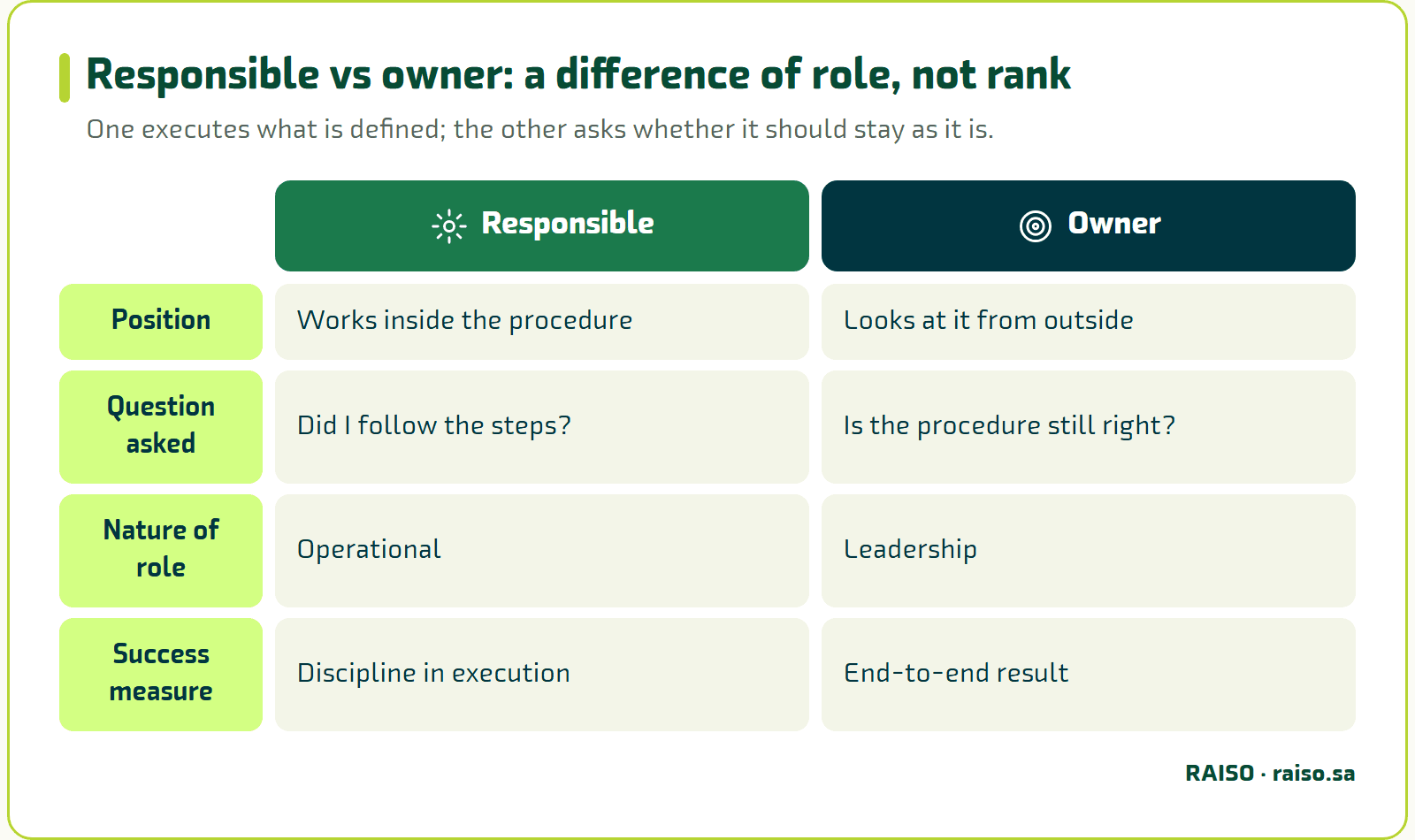
“The responsible person executes what is defined, and the owner redefines what ought to be.”
When someone is named “owner” while holding only partial execution responsibility, the organisation is calling a responsible person an owner and expecting a role whose tools and powers it never gave. It demands the results of leadership without the instruments of leadership. The gap between title and practice here is not an individual error but a design flaw.
Roger Tregear, the international process management expert, sums up the difference by saying that a process owner is not a manager of daily operations but the person accountable for the process’s performance from end to end and charged with improving it continuously. That requires the authority to intervene and the ability to influence, not just a title in a document.
Where the case stands now: Hind looked at her day and found she was “responsible” for executing a part, not “owner” of a process. She attends meetings, signs, and sends up reports. But she had never asked: is this procedure still suitable? Because nobody asked her to, and nobody gave her the tools to.
“For one process in your organisation, write a column headed “what the responsible person does” and another headed “what the owner does”. Then put beside each item the name of who actually does it today.”
Five reasons ownership fails before it starts
Formal ownership is not an accident or bad luck. It is the natural result of interlocking structural causes that doom the role from the moment of appointment. We saw all of them in Hind’s case.
- Appointment without a charter
Hind was appointed by a line in a table, and nobody defined where her process begins and ends, what falls within her authority and what exceeds it. Without that, an owner works in a grey zone where she avoids decisions because she does not know the limits of her power.
- Suspended authority
When Hind wanted to amend the classification criteria she needed operations’ approval, then IT’s, then an issue cycle. Her role became sending up recommendations and waiting for others’ decisions.
- Detachment from performance indicators
The figures sat with the excellence office, and Hind saw only a monthly report. An owner who does not see her process’s numbers regularly is a blind owner, who finds no drift and reads no trend.
- Rigid functional structures
The classification process crosses three departments, each running its own vertical scope, and nobody adopts responsibility for the horizontal flow. So Hind has no authority over the parts carried out outside her department.
- No support or capability building
Nobody trained Hind in process analysis, reading indicators or managing change. When a person is put in a leadership role without building her capability, she retreats to the safest role: signing and formal approval.
These causes do not work alone. Appointment without a charter yields suspended authority, suspended authority weakens the motive to follow indicators, weak indicators hide the effect of rigid structures, and all of it is aggravated by missing capability. That is why treating one cause is not enough. The whole system needs treatment.
| # | Reason | How it shows up in practice | Present | Partial | Absent |
|---|---|---|---|---|---|
| 1 | Appointment without a charter | Nobody defined where the procedure begins and ends, or the limits of the owner’s power. | |||
| 2 | Suspended authority | Every amendment needs others’ approval, so the owner only sends up recommendations. | |||
| 3 | Detachment from indicators | The figures sit elsewhere; the owner sees only a monthly report. | |||
| 4 | Rigid functional structures | The procedure crosses several departments and nobody owns the horizontal flow. | |||
| 5 | Missing support and capability | The owner was never trained in process analysis, indicators or change management. |
Tick one box per reason: present, partial, or absent.
Where the case stands now: Hind drew five boxes and wrote beside each: “do I have this?” She wrote “no” four times and “partly” once. It was not discouraging. On the contrary, she now had a clear map of what she lacked.
“Assess one process owner in your organisation against the five reasons, and write beside each: present, partial or absent. Which reason is most absent?”
Tregear’s lesson: zero authority, wide influence
It may seem that the answer is to give Hind direct authority over everyone who works in the process. But Roger Tregear puts forward an idea that sounds contradictory: give the process owner zero formal authority and allow wide influence. How can someone be an owner and a leader without authority over those who execute?
The reason is that most processes cross the boundaries of more than one organisational unit. Give the owner direct authority over staff in different departments and you create clashes of authority, strained relationships and double management. Give her nothing, and what does she lead with?
Tregear’s answer: by influence and coordination, not command and control. The effective owner is like an orchestra conductor. She does not play the instruments herself, but coordinates their performance towards one goal. She convenes stakeholders, analyses data, persuades with argument, initiates improvement and escalates when she needs support. Her strength comes not from her place in the hierarchy but from the clarity of her role and the strength of her data.
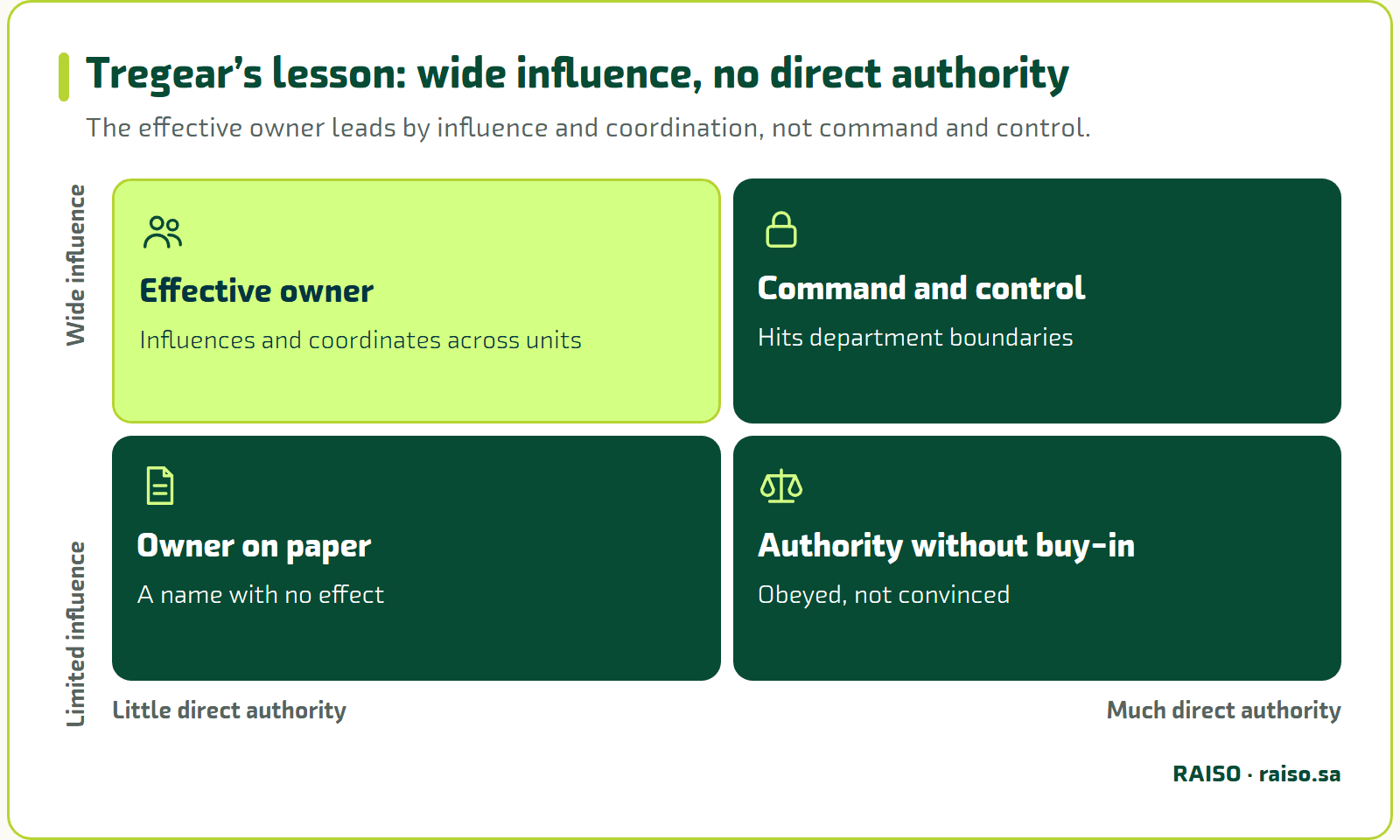
This model needs three conditions without which it does not work:
- A clear role, so everyone knows what the owner holds and what she does not.
- A clear escalation path, which Tregear calls a “process council”, to which the owner turns when she meets the limit of her influence.
- Clear data, because numbers persuade where orders fail.
Tregear tells of a commercial laundry called Whyte & Brite. Barbara led the process as its owner without being the direct manager of the operating team. She gathered performance data and shared it with stakeholders, and launched an improvement project run by the operations manager and funded by two departments. It did not succeed through her formal authority, which she never held over these people. It succeeded through the clarity of her role, the strength of her data and her ability to coordinate and build agreement. She led by influence, not authority.
Where the case stands now: Hind changed her approach from “I need approval” to “here is my data”. She gathered three weeks of wrongly classified request figures and showed them to the three department heads in a short meeting. The numbers persuaded better than any formal note, but she ran into the need for a clear path: who approves what? That is what the charter will settle.
“Pick a problem in a process that crosses more than one department and write three numbers of your own that show its size. Those numbers are the first tools of influence.”
First pillar: the process owner charter
RAISO’s model answers an earlier question than Tregear’s. It asks: how do we build the owner? It rests on three complementary pillars, none of which works without the other two. The first is the charter.
| # | Element | The question it answers |
|---|---|---|
| 1 | Scope | Where does the procedure begin and end? What are its inputs and outputs? |
| 2 | Purpose and value | What value does it give the customer or the organisation? |
| 3 | Authorities | What does the owner decide alone, coordinate, and escalate? |
| 4 | Performance indicators | What is measured, how often, and at what threshold must she act? |
| 5 | Stakeholders | Who must she coordinate with across department lines? |
| 6 | Continuous improvement | What is the owner’s role in periodic review and improvement? |
A draft charter missing any one is an incomplete charter.
The charter is a founding document that turns a formal appointment into an operating system. It is not a job description but a working framework that answers the essential questions before problems arise, not after.
An effective charter has six elements, none dispensable:
- The scope of the process, precisely: where it begins and ends, its inputs and outputs.
- The purpose and the value the process gives to the customer or the organisation.
- The authorities: what the owner decides alone, what she coordinates, and what she escalates.
- The process’s performance indicators, their frequency, and the thresholds that call for intervention.
- A map of stakeholders and the mechanisms of coordination across department lines.
- The owner’s role in continuous improvement and periodic review.
The charter does not restrict the owner, as may be assumed, but frees her. It gives her the clarity she needs to act with confidence and ends the overlaps that paralyse decision. When the owner knows exactly what she owns, she stops hesitating and starts leading.
Where the case stands now: Hind sat with the three department heads and Salman, and together they wrote a two-page charter. It set the scope from the moment a request arrives until it reaches the right team. Under authorities it said Hind amends the classification criteria alone within agreed limits, requests system changes through a pre-written procedure without a committee, and escalates to the process council when a matter exceeds her limits.
“Write a half-page draft charter for a process in your organisation, focusing on three elements: the scope, what the owner decides alone, and where she escalates.”
Second and third pillars: enablement and capability
A charter alone is not enough if the environment around the owner stays hostile to decision. This is where the second pillar comes in, operational enablement: redesigning the environment so that it reinforces real ownership instead of choking it.
Enablement has three strands:
- Clear decision channels, so the owner knows where a decision goes and how.
- Redefining the role of supporting offices from de facto owner to supporter and enabler.
- Removing bureaucratic obstacles that turn a simple decision into a long journey.
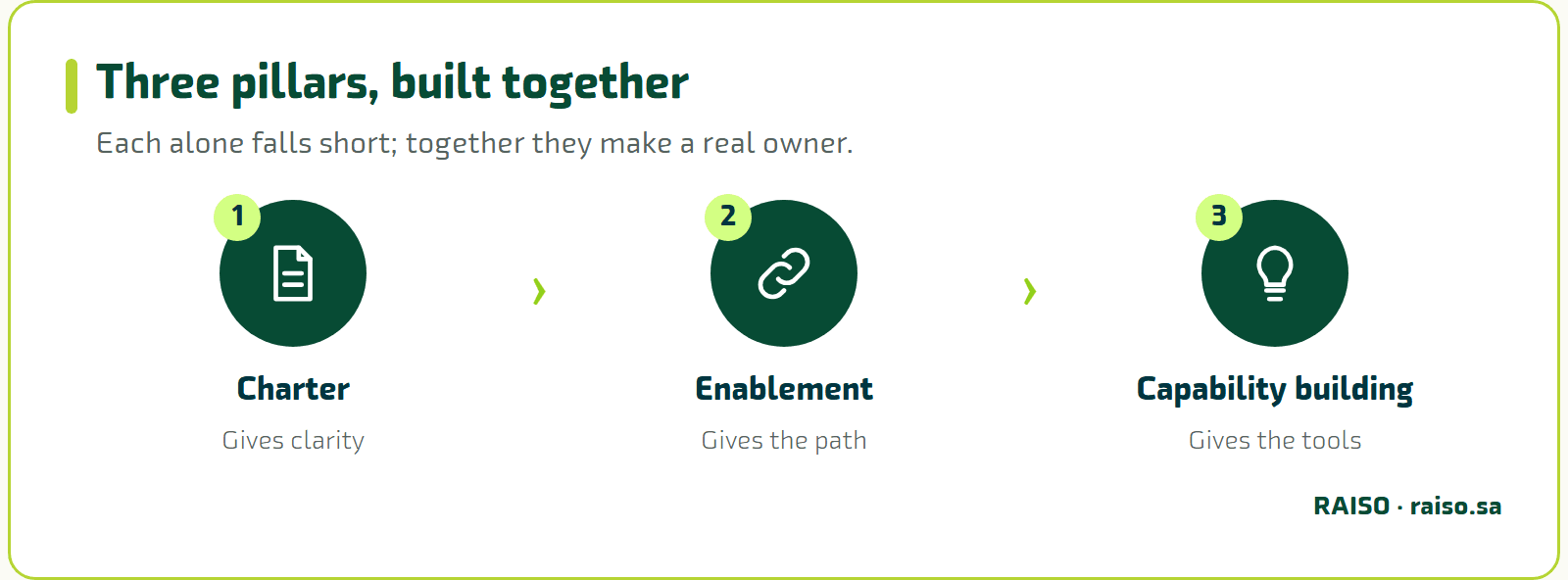
The third pillar is capability building. An owner who cannot read performance indicators or analyse root causes stays an owner in name even if given every authority. Authority without competence is a burden, not an asset. So capability building covers four areas: analysis and diagnosis, designing improvements, communication and influence across departments, and documentation and preservation of knowledge so that experience is not lost when people leave.
“A charter without enablement is clarity without effect. Enablement without a charter is authority without direction. And both without capability are a role without competence.”
The strength of the three pillars shows when we return to the classification problem. Before the charter the problem repeated for months, because Hind could not change the criteria, could not change the system and could not see the full figures across the three departments. After the charter she saw weekly indicators covering the process end to end, spotted the problem within forty-eight hours, amended the criteria within her authority without waiting, and launched a small improvement initiative without a committee. The error fell noticeably within two weeks.
The essential point is that Hind is the same Hind. Neither her character nor her effort changed. What changed was the system around her. The charter gave her clarity, enablement gave her a path, and capability building gave her tools. We changed the system and the result changed.
Where the case stands now: Hind joined short sessions on reading indicators and root cause analysis, and began chairing her own weekly meeting. The figures in this example are hypothetical, for illustration only, but the lesson is real: the person did not change, what surrounds her did.
“Ask a process owner in your organisation: what decision do you wish you could take and cannot? What number do you wish you saw every week and do not? What skill do you need? Three questions that reveal which pillar is missing.”
And what about the excellence office?
It may seem to Salman that all this takes his role away. But the truth is that the excellence office did not err when it filled the gap. It did what organisational logic dictates when a capable owner is absent. Now it faces a moment of repositioning: does it stay a “de facto owner without the name”, or become a “builder of real ownership”?
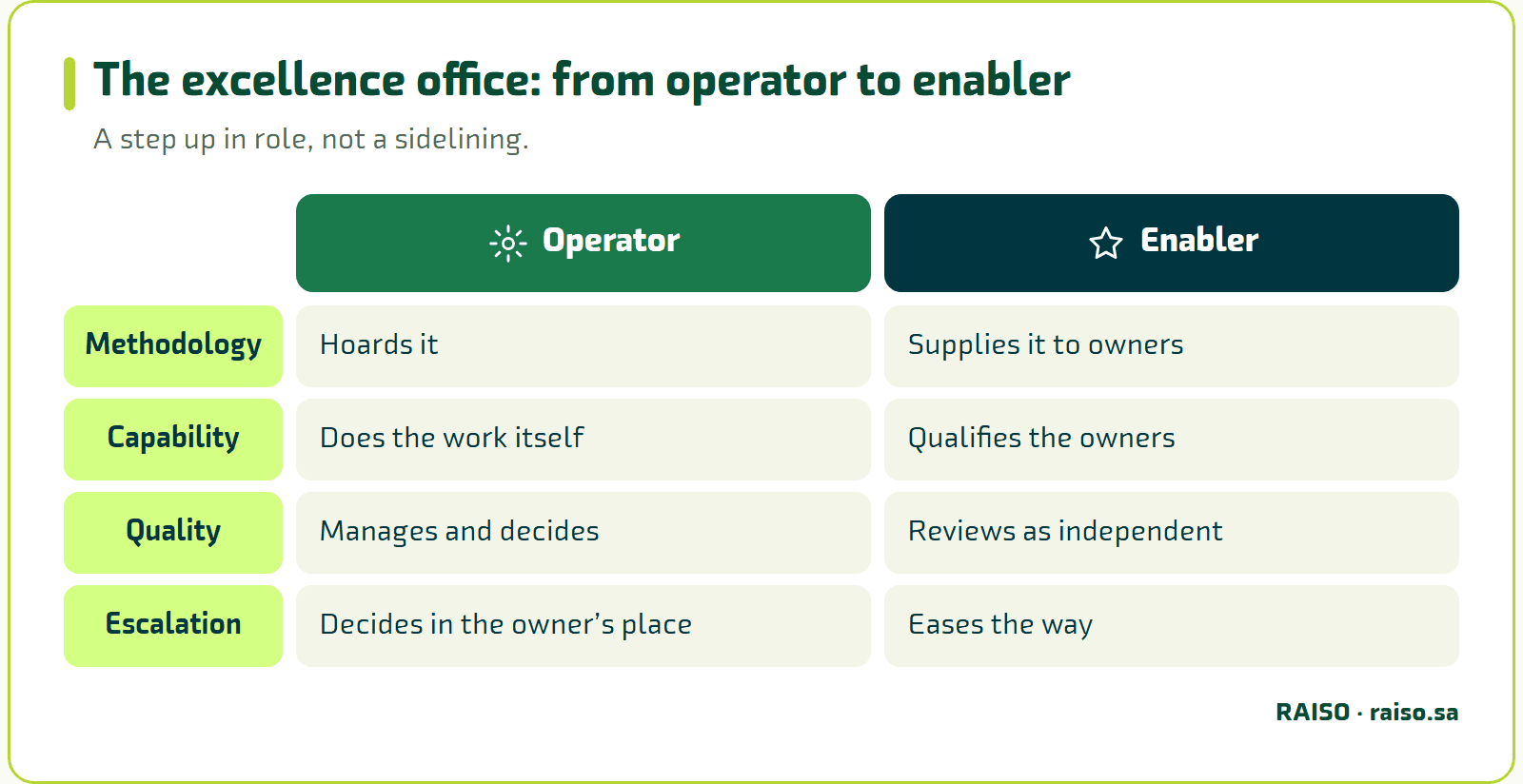
Its new role rests on four strands that move it from operator to enabler:
- Building and supplying the methodology: charter templates, analysis tools and standard indicators, made available to owners instead of hoarded.
- Developing owners’ capability: training and qualification programmes that give them the tools to practise real ownership.
- Quality review, not management: assessing the level of ownership in processes as an independent reviewer, not an operator holding the decision.
- Supporting escalation: when an owner needs the higher level to pass an improvement or resolve a conflict, it eases the way.
This is a step up for its role, not a sidelining. Instead of being the body that does procedural work itself and is drained by it, it becomes the body that builds a system in which others do the work with greater efficiency and clearer ownership. It moves from a lone hero carrying the burden to a coach who creates heroes spread across the organisation.
Where the case stands now: Salman no longer edits the procedure himself. He reviews Hind’s charter, trains other owners to write theirs, and opens the way to the process council when she needs it. A month later he told her: “I used to feel I was carrying thirty procedures. Today I have thirty owners I support.”
“If you are in an excellence office, write one item of your work today that you could hand to the process owner while keeping a support role. If you are an owner, write one item you want to take over.”
The question that reveals your operational maturity
In closing, one simple question shows where your organisation stands: if one of your main processes needed an urgent change today, is there one person able to decide immediately?
If your answer is yes, without hesitation and without long thought, you are looking at a real sign of maturity. If you started thinking “who is supposed to be responsible?” or “we would take it to a committee” or “it goes through the excellence office first”, you are living the organised illusion we began with.
Process ownership is not a matter of intentions or awareness but of design. Organisations that build real ownership do not just pick better people. They design an operating environment that makes real ownership possible and rewarded. The person matters, but the system she works in matters more.
What do you take with you?
- A name in a document is not ownership. Ownership is decision, accountability and capability in one person’s hands.
- The responsible person executes what is defined; the owner asks whether it should stay as it is.
- Ownership fails for five interlocking reasons: appointment without a charter, suspended authority, detachment from indicators, rigid structures and missing capability.
- The owner leads by influence, not authority: with a clear role, an escalation path and data.
- Three pillars together: charter, enablement and capability building. And the excellence office moves from operator to enabler.
The question every organisation should ask is not “who owns the process on paper?” but: who holds the decision about it in reality, and have we built a system that enables them? Only here does real process management begin.
At RAISO we work with organisations on designing process ownership roles, writing charters, enabling owners and repositioning excellence offices. If you have an important process owned by a name without a decision, we suggest starting this week with the three questions in the first exercise, then drawing a half-page charter. To go deeper, explore RAISO’s procedures management practice, or write to us at marhaba@raiso.sa and we will help with your first charter.
“The case, names and numbers in this article are hypothetical, for illustration only, and do not refer to any particular organisation.”