



Policies as Leadership Tools, Not Documents to File
Faisal, a customer service employee at one branch, stood in front of an angry customer. The customer's shipment was three days late, and he was demanding immediate compensation and threatening to move to a competitor. Faisal knew the organization had a customer service policy, but he did not know what it said about this situation. So he told the customer: “One minute, please,” and went to look for his manager. The whole matter needed one small decision, but nobody in the branch had enough certainty to make it.
This article defends one idea: a policy that is not used is worth nothing, and a good policy is the leader when the leader is absent. We follow Hind, a regional director in a hypothetical service organization, as she discovers that her approved policy never answered Faisal's question, then rewrites and runs it in a different spirit. You will leave with an understanding of two leadership functions of a policy, four reasons policies fail, the traits that make a policy usable, and the behaviors leaders practice to keep it alive. After each section is a short exercise to try on a policy in your own organization.
Hind and the policy that does not answer
Faisal found his manager, who whispered what she remembered: “I think compensation is possible, but call the regional director.” So he called. The regional director was in a meeting, and Faisal waited twenty minutes. When he returned to the customer, the customer had left, and an hour later wrote a one-star review.
Hind read the review the next morning. She opened the customer service policy that management had approved two years earlier. She found an eight-page document with a clause saying: “The organization is committed to the highest standards of customer service, and complaints are handled within the approved authorities.” She read it twice, then asked herself honestly: does this sentence tell Faisal what to do when a shipment is three days late?
It did not. The sentence is beautiful and nobody could disagree with it. But it answers no question: what is the limit of compensation? What is the approved authority in the first place? When does an employee need permission? A diligent auditor wrote it to show that the organization has a policy, and it played its full role in the last audit. In the branch, it played no role at all.
“A policy that pleases the auditor and does not serve the employee succeeds in the file and fails in the branch.”
“Hind, Faisal and the numbers in this article are hypothetical, made up for illustration, and refer to no real organization.”
What did the organization lose in this story? It lost a customer, which is obvious. But it lost less visible things too. The answer moved from the document to people: the real answer now lives in the regional director's memory, and changes with whom you ask. The cost of every question rose: a phone call, a manager's time, a waiting customer. And most important, Faisal learned a lesson he will carry: when a problem comes up, do not decide, escalate.
“The case now: Hind holds an approved, signed and numbered policy, and also evidence that it has not changed a single decision in the branch. And she is asking: why did we write this policy in the first place?”
“Try it now: Choose a policy in your organization. Ask three colleagues about a specific situation in it: “Is it allowed to…?” Write down their answers without correcting, and see whether they agreed.”
A policy is a decision made in advance
Let us start with a question rarely asked: why does an organization write a policy at all? The common answer: because a standard requires it, or because the regulator demands it. That answer is the very cause of the failure, because it turns the policy into an end in itself, a document produced to satisfy an outside party.
The right answer is different. An organization writes a policy to take a decision once, instead of retaking it thousands of times. When leadership decides that the organization will not deal with a supplier connected by kinship to one of its employees, it has not written a rigid rule. It has taken a decision on behalf of every procurement employee who will face that situation later. The employee does not need to escalate, to improvise, or to risk a personal decision. The decision was made in advance, and the policy delivers it at the moment it is needed.
Here the difference between two views of policy appears. The first sees it as a document describing what the organization believes, written in a rhetorical language that pleases the reader and binds nobody. The second sees it as a tool that produces a decision, written in language that settles situations and removes the need to improvise. The first is read and people say: nice words. The second is read and people know exactly what to do.
| Dimension | A policy that describes | A policy that decides |
|---|---|---|
| Its job | Describes what the organization believes | Takes the decision in advance |
| Its language | Rhetorical, pleases the reader | Settles situations, removes improvising |
| When read | People say: nice words | People know exactly what to do |
| Effect on the employee | Goes back to the manager to ask | Decides without asking permission |
The difference shows at the moment of decision, not in the file.
Once you accept that a policy's function is to take the decision in advance, your question changes. It is no longer: have we covered all the principles? It becomes: will real situations be settled when this policy is read? A policy that settles not one situation, however eloquent, is not a policy. It is an approved opinion piece.
“The case now: Hind wrote on a sheet the decision Faisal needed to make: “Is the customer compensated for the late shipment, by how much, and when do I need permission?” That decision is what the policy should have said.”
“Try it now: Write down the decision your employees most often have to make every week. Does any approved policy contain a sentence that settles it?”
Why do most policies fail?
If a policy is a tool for producing decisions, why do most policies fail at it? Why are they written, approved and distributed, then change nothing in the behavior of those they were written for? The causes repeat across organizations so often that they are almost a law. Hind found all four in her policy.
- It was written for the auditor, not the employee
When the auditor is the reader the writer imagines, the policy comes out in language that proves compliance and does not guide behavior. A phrase like “the organization is committed to the highest standards of integrity” pleases the auditor because it shows awareness of the principle, but it does not tell the employee what to do. A policy written for the auditor answers: do you have a policy? One written for the employee answers: what do I do now?
- It describes the principle and does not settle the situation
Many policies stop at declaring the principle. They say “conflicts of interest must be avoided,” and leave the employee facing the real questions: what counts as a conflict? When do I disclose? To whom? This throws the burden of the decision on someone with no authority to take it, who then freezes or improvises as he or she likes.
- Nobody knows it exists
An excellent policy in a system nobody opens is nothing. Many policies die not because they are poor but because they are buried in folders the employee cannot reach at the moment of need. A policy that is absent at the point of decision is absent, however approved.
- It contradicts what is actually rewarded
This is the deepest and most dangerous cause. The policy states quality while teams are rewarded for speed alone. It calls for disclosing risks while whoever raises a problem is punished. In this contradiction, the employee learns that the written policy is one thing, and the real policy, what is rewarded and punished, is another.
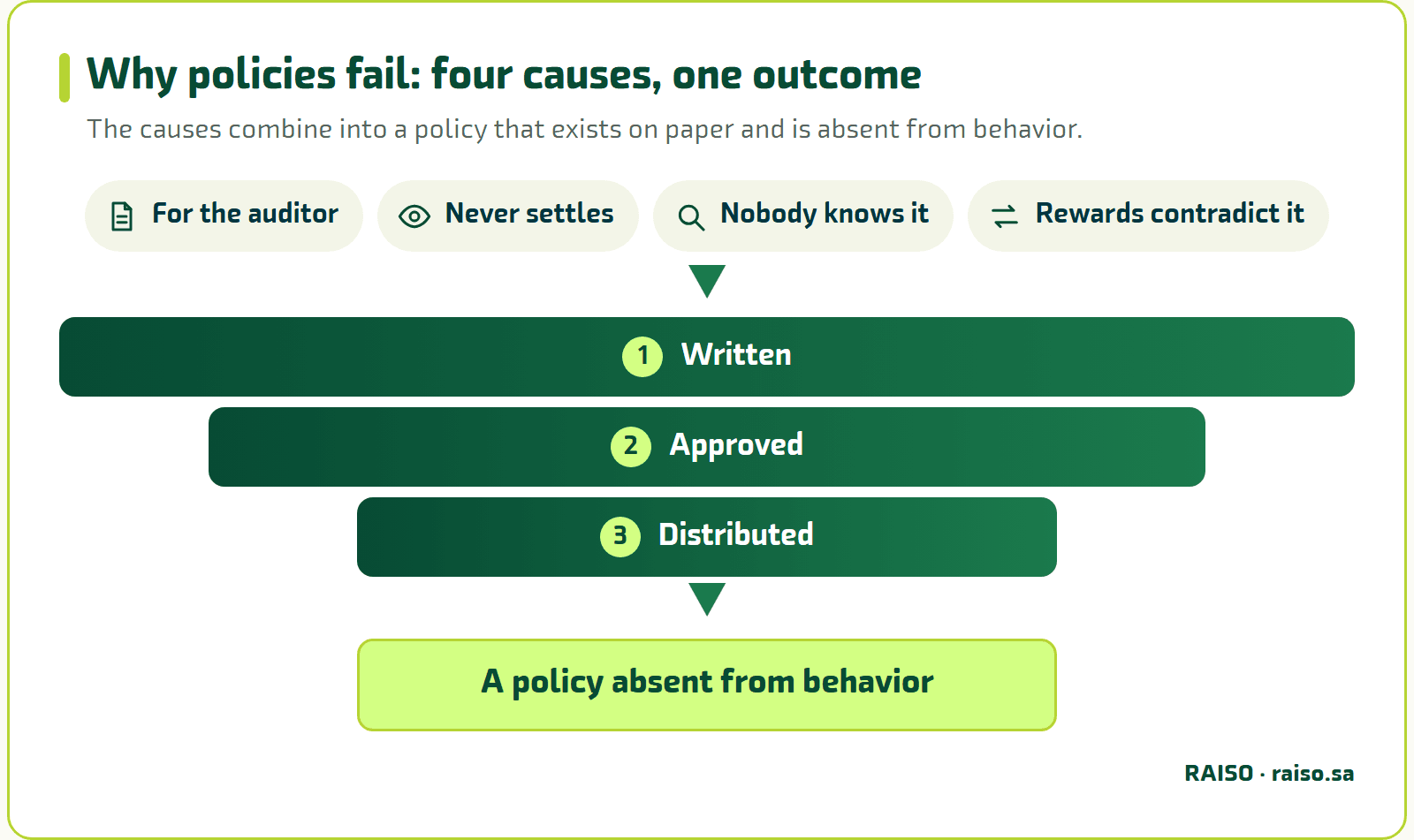
These causes do not work in isolation. They combine to produce the same phenomenon: policies that exist on paper and are absent from behavior. What they share is that the policy was treated as a document to be produced and filed, not a tool to be used and to guide. Treating them starts with changing this view, before any technical detail.
“When a policy says one thing and the system rewards the opposite, the employee learns that the real policy is what gets rewarded, not what is written.”
“The case now: Hind went through the four causes as she reread her policy. It was written for the auditor, it describes a principle, and nobody in the branch has it at hand. On the fourth she asked: what do we actually reward? And she found that branch evaluation measures spending on compensation alone.”
“Try it now: Put a policy from your organization beside the four causes, and mark each cause that applies. Which seems hardest to treat?”
The first function: setting direction
Let us now learn how a policy works when it is written as a leadership tool. Its first leadership function is to set direction. A leader cannot be present at every decision, but can set policies that make thousands of decisions lean automatically toward the direction wanted. Here the policy turns from a negative restraint into a compass, from “forbidden” to “we are heading toward.”
Consider the difference between two policies. The first says: “Exceeding the set financial authorities is prohibited.” The second says: “We give the employee closest to the customer the widest possible authority to solve the problem right away, within clear limits.” Both speak of authorities. But the first draws defensive borders that make the employee fear acting, while the second sets a direction that makes the employee take initiative with confidence. The second leads, and the first merely forbids.
A good policy settles hard trade-offs in advance. Every real job has recurring trade-offs: speed against accuracy, cost against quality, customer satisfaction against rule compliance. Employees face them every day, and without clear guidance each settles them by their own judgment, mood and fear. A leadership policy states plainly: when customer satisfaction conflicts with a secondary procedural rule, put the customer first within the following limits. So thousands of small decisions lean toward one direction, without the leader intervening in any of them.
This is where the policy's power appears as an organization grows. A leader is limited by time and presence, and can guide only those he or she sees. A policy guides people the leader has never met, in branches never visited, in situations never imagined. An organization that leads through policies expands without losing its direction, while one that leads through personal presence stumbles at the first limit of its leader's energy.
“The case now: Hind began a new draft with a direction sentence: “We give the employee closest to the customer the authority to solve the problem on the spot, and we protect the decision as long as it is within the limits.” Before writing any limit, she wrote where she wants the branches to go.”
“Try it now: Write the direction of a policy in your organization in one sentence beginning “We are heading toward…”. Then ask: could any employee read it and know what to prefer when there is a conflict?”
The second function: drawing limits and giving freedom
If the first function is setting direction, the second is more surprising: a good policy gives freedom. This is the opposite of what many imagine, since policy is often reduced to a tool of prohibition and restriction. But a well-built policy, written as a leadership tool, does the opposite: it draws clear limits, and inside them it releases the employee to act with confidence, without fear or asking permission.
Consider the paradox. An employee who works without clear policies is not free but afraid. Every decision is a gamble that may later be judged by standards unknown at the time. So the employee falls back on the safest behaviors: escalating everything, or not acting at all. That is what Faisal did. The absence of clear limits produces not freedom but defensive paralysis.
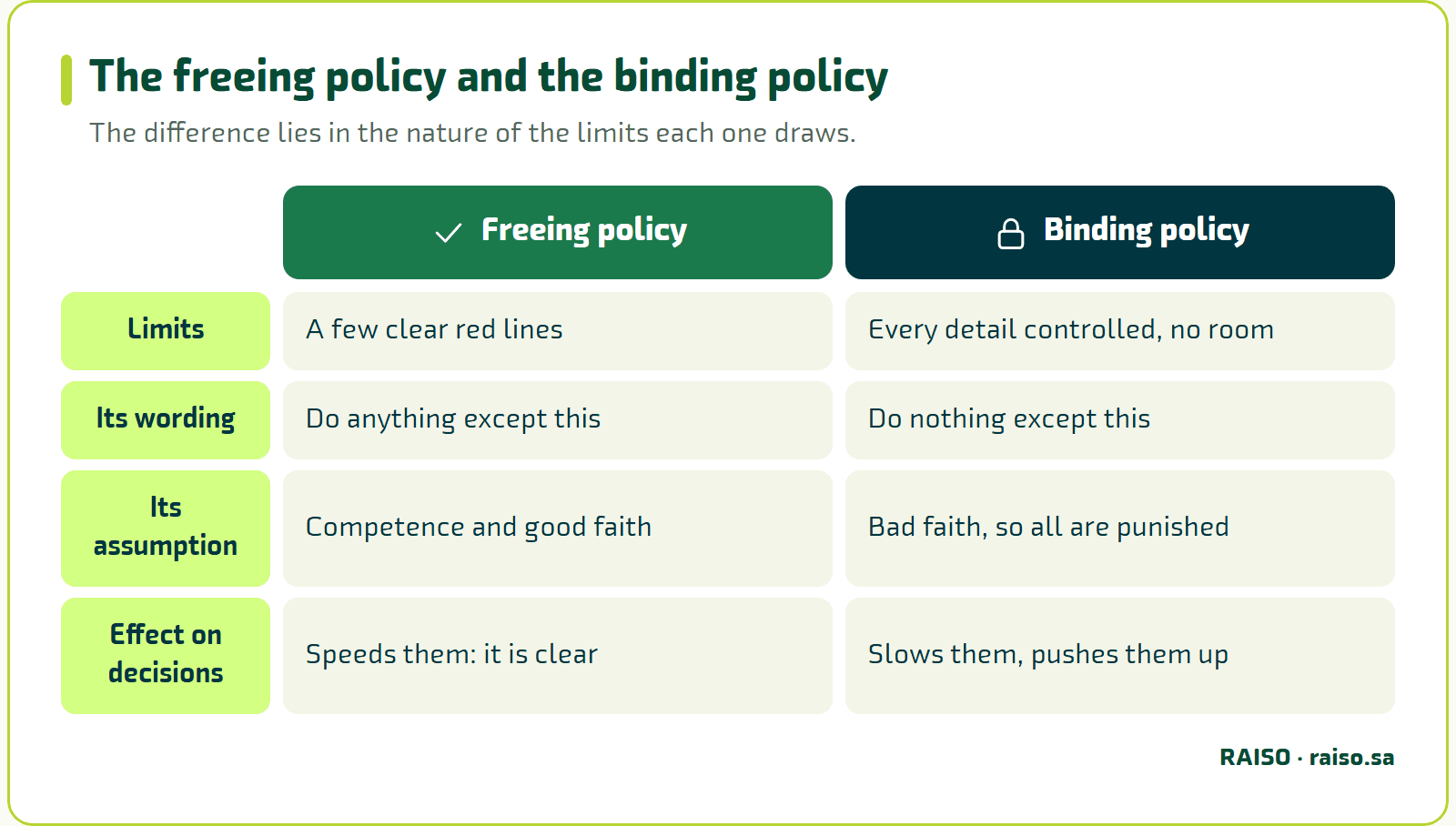
The difference between a freeing policy and a binding one lies in the nature of its limits:
- The freeing one sets a few clear red lines and leaves the rest to judgment. The binding one tries to control every detail and leaves no room to act.
- The freeing one says: you may do anything except this. The binding one says: you may do nothing except this.
- The freeing one assumes competence and protects good-faith initiative. The binding one assumes bad faith and punishes everyone in advance.
- The freeing one speeds decisions because it is clear. The binding one slows them because it pushes everything upward.
A wise leader knows that every limit drawn has a price. A necessary limit that protects against a real risk has a justified price. An excess limit that controls a detail carrying no risk has a pure price: slowness, fear and killed initiative for nothing in return. So the hardest decision in writing a policy is not what we prohibit, but what we allow despite our wish to control it.
When the two functions combine, the picture is complete. Direction says where we are heading. Limits say where we must never go. And between them lies a wide space in which the employee moves with confidence and initiative. This protected space, between a clear direction and clear limits, is exactly where good work happens.
“The case now: Hind wrote only three limits: a branch employee alone decides compensation up to a set amount, anything above needs her permission, and there is no compensation for a delay caused by the customer. Everything else she left to the judgment of Faisal and his colleagues.”
“Try it now: Write the real red lines of a policy you know. Strike out every limit that does not protect against a realistic risk, and ask: if we removed it, what would actually happen?”
What makes a policy usable?
We reach the practical question: what turns an approved document into a tool that is really used at the moment of decision? Usability is not a trait added after writing. It is designed into the policy from the start. Hind rewrote her policy on four traits.
| # | Trait | Question | Compliant | Partly compliant | Not compliant |
|---|---|---|---|---|---|
| 1 | Settles, not describes | Can an employee facing a real situation leave with a decision? | |||
| 2 | Language of situations | Does it name the cases the reader will face, not only principles? | |||
| 3 | Brevity | Can the employee read all of it at the moment of decision? | |||
| 4 | Present at decision | Does it reach them in the system or form, without searching? |
Rate one of your policies on the four questions.
- It settles, it does not describe
It ends with a decision, not a description. It does not merely declare that integrity is a core value, but says what the employee does when offered a gift, when to accept and when to refuse, and how to disclose. The test is simple: can an employee facing a real situation come away with a decision? If it leaves them more confused than when they came, it describes and does not settle.
- It speaks the language of situations
Abstract principles do not turn into behavior automatically. A usable policy moves down from principle to situation and names the cases the reader will face. Instead of “information confidentiality must be preserved,” it says what counts as confidential information, and what the employee does when an outside party asks for it. Examples are not padding. They are the bridge over which a principle crosses from paper to action.
- It is short enough to be read
A policy that is not read is not used, and a long policy is not read. There is a limit to what an employee absorbs at the moment of decision. Brevity here is a functional requirement, not a stylistic luxury. A policy says what is needed in as little as possible, and leaves execution detail to procedures, their natural home.
- It is present at the point of decision
The closer a policy is to the moment of decision, the more likely it is to be used. It may be built into the system the employee uses, written on the form they fill in, or tied to training that shows the real situation. A policy the employee must search for will be ignored, and one that comes to them will be used.
See how Hind's text changed. The old sentence read: “Complaints are handled within the approved authorities.” It became: “If a customer's shipment is delayed more than two days for a reason not attributable to the customer, the branch employee compensates immediately by no more than the amount in the attached table, and records it in the system.” You can place any situation in front of this sentence and say: it applies, or it does not.
These traits come together in one idea: a usable policy is designed from the user's perspective, not the writer's. The writer asks: what do I want to say? The good designer asks: what will the reader need at the moment of decision? That shift in the question alone separates a policy that is filed from one that is used.
“The case now: Hind's policy became two pages, holding five common situations and a decision for each, then linked to the system screen where the employee records compensation, so the table appears in front of them.”
“Try it now: Take a sentence from an existing policy and rewrite it in the language of a real situation, so that a new employee could decide with it without asking anyone.”
How do leaders really use policy?
A good policy is necessary but not sufficient. Even the best policies stay ink on paper unless leaders themselves use them every day. The difference between an organization led by its policies and one that neglects them lies mostly in the behavior of its leaders, not in the quality of its documents.
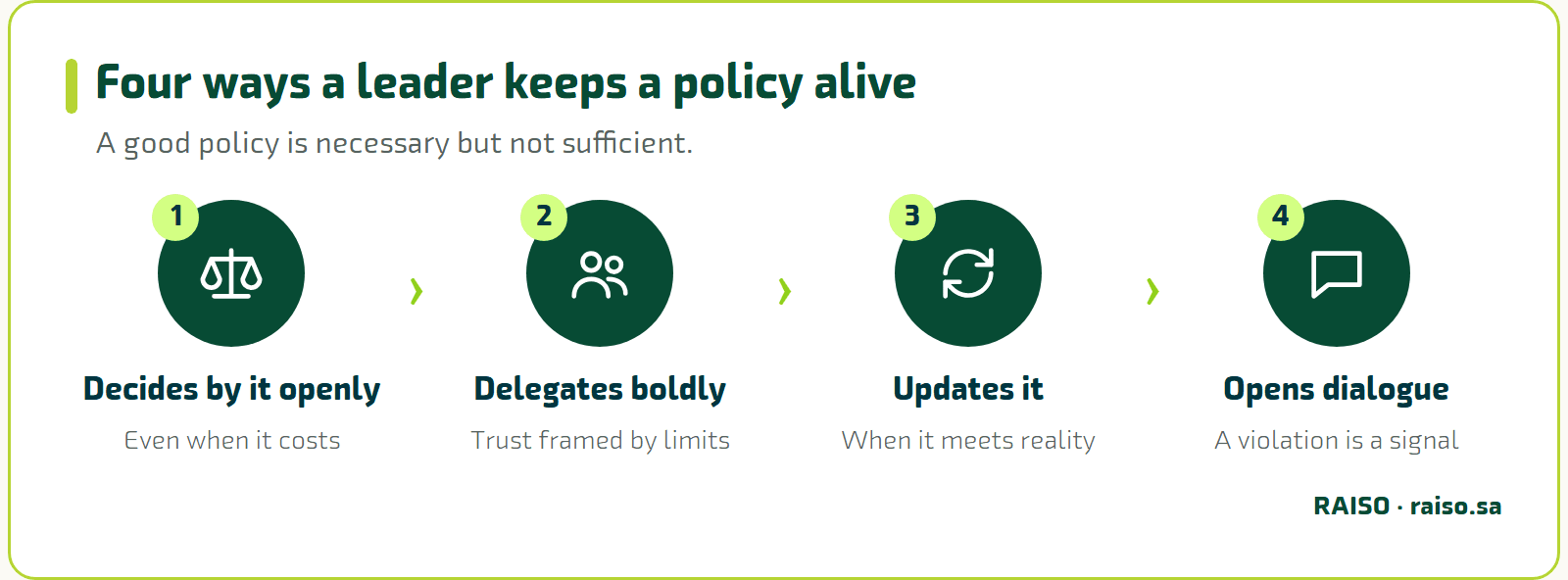
The first thing a leader does is decide by the policy, openly. When facing a hard situation and making a decision, the leader refers the decision explicitly to the policy: “We decline this request because our policy prohibits it, despite the loss.” At that moment, the leader proves the policy is real and not decoration, and teaches everyone that it is applied even when costly. A leader who breaks his or her own policy when it costs something kills it with their own hand, however well it was drafted.
Second, the leader uses it to delegate with confidence. When the policy is clear, the leader can tell the team: “Act within the policy without coming back to me.” Delegation here is not abandoning responsibility but trust framed by limits. The policy ensures that the decision stays within the right direction. Without it, delegation becomes a gamble, and the leader goes back to gathering every decision into their own hands.
Third, the leader updates it when it collides with reality. A policy is a living tool, not a sacred text. When leaders find that it produces bad decisions in situations they did not imagine, they amend it rather than force reality to bend to it. A leader who insists on a policy that reality has proved wrong teaches people that policies are followed in form and bypassed in practice.
Fourth, the leader uses it as a tool for dialogue, not a weapon of punishment. When an employee breaks a policy, the most valuable opportunity is not to punish but to understand why. They may not know it, and then the problem is in publication. They may have understood it and broken it because it produces a bad result, and then the problem is in the policy. They may have ignored it because it conflicts with what is rewarded, and then the problem is in the incentives. Whoever treats a violation as a diagnostic signal repairs the system. Whoever treats it as a crime pushes people to hide it.
“The case now: Weeks later, another customer's shipment was late, and Faisal compensated him on the spot and recorded it. Hind called, not to ask why he had not asked permission, but to tell him: “Your decision was right under the policy, and thank you for your speed.” His colleagues heard it.”
“Try it now: Recall the last time someone in your team broke a policy. What was the first question you put to them: why did you do this? Or who allowed you?”
A living policy and culture
Many organizations treat the moment of approval as the end of the journey: it was signed, so the work is complete. The truth is the opposite. Approval is the beginning of the policy's life, and what happens after signing decides whether it becomes a living tool or a dead document.
A living policy is published, not merely filed. Publishing is not a group email deleted on arrival. It is a deliberate process of getting the policy to those who need it in a form that makes it usable: an explanation tying it to real situations, integration into systems and forms, and presence at the moment of decision. It is measured by its effect, not its existence: have decisions changed? Have the cases it was meant to treat declined? Do employees cite it? An organization that collects policies asks only: is it approved and current? The first measures behavior, and the second measures paper.
And it is reviewed at a regular rhythm. The world in which the policy was written changes: new risks appear, systems change, gaps emerge. A policy that is not reviewed ages silently until it becomes an obstacle that everyone bypasses. Review is not extra bureaucracy but maintenance. A tool that is not maintained rusts.
The deepest challenge is the policy's relation to the actual culture of the organization. A written policy does not operate in a vacuum, but in an environment with its own unwritten policies: what is rewarded, what is punished and what is overlooked. When the written policy conflicts with the culture, culture always wins. Employees do not learn what is expected from documents but from observation: who is promoted and who is overlooked, and what leaders do, not what they say.
So launching a new policy without alignment with incentives is a recipe for failure. A leader who wants a policy to really lead asks before launch: what do we reward today? Does it support this policy or contradict it? If it contradicts, the policy will change nothing until the incentives change with it. A policy without supporting incentives is a written sermon.
“The moment of approval is not the end of the journey but its beginning. What happens after signing decides whether the policy will lead or be filed.”
“The case now: Hind amended the branch evaluation criterion so that it now includes customer satisfaction after a complaint alongside spending on compensation. And she opened a quarterly meeting to hear from branches which limits proved too narrow or too wide, and updated the table twice a year.”
“Try it now: Before any new policy, ask: what do we reward today on this subject? If you find a contradiction, write it down and bring it to whoever can change the incentives.”
A policy is the leader's extension when absent
Return to Faisal standing before the angry customer. Imagine that Hind had been standing beside him at that moment. She would have said: compensate him now. That is what the policy should have said. All of a policy's value lies in its being an extension of the leader to where the leader cannot reach. A leader who understands this does not look at policies as burdens imposed by regulators, but as tools to multiply influence.
Imagine a leader who could be present at every decision taken in the organization, in every branch, every department and every moment. This is impossible through personal presence, but possible through policies. A good policy is the leader when the leader is absent: it sets the direction the leader would have given, draws the limits the leader would have drawn, and gives those in the field the trust the leader would have given.
This turns upside down the equation from which most organizations start. The question is no longer: how many policies do we have to pass the audit? It becomes: how many right decisions do our policies produce every day without our intervention? And the measure of success is no longer a complete file, but that an employee in a distant branch, in a situation nobody imagined, acts exactly as the leader would have.
“The case now: Six months later, Hind reviewed the number of cases escalated to the regional director because of delayed shipments. It had fallen to a small fraction of what it was. And nobody says “one minute, please” to a customer and then disappears for twenty minutes.”
“Try it now: Choose a decision you often take yourself. Write it as a one-page policy: a direction, three limits and five situations. Then hand it to someone else to decide with.”
What you take with you
A policy that is not used is worth nothing. That harsh sentence at the start of this article has now become a practical question to put to every policy: does it change a decision taken in the field? If it does not, the time has come to rewrite it to lead, not to be filed.
Take five ideas with you from this article:
- A policy is a decision made in advance, and is measured by the behavior it changes, not by the number of its sections.
- Policies fail when they are written for the auditor, describe a principle without settling, do not reach the point of decision, and are contradicted by incentives.
- A policy has two leadership functions: setting direction, and drawing the limits that give freedom.
- It becomes usable when it settles, speaks the language of situations, is brief, and is present at the point of decision.
- Leaders keep it alive by deciding openly by it, delegating with confidence, updating it, opening dialogue about violations, and aligning incentives.
Start this week with one policy and one situation. Write the sentence that will let a new employee decide without asking permission. And if you want to learn how to write policies as leadership tools, run them and measure their effect, explore RAISO's policy management practice and the courses that train your team to write policies that settle and are used, and to apply this to its real policies.